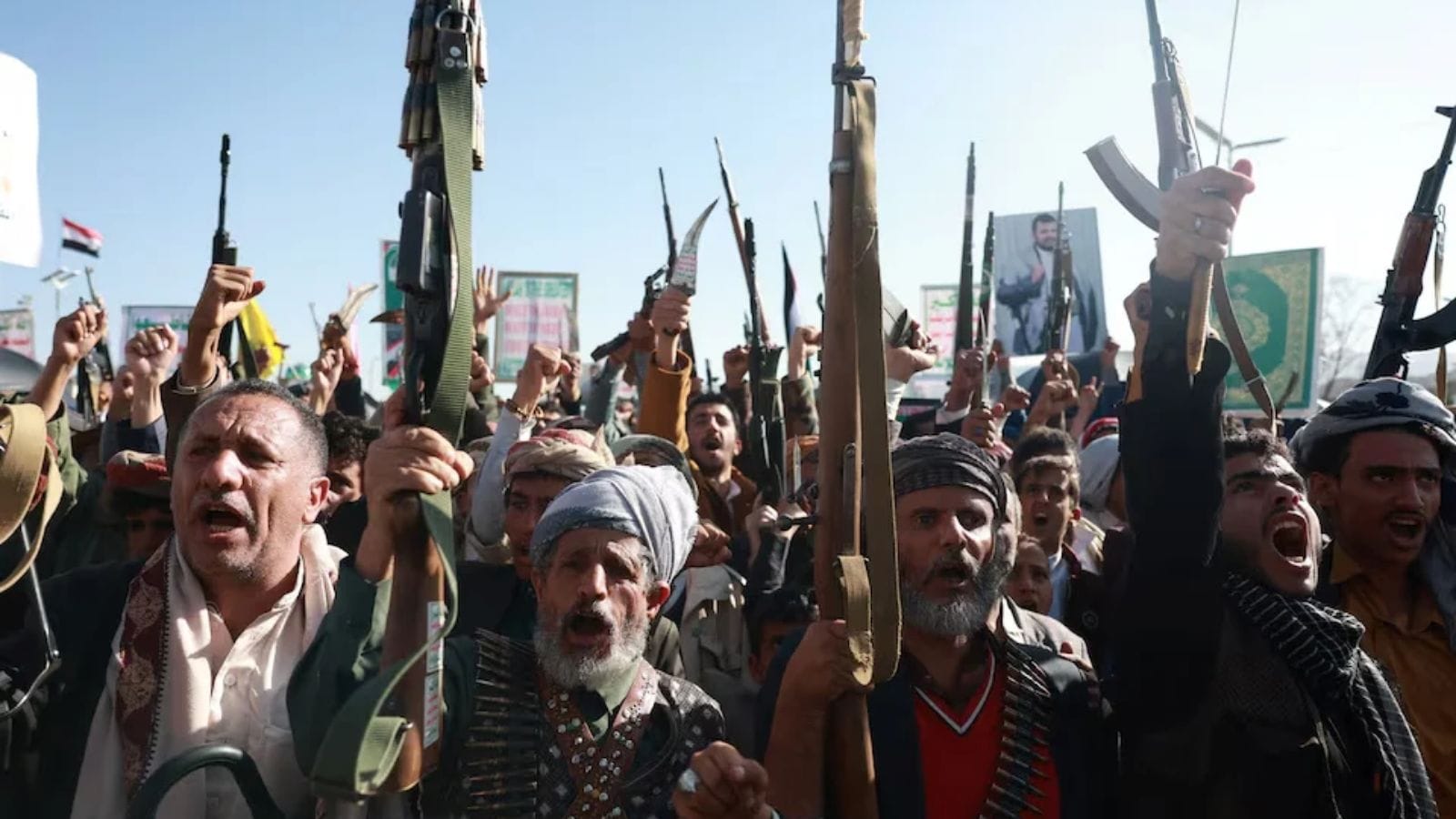
Yemen's Houthi movement has repeatedly claimed missile and drone strikes against Saudi military positions in the southwestern border province of Jazan, a flashpoint that sits at the intersection of domestic Yemeni politics, regional deterrence, and fragile diplomatic negotiations. While major international headlines often fixate on maritime disruptions in the Red Sea or high-profile attacks deep inside Gulf cities, the grinding artillery and ballistic exchanges along the Saudi-Yemeni frontier tell the real story of how this conflict is fought and sustained.
The mechanics of these announcements are rarely straightforward. When the Houthi military spokesperson steps before a camera to declare a successful strike on Saudi forces in Jazan, the statement serves multiple masters simultaneously. It is a battlefield report, a domestic morale booster, a warning shot to Riyadh, and a bargaining chip on the negotiating table.
The Geography of a Forgotten Front
Jazan is not merely a dot on a military map. Situated on the Red Sea coast directly north of Yemen's Saada and Hajjah governorates, the province is home to vital Saudi infrastructure, agricultural land, and the massive Jazan Economic City and refinery complex. For Saudi border guards and coalition forces, defending this stretch of rugged mountains and coastal plains has been a relentless logistical headache since the Saudi-led coalition intervened in Yemen in 2015.
The terrain favors the defender—and the insurgent. Jagged peaks, deep wadis, and porous mountain passes allow small, mobile Houthi units to infiltrate, spot targets, and slip back across the border before coalition air superiority can effectively respond. Over the years, this frontier has absorbed thousands of cross-border projectiles, ranging from unguided Katyusha rockets and mortar rounds to short-range ballistic missiles like the Badr series and domestically assembled loitering munitions.
Riyadh has spent billions fortifying this southern perimeter. Layered air defense batteries, including Patriot and THAAD systems, stand guard over high-value industrial targets, while forward operating bases and border outposts rely on electronic warfare, surveillance balloons, and rapid-reaction ground units. Yet no air defense umbrella is hermetically sealed, especially when projectiles travel mere dozens of kilometers with flight times measured in seconds rather than minutes.
Why Jazan Remains a Strategic Pressure Valve
To understand why the Houthis target Jazan, you have to look at the asymmetry of escalation. Firing a long-range ballistic missile at Riyadh or Jeddah carries immense political risk. Such strikes invite severe retaliatory airstrikes, draw immediate international condemnation, and can derail delicate backchannel diplomacy with Saudi leadership.
Jazan offers a different calculus.
Striking military camps, logistics hubs, or troop concentrations near the border allows the Houthis to demonstrate offensive reach without crossing the threshold into strategic terror against major population centers. It is calibrated friction. By keeping pressure on Saudi forces in Jazan, the group reminds Riyadh that a freeze in hostilities is not a permanent peace, and that the southern border remains vulnerable as long as core Houthi demands—such as the lifting of blockades, payment of public sector salaries, and the exit of foreign forces—remain unresolved.
There is also the internal audience in Sanaa and Saada. Managing a wartime economy under severe financial strain requires constant ideological mobilization. Claims of hitting Saudi military installations project strength to a weary population, framing the movement not as a besieged faction struggling with governance, but as an undefeated regional military power capable of taking the fight onto Saudi soil.
The Information War Behind the Launch
Veteran observers of the Yemen conflict treat every battlefield claim from both sides with measured skepticism. The information space surrounding Jazan is notoriously opaque. Independent journalists rarely have unimpeded access to the active border zones, leaving analysts to triangulate between Houthi military media, official Saudi Press Agency releases, satellite imagery, and local tribal networks.
A pattern has emerged over the past decade. Houthi statements frequently describe strikes as "accurate" and claim heavy casualties or the destruction of command centers. Conversely, Saudi authorities often report intercepting incoming aerial threats, acknowledge only minor shrapnel damage, or maintain complete operational silence when an incident does not affect civilian infrastructure or global energy markets.
The truth usually sits somewhere in the gray zone between those two narratives. A missile might breach forward perimeter defenses and strike an empty staging area, or be intercepted at low altitude, scattering debris across a military compound. Both sides then spin the physical event to fit their political needs. For the Houthis, the launch itself is the victory; it proves supply lines are intact and launch crews remain operational. For Riyadh, downplaying the impact denies the adversary psychological leverage and reassures foreign investors that the kingdom's southern flank is secure.
How the Arsenal Evolved
The weapons flying toward Jazan today bear little resemblance to the stockpiles the Houthis seized from the Yemeni military in 2014 and 2015. Early in the war, the group relied heavily on aging Soviet-era Scuds and Tochka tactical ballistic missiles. Those stocks were finite and vulnerable to coalition airstrikes targeting storage depots.
Over time, aided by smuggling networks and technical transfers from Iran's Islamic Revolutionary Guard Corps, the Houthis shifted toward modular, easily concealed, and locally assembled systems. Solid-fuel short-range rockets replaced bulky liquid-fuel missiles that required hours of vulnerable fueling procedures before launch. Commercial off-the-shelf components, civilian GPS modules, and small internal combustion engines were adapted into cheap, expendable drones capable of flying low beneath radar coverage.
This technological shift changed the economics of the border war. When a defensive interceptor missile costs upwards of a million dollars, and an incoming drone or short-range rocket costs a fraction of that, the defender faces a punishing cost-exchange ratio. Even when Saudi air defenses perform well, the financial and operational burden of maintaining constant high alert along hundreds of kilometers of border wears down equipment and personnel.
The Diplomatic Tightrope
Every flare-up in Jazan ripples outward into broader regional diplomacy. Saudi Arabia has spent recent years trying to extricate itself from the quagmire in Yemen, pursuing direct talks with Houthi representatives to secure a durable ceasefire and pivot toward domestic economic transformation under Vision 2030.
The Houthis understand this dynamic intimately. They recognize that Riyadh wants out, and they use kinetic pressure along the border to extract maximum concessions before signing any binding agreement. Yet overplaying that hand carries dangers. If cross-border attacks become too frequent or inflict mass casualties on Saudi personnel, hardliners in Riyadh may conclude that diplomacy is futile and that only renewed military pressure can restore deterrence.
Meanwhile, local Yemeni factions aligned with the internationally recognized government watch these border skirmishes with deep unease. For them, a bilateral security arrangement between Riyadh and the Houthis—one that buys quiet in Jazan at the expense of conceding northern Yemen to Houthi rule—represents an existential threat.
The rockets and missiles aimed at Jazan are ultimately instruments of leverage in an unfinished war, where every explosion on the border is designed to echo inside a negotiating room.


