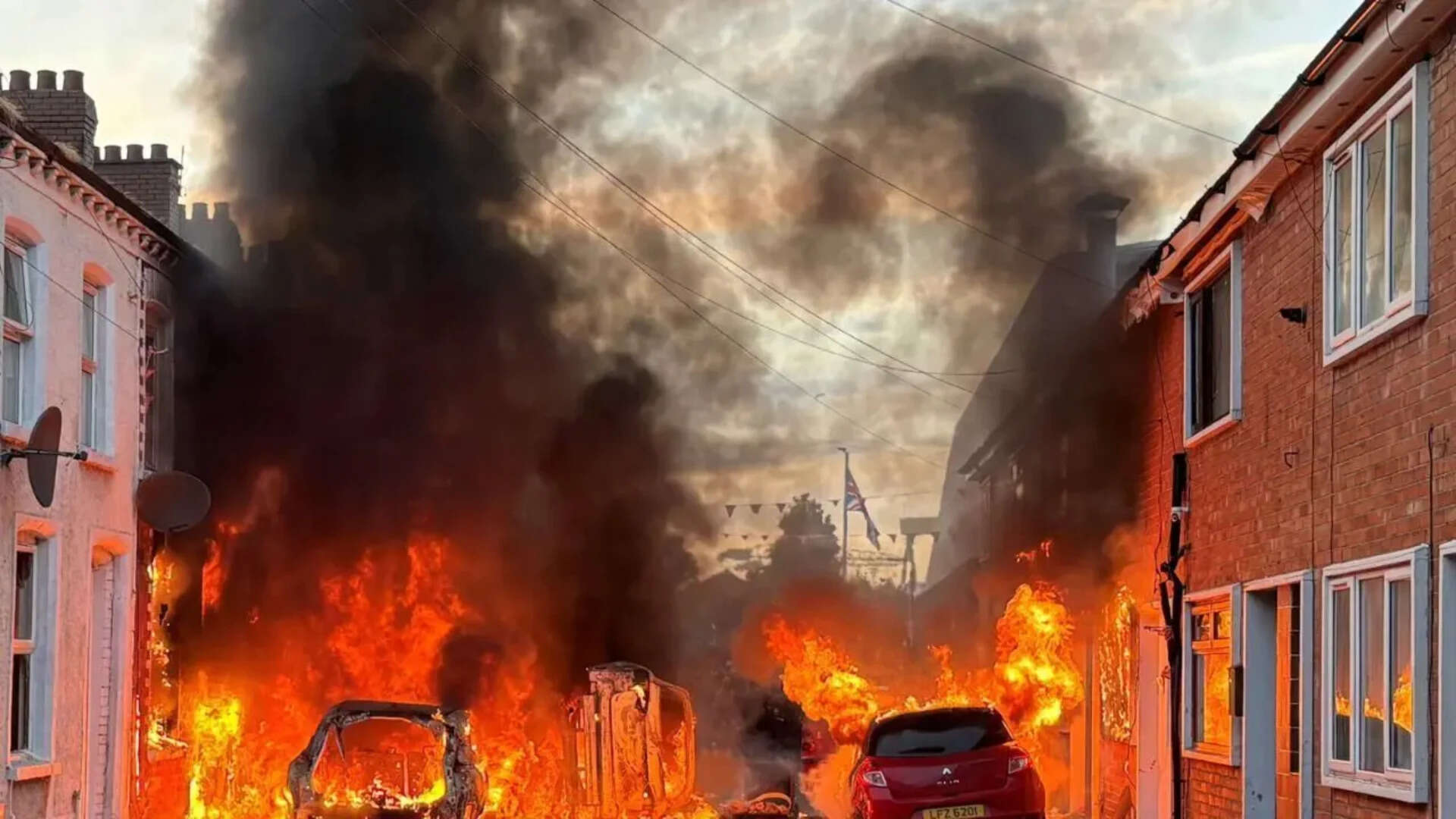
Street violence in Belfast has forced Prime Minister Keir Starmer into a familiar political corner. Following a horrific knife attack on children in England, a wave of anti-immigrant rioting swept across parts of the UK, stretching its volatile tendrils into Northern Ireland. Starmer quickly issued fierce condemnations, promising the full force of the law against those hijacking local anxieties to cause chaos. He spoke of fast-tracked justice and severe sentencing.
But condemning the riots does not solve the underlying friction. The standard political playbook of deploying riot police and promising prison sentences treats the symptoms of the unrest while completely ignoring the unique, underlying mechanisms that make Belfast a powderkeg. Northern Ireland operates under a complex social framework where historic sectarian divisions are increasingly colliding with modern anxieties over immigration, housing, and economic stagnation.
To view the Belfast unrest purely through the lens of mainland British politics is a critical mistake. The violence on the streets is not just a localized echo of English rioting. It represents a dangerous convergence where old paramilitary structures and new far-right digital networks meet.
The Mechanics of a Distributed Riot
The violence in Belfast did not happen in a vacuum. It was systematically organized, but not through traditional command structures. Instead, the unrest relies on a decentralized digital framework that bypasses established local community leaders.
Organizers used encrypted messaging apps and public social media platforms to cross-pollinate grievances. For weeks, accounts originating in both Dublin and London fed localized Belfast groups a steady diet of unverified rumors regarding asylum seekers. When the tragic knife attack occurred in Southport, England, these digital networks weaponized the horror instantly. They mapped the anger onto pre-existing local frustrations in Belfast, specifically targeting working-class areas that have long felt abandoned by the post-Good Friday Agreement economic boom.
The speed of the mobilization caught authorities off guard. Traditional policing relies on monitoring known agitators and community gatekeepers. However, these newer digital networks operate horizontally. A single viral video or a shared geolocation tag can draw hundreds of angry individuals to a street corner within an hour. By the time tactical riot units deploy, the crowd dynamic has already solidified into a confrontational stance.
The Dangerous Alliance of Old Paranoia and New Agitation
What makes the Belfast unrest uniquely dangerous is the collision between modern anti-immigrant rhetoric and historical loyalist paramilitary structures. This is a dynamic the Westminster government routinely fails to grasp.
For decades, working-class loyalist communities have harbored deep-seated anxieties about their identity and political standing within the UK. Many residents in these areas feel that the peace process favored their republican neighbors, leaving loyalist enclaves with underfunded schools, crumbling infrastructure, and a lack of generational wealth. Into this fertile ground of resentment steps the modern far-right.
The rhetoric has shifted seamlessly. The old language of defending the Union against republicanism has been adapted to defending the neighborhood against a perceived influx of foreign nationals. Investigative observation on the ground reveals that while senior paramilitary figures often deny official involvement, younger elements within these organizations are actively participating in the riots. They provide the logistical muscle. They know how to handle petrol bombs, how to construct makeshift barricades, and how to exploit blind spots in police surveillance.
This creates a terrifying hybrid threat. You have the ideological fervor of the internet-fueled anti-immigrant movement combined with the urban guerrilla expertise of decades-old paramilitary traditions. Starmer’s promises of standard policing mechanisms look incredibly naive when facing an adversary that understands the terrain this deeply.
The Flaw in the Westminster Playbook
Starmer’s response has relied heavily on the concept of "swift justice." The British government points to the use of 24-hour courts and the rapid jailing of rioters in England as proof that the state can regain control.
This strategy faces severe structural roadblocks in Northern Ireland. The Police Service of Northern Ireland (PSNI) is already facing a massive budgetary crisis and a historic low in officer numbers. Decades of budget cuts have left the force stretched to its absolute limit. When major riots break out in Belfast, resources must be pulled from rural districts, leaving other parts of the region entirely unprotected.
Furthermore, the judiciary in Northern Ireland operates under different pressures than its counterpart in England. The legacy of the Troubles means that heavy-handed state policing and rapid-fire sentencing can easily be framed by agitators as state oppression, potentially driving more moderate community members into the arms of the radicals.
PSNI Operational Pressures:
├── Record Low Officer Recruitment
├── Mandatory Legacy Investigation Costs
└── Structural Overtime Deficits
If the government simply locks up fifty low-level rioters, the digital infrastructure and the socioeconomic conditions that produced them remain completely untouched. The cells fill up, but the anger on the street merely simmers under the surface, waiting for the next spark.
The Exploitation of the Housing and Services Deficit
To truly understand why anti-immigrant sentiment found traction in Belfast, one must look at the brutal reality of local public services. Northern Ireland is currently enduring a severe housing crisis. Social housing waiting lists are at an all-time high, with thousands of families stuck in temporary accommodation for years.
When the state places asylum seekers or refugees into working-class Belfast neighborhoods, it often does so without expanding local infrastructure. GP surgeries are already overwhelmed. Classrooms are overcrowded. Community funding is practically non-existent.
Radical agitators do not need to invent grievances; they merely need to misdirect the existing ones. They tell a young family that has been waiting five years for a home that their delay is caused by the arrival of outsiders. It is a mathematically flawed argument—the housing crisis is the result of systematic government underinvestment, not immigration—but it is an incredibly potent emotional narrative when you are the one sleeping on a relative's couch.
By failing to address the collapse of municipal services, the Stormont Executive and the Westminster government have effectively left the door wide open for far-right exploitation. The riots are the violent manifestation of a governance vacuum.
The Counter-Argument the Government Ignores
The prevailing political narrative insists that these riots are purely the work of far-right thugs and criminals who represent nobody but themselves. While the criminality on the streets is undeniable, dismissing the entire phenomenon as mindless thuggery is an act of political cowardice.
It ignores the fact that a significant portion of the local population, who would never throw a petrol bomb, quietly harbor similar anxieties regarding rapid demographic changes. When politicians refuse to have an honest, nuanced conversation about migration patterns, integration strategies, and infrastructure capacity, they cede the entire conversation to extremists.
The average resident in a volatile Belfast district sees a government that is quick to send in riot police but slow to fix their schools or build their homes. This creates a deep cynicism. Until the state proves it can deliver basic public goods effectively, the promises of tough sentences will do little to deter communities that feel they have nothing left to lose.
Beyond the Security Response
Relying solely on police batons and court dates to solve the Belfast crisis ensures that the peace remains fragile. True stability requires a coordinated overhaul of how integration and infrastructure development are managed in post-conflict zones.
Security measures must be backed by immediate, transparent capital investment in the specific neighborhoods currently experiencing high tension. If the state deploys resources to house new arrivals, it must simultaneously deploy resources to expand the capacity of local clinics, schools, and community centers. The zero-sum game narrative pushed by extremists can only be broken when communities see that an increase in population does not mean a decrease in their quality of life.
At the same time, the PSNI requires urgent structural funding specifically earmarked for digital intelligence gatherers who can track the horizontal networks organizing these disruptions before the crowds hit the asphalt.
The British government must abandon the illusion that Northern Ireland can be policed like a standard English suburb. The historical scars are too deep, the paramilitary structures are too resilient, and the social fabric is too delicate for lazy political platitudes.
The current peace in Belfast is not a permanent state of affairs; it is a daily negotiation that the government is currently losing.