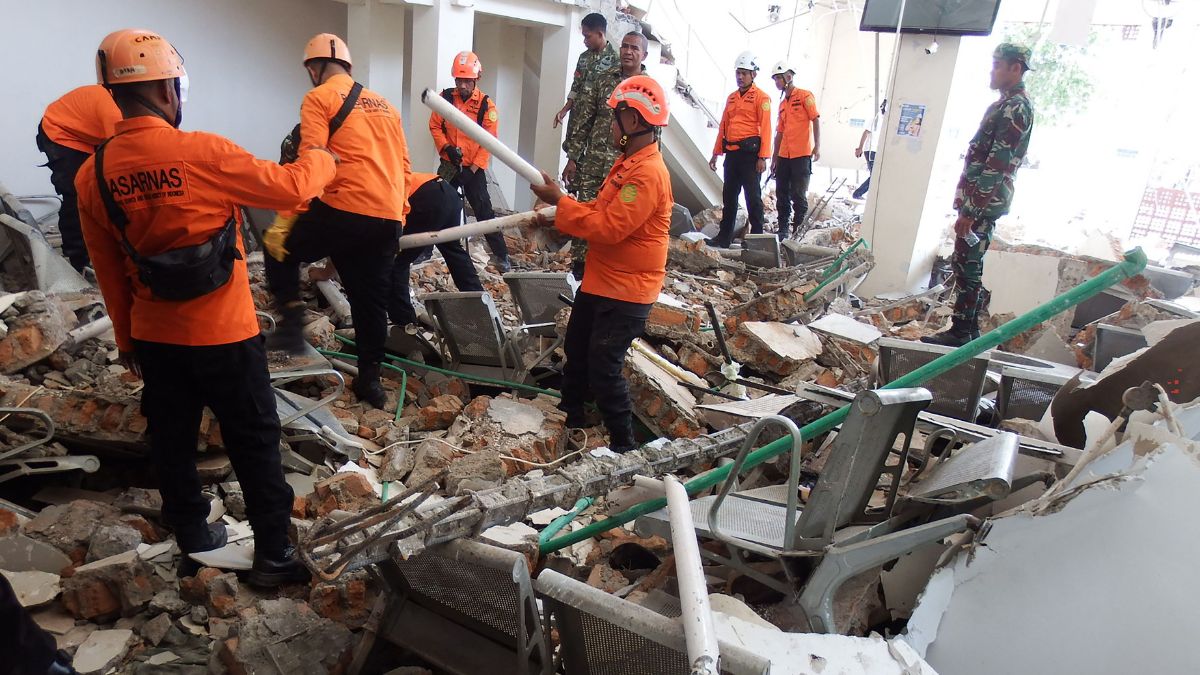
The ground beneath Indonesia does not merely shift; it acts as an active, relentless machine of geological destruction. When a 7.7 magnitude earthquake strikes off the coast of Flores, followed hours later by a 6.4 tremor in Northern Sumatra, the world observes a familiar tragedy. Yet, these events are not random acts of misfortune. They are the inevitable output of a massive tectonic intersection. Indonesia sits at the nexus of the Indo-Australian, Eurasian, and Pacific plates, forming a collision zone that renders the archipelago one of the most volatile seismic environments on the planet.
This is the Pacific Ring of Fire. It is not just a poetic description of a volcanic arc but a literal, high-energy grinding mill where crustal plates are forced beneath one another in a process known as subduction.
The Physics of Perpetual Instability
To understand why Indonesia remains in a constant state of seismic anticipation, one must look at the Sunda-Java trench. This feature is the front line where the Indo-Australian plate relentlessly dives under the Eurasian plate. The speed of this convergence is significant, often measured in centimeters per year. Over centuries, this movement creates a colossal accumulation of elastic strain. When the rock eventually snaps under this pressure, the energy released manifests as an earthquake.
Consider a hypothetical scenario of a large rubber band stretched to its absolute limit. The tension becomes unbearable, and when it finally breaks, the snap is violent and immediate. The crustal plates in Indonesia function with similar mechanics, storing decades of stress that release in mere seconds. The shallow depth of the 7.7 magnitude quake off Flores—approximately 10 kilometers—compounded the danger. Shallow earthquakes allow less energy to dissipate before reaching the surface, meaning the shockwaves hit with maximum ferocity.
Infrastructure Against a Hostile Earth
The seismic history of the archipelago is written in both geology and human architecture. A major point of contention among industry analysts is the disparity between tectonic reality and building standards. A 7.7 magnitude event in a more rigid, technologically advanced seismic zone might result in structural damage but fewer casualties. In parts of Indonesia, the lack of widespread earthquake-resistant construction turns moderate quakes into humanitarian crises.
Schools, ports, and residential dwellings in rural areas often lack the reinforced steel skeletons and flexible joints required to survive intense lateral shaking. When the ground accelerates violently, these rigid structures fail. The collapse of an assembly hall roof at a seminary during the recent Flores event serves as a grim reminder that concrete and masonry are unforgiving when they meet shifting foundations.
The Myth of Predictability
Seismology remains a field defined by probabilities rather than timelines. While experts can map fault lines and identify zones of high strain—such as the Semangko Fault in Sumatra or the complex fault networks in Sulawesi—nobody can pinpoint the exact moment of rupture. The recent sequence of a massive tremor in the east followed by a significant jolt in the west is a statistical coincidence rather than a causal chain, yet it highlights the sheer scale of the hazard.
These are not isolated islands of instability. The entirety of the Indonesian archipelago functions as a single, connected seismic system. A rupture on the Sunda megathrust can redistribute stress elsewhere, potentially priming a secondary fault to slip. The complexity is compounded by back-thrust faults, which add the terrifying possibility of localized tsunamis.
Economic and Humanitarian Cost
The cost of this constant threat goes beyond the immediate casualty count. For local economies, the destruction of transit hubs like the Laurensius Say port ripples through supply chains, isolating communities that rely on maritime transport for basic survival. Every major quake forces a reset, diverting capital toward emergency recovery rather than long-term infrastructure hardening.
Resilience in this environment requires a shift in how the nation views its physical territory. It is not enough to respond after the shaking stops. The focus must be on granular, site-specific building codes that account for the unique soil profiles of each island. Engineering solutions that might work in the soft sediment of Jakarta would prove useless on the volcanic rock of Flores.
The Earth will continue its inevitable shift. The plate boundaries will not stop moving, and the energy will not stop accumulating. Indonesia remains a testament to the fact that humans are often building in the most dangerous laboratories on Earth, and the price of that proximity is a cycle of destruction that demands far more than just disaster relief. It demands a total revision of the architecture of survival.