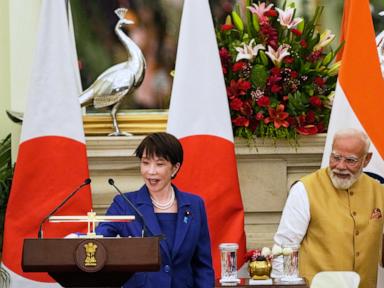
The strategic convergence between India and Japan has transitioned from traditional diplomatic alignment to a highly transactional, defense-industrial partnership. Bilateral statecraft between Indian Prime Minister Narendra Modi and Japanese leadership focuses heavily on mitigating single-source supply chain vulnerabilities and establishing maritime denial capabilities in the Indo-Pacific. This analysis maps the structural mechanics, economic trade-offs, and industrial friction points defining this bilateral security architecture.
The Tri-Border Supply Chain Resilience Framework
The economic security architecture between New Delhi and Tokyo operates as a risk-mitigation strategy against industrial concentration in the East Asian mainland. Rather than relying on generalized free-trade agreements, the strategy enforces diversification across three distinct operational layers.
1. Upstream Critical Mineral Allotment
Japan possesses advanced processing capabilities but lacks domestic access to critical inputs like rare earth elements, lithium, and gallium. India offers raw extraction potential but lacks the refining infrastructure required to meet industrial specifications. The bilateral framework establishes a direct capital-for-resource mechanism: Japanese state-backed financing flows into Indian mining infrastructure in exchange for preferential off-take agreements. This structural link insulates both nations from sudden export restrictions on vital technology inputs.
2. Midstream Semiconductor and Assembly Redundancy
The concentration of semiconductor fabrication in the Taiwan Strait presents an existential risk to both economies. The strategic response utilizes Japan’s mastery of semiconductor manufacturing equipment and specialized chemicals to build out India’s nascent fabrication and outsourced semiconductor assembly and test facilities. The core objective is not cost-optimization, but localized redundancy.
3. Downstream Digital Infrastructure Integration
Securing physical hardware is ineffective if the data transmission layers remain vulnerable. The integration efforts focus on deploying Open Radio Access Network (Open RAN) architecture across telecom networks in South Asia. By avoiding proprietary, single-vendor stacks, both nations reduce western and mainland cybersecurity vulnerabilities while building exportable digital architecture for third-party developing markets.
The Economics of Maritime Interoperability and Defense Coproduction
Defense cooperation between New Delhi and Tokyo is bounded by distinct structural constraints. Japan operates under constitutional limits on military power projection, while India adheres to a doctrine of strategic autonomy and domestic manufacturing mandates under its "Make in India" initiative. To bridge this gap, the defense relationship focuses on technological co-development and maritime domain awareness rather than formal mutual defense treaties.
[Japanese Capital + Advanced Sub-Component Materials]
                       │
                       ▼
         [Indian Co-Development Facilities]
                       │
                       ▼
[Sustained Production of Maritime Surveillance Hardware]
This operational flow directly addresses the structural mismatch between Japanese technical intellectual property and Indian manufacturing scale.
The Western Indian Ocean and the Malacca Strait serve as primary maritime choke points. The joint naval strategies function via a three-part operational calculus:
- Data-Sharing Reciprocity: Real-time satellite telemetry and maritime acoustic data are synchronized between India’s Information Fusion Centre for the Indian Ocean Region and Japanese maritime command centers. This structural data loop minimizes blind spots regarding sub-surface naval deployments.
- Logistical Mutualism: Through the Acquisition and Cross-Servicing Agreement, warships from both nations access refueling and maintenance facilities at critical nodes, including Japan’s base in Djibouti and India’s naval assets in the Andaman and Nicobar Islands. This extends the operational loiter time of maritime patrol aircraft and surface combatants without requiring permanent foreign basing.
- Industrial Co-Development Friction: The primary barrier to deeper defense industrial integration is the transfer of sensitive military technology. Japanese defense firms operate under strict cost structures and low production volumes, making them hesitant to transfer proprietary source code or advanced manufacturing techniques to Indian public sector undertakings. Conversely, New Delhi rejects pure procurement models, demanding deep technology transfers to build local capacity.
Assessing Capital Deployment and Infrastructure Bottlenecks
Japan’s Official Development Assistance has historically acted as a primary mechanism for building Indian infrastructure, particularly the Western Dedicated Freight Corridor and the Mumbai-Ahmedabad High-Speed Rail. However, shifting the focus toward economic security introduces severe capital deployment bottlenecks.
The primary bottleneck rests within the bureaucratic friction of project execution inside India. Land acquisition delays, regulatory variances across state borders, and complex environmental clearance pathways frequently extend project timelines, degrading the net present value of Japanese capital injections.
The second limitation stems from currency volatility. Japanese investments are largely denominated in yen, creating a structural hedging requirement for Indian entities that generate revenue in rupees. When the yen appreciates or the rupee depreciates unexpectedly, the debt-servicing costs for these mega-infrastructure projects spike, squeezing the capital available for subsequent security-critical deployments.
To evaluate the true economic viability of these joint initiatives, planners utilize a basic security-weighted capital efficiency function:
$$E = \frac{R_{sys} - C_{fric}}{I_{cap}}$$
Where $E$ represents net security-industrial efficiency, $R_{sys}$ is the systemic risk reduction achieved via supply chain diversification, $C_{fric}$ is the localized bureaucratic and currency friction cost, and $I_{cap}$ is the total capital deployed. As long as the risk reduction outpaces local execution friction, the strategic rationale for the corridor remains intact, even if short-term commercial returns are sub-optimal.
Explicit Strategic Adjustments for Industrial Planners
To extract measurable value from this shifting geopolitical alignment, industrial operators and enterprise strategists must alter their capital allocation models immediately.
Reconfigure Technology Supply Chains for Dual-Sourcing Nodes
Enterprises currently operating single-node manufacturing structures within the East Asian mainland must establish secondary production footprints along the Tokyo-New Delhi axis. This requires auditing existing Bills of Materials to isolate components reliant on single-source suppliers and shifting assemblies to Indian facilities backed by Japanese manufacturing equipment.
Capitalize on Joint Sovereign Subsidies
Both governments are deploying capital to subsidize private sector joint ventures in critical technologies. Corporations should actively position their R&D roadmaps to capture funding from Japan's Economic Security Promotion Act funds alongside India's Production Linked Incentive schemes, effectively lowering the cost of capital for cross-border projects.
Implement Structural Risk Hedging for Long-Term Infrastructure
Given the long gestation periods of defense-industrial and logistical projects, financial officers must implement multi-layered currency hedging strategies. Utilizing long-dated cross-currency swaps and structuring contracts with shared exchange-rate risk clauses will prevent localized macro shifts from derailing long-term engineering and defense outputs.