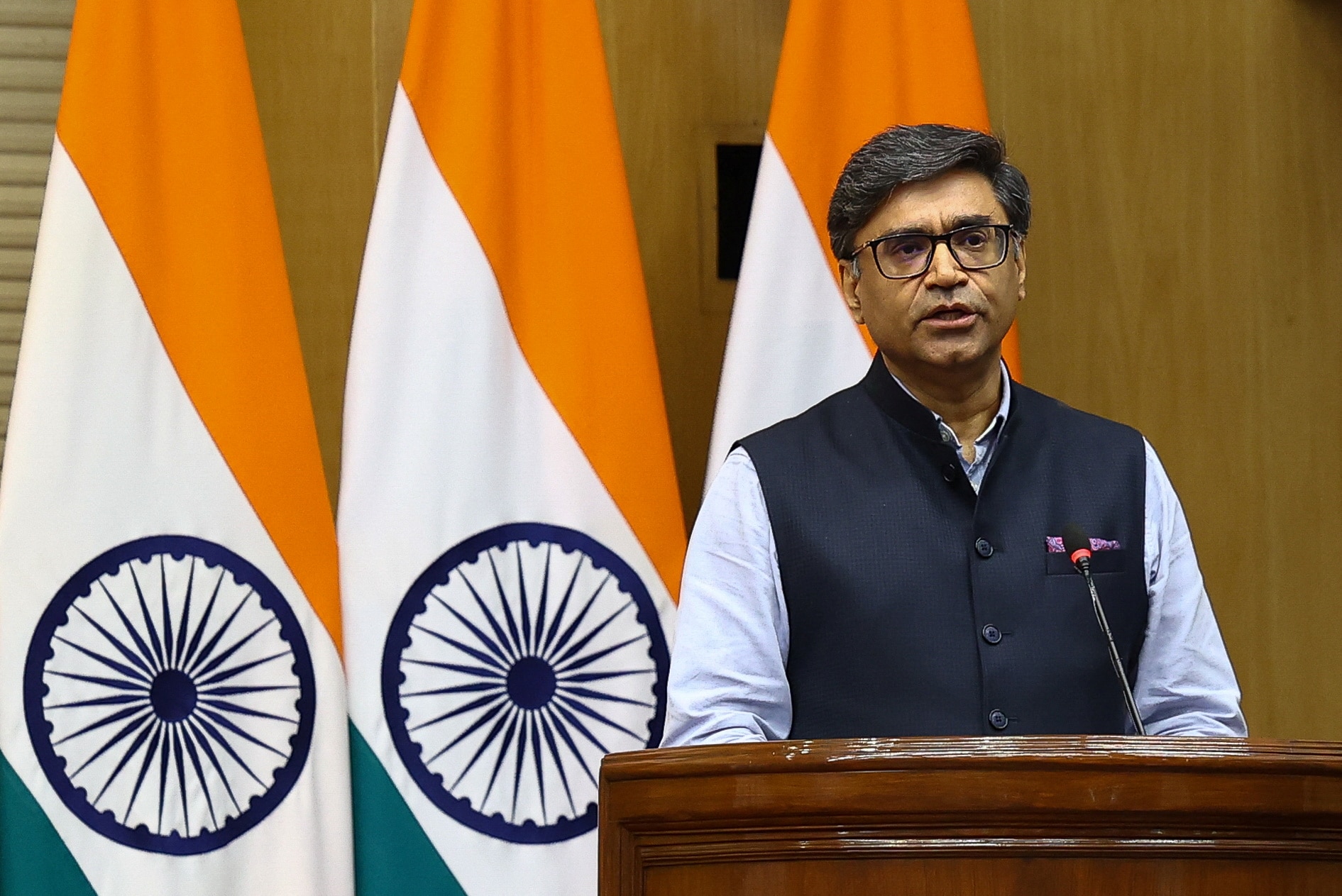
The visit of Indian Foreign Secretary Vikram Misri to the United Arab Emirates (UAE) represents more than a routine diplomatic engagement; it serves as a calibration of the Comprehensive Economic Partnership Agreement (CEPA) and a stress test for the emerging I2U2 and IMEC corridors. While conventional reporting focuses on the surface-level cordiality of high-level meetings, the underlying reality is a calculated alignment of India’s massive labor and consumer scale with the UAE’s capital surplus and logistical dominance. This relationship has shifted from a transactional energy-buyer-seller dynamic into a structural interdependence that functions across three specific dimensions: institutionalized capital flows, energy transition hedging, and trilateral geopolitical balancing.
The Architecture of Institutionalized Capital Flows
The primary driver of the bilateral relationship is no longer just trade volume, but the deep integration of financial systems. India requires roughly $1.5 trillion in infrastructure investment over the next decade to sustain growth targets. The UAE, through entities like the Abu Dhabi Investment Authority (ADIA) and Mubadala, seeks long-term, inflation-protected yields that domestic or Western markets currently struggle to guarantee at scale.
- The Infrastructure-Capital Loop: UAE sovereign wealth funds are not merely passive investors; they are becoming embedded in Indian physical infrastructure. This includes significant stakes in ports, logistics parks, and renewable energy grids. By anchoring capital in India’s National Investment and Infrastructure Fund (NIIF), the UAE secures a foothold in the world’s fastest-growing major economy while India derisks its infrastructure deficit.
- Local Currency Settlement (LCS) Systems: A critical but under-analyzed component of Misri’s review is the operationalization of the LCS. By bypassing the USD for bilateral trade, both nations reduce transaction costs and mitigate exchange rate volatility. This is not a purely political move toward "de-dollarization" but a pragmatic treasury management strategy to protect the thin margins of SME exporters in both territories.
- CEPA Optimization: Two years post-implementation, the CEPA has already moved bilateral trade toward the $100 billion target. However, the current focus is on "Product-Specific Rules" and the removal of non-tariff barriers. The strategic intent is to turn the UAE into a re-export hub for Indian manufactured goods entering the African and European markets, leveraging DP World’s global logistics footprint.
Strategic Hedging and the Energy Transition Paradox
Both New Delhi and Abu Dhabi are navigating the "Green Dilemma": the need to maximize current hydrocarbon revenues and security while aggressively pivoting toward a post-oil economy. Misri’s review of bilateral ties heavily weighted the Strategic Petroleum Reserve (SPR) program alongside Green Hydrogen initiatives.
The UAE’s participation in India’s SPR program provides a physical security buffer for India’s energy needs. In exchange, the UAE gains guaranteed market share in a region where energy demand is still rising, unlike the stagnating demand in the OECD. This creates a "Locked-In Demand" model.
Simultaneously, the partnership is evolving into a technology-for-deployment exchange. The UAE possesses the low-cost solar generation profile necessary to produce Green Hydrogen at scale, while India offers the industrial application and engineering talent to deploy these technologies. The logic here is clear: if the world moves away from oil, the India-UAE axis intends to control the supply chain of the replacement fuel.
Trilateralism as a Force Multiplier
The discussion on trilateral cooperation—specifically involving partners like France or the Mediterranean nations—marks a departure from traditional non-alignment. India is utilizing the UAE as a gateway to broader "minilateral" groupings.
The I2U2 Framework (India, Israel, UAE, USA)
This grouping functions as a technological and food security syndicate. The UAE’s "Food Parks" project in India, supported by Israeli technology and US private sector capital, addresses a fundamental vulnerability. India’s fragmented agricultural supply chain results in massive wastage; UAE investment in "Cold Chain" logistics creates a direct pipeline for Indian produce to reach Middle Eastern markets, stabilizing food prices in the Gulf while boosting Indian farm incomes.
The IMEC (India-Middle East-Europe Economic Corridor)
Despite regional volatility, the IMEC remains the long-term logical successor to traditional maritime routes. The UAE serves as the critical "land bridge" component. Misri’s visit confirms that the technical specifications—rail gauges, digital customs clearing, and port synchronization—are proceeding despite the geopolitical noise. This corridor reduces transit time to Europe by 40%, fundamentally altering the cost function of Indian exports.
Identifying Operational Bottlenecks
While the strategic alignment is high, several structural frictions persist that Misri’s delegation must address to prevent stagnation:
- Regulatory Divergence: India’s tax environment and the UAE’s evolving corporate tax laws create compliance hurdles for mid-cap firms attempting to cross-list or expand operations.
- Labor Market Evolution: The UAE’s "Emiratization" drive and India’s push for high-skill migration (as opposed to just blue-collar labor) require a new framework for professional certification and social security portability.
- Geopolitical Risk Insurance: The heightening tensions in the Red Sea and the Levant introduce a "risk premium" on the IMEC and general maritime trade. The two nations must develop a joint maritime security protocol that goes beyond occasional naval exercises.
The Shift to Digital and Fintech Interoperability
The integration of India’s Unified Payments Interface (UPI) with the UAE’s AANI platform is a definitive signal of digital sovereignty. This move targets the $20 billion annual remittance flow. By digitizing this corridor, the two nations are removing the "middleman tax" imposed by global banking syndicates.
Furthermore, the establishment of the IIT Delhi campus in Abu Dhabi signals a move toward "Knowledge Export." India is no longer just exporting labor; it is exporting its educational frameworks to train the next generation of Emirati technocrats. This creates a shared intellectual property ecosystem that will eventually underpin joint ventures in Artificial Intelligence and Space exploration—sectors where both nations are currently over-indexing their investments.
Strategic Forecast: The Integration of Global South Interests
The trajectory of India-UAE relations suggests a move toward a "Shared Governance" model in the Indian Ocean Region (IOR). As the US focuses on the Indo-Pacific and China expands its Belt and Road Initiative, the India-UAE partnership offers a middle-path alternative for other nations in the Global South.
The final strategic play is the creation of a "Resilient Supply Chain" that is agnostic to Western or Chinese dominance. By linking Indian manufacturing, UAE logistics, and joint investments in African natural resources, this axis is building a vertical integration that spans from raw material extraction to final consumer delivery.
Success in this bilateral relationship will not be measured by the number of MOUs signed, but by the percentage of trade settled in local currencies and the total kilowatt-hours of green energy traded between the two borders. The shift from a diplomatic friendship to a hard-coded economic engine is now irreversible. Entities operating within this corridor must prioritize alignment with the CEPA framework and the digital payment stack to capture the arbitrage opportunities created by this structural convergence.