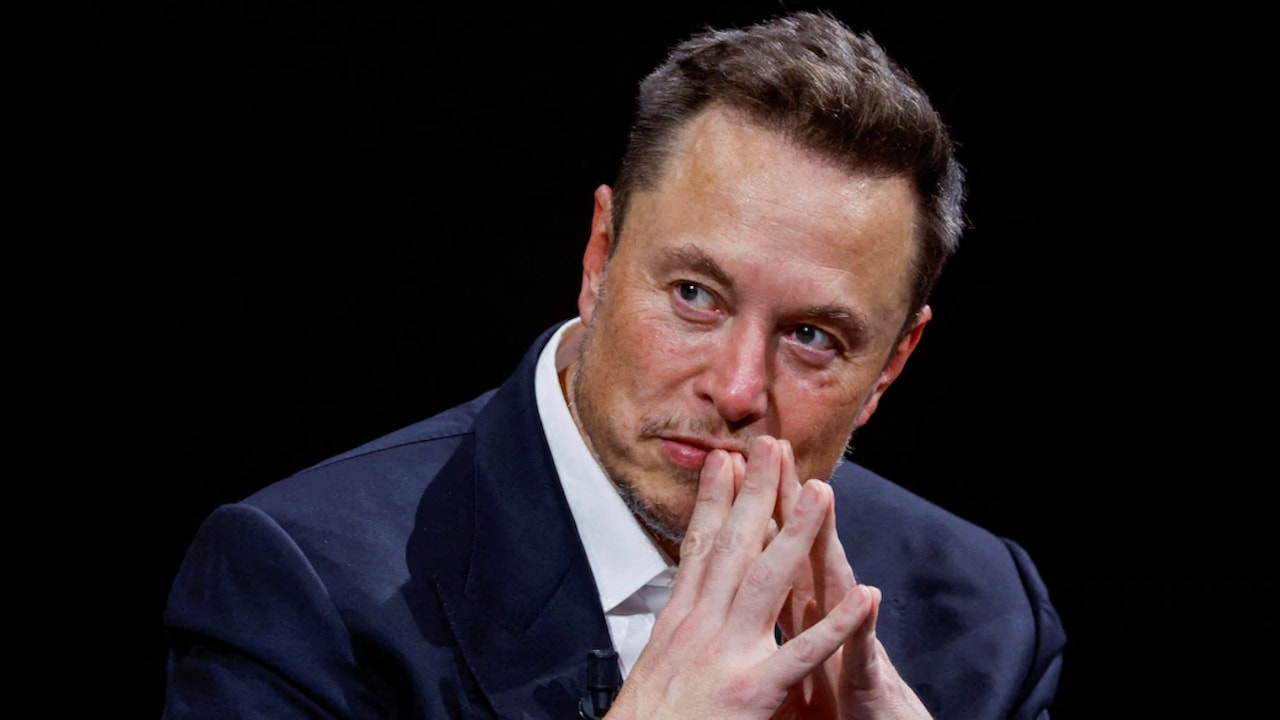
Elon Musk is on the verge of crossing the trillion-dollar net worth threshold, a milestone driven by the impending initial public offering of SpaceX. Financial commentators are scrambling to convert this wealth into eye-popping statistics, noting that his projected fortune of over 1.1 trillion dollars translates to roughly 95 lakh crore Indian rupees. They list the absurd things he could theoretically buy with that money, from purchasing entire metropolitan real estate markets to outspending the annual gross domestic product of mid-sized nations.
But these calculations miss the fundamental reality of ultra-high-net-worth engineering.
Musk does not have a trillion dollars. He has an unprecedented concentration of corporate equity locked behind regulatory hurdles, market volatility, and immense operational risk. The narrative that an individual can simply liquidate this capital to buy up pieces of the physical world ignores how modern corporate finance actually works. To understand the true mechanics of this wealth, one must look past the hypothetical shopping lists and examine the structural fragile nature of paper valuations.
The House of Cards Built on Public Offerings
The surge in Musk’s net worth relies almost entirely on the projected valuation of SpaceX as it prepares for its market debut. Analysts peg the space company's post-IPO market capitalization at roughly 1.77 trillion dollars, with Musk retaining nearly half of the shares. On paper, this adds an instant 841 billion dollars to his existing fortune, cementing his place as the world’s first paper trillionaire.
This valuation is staggering, considering SpaceX is fundamentally a high-risk manufacturing and logistics operation. Recent regulatory filings reveal that SpaceX lost 2.6 billion dollars from operations last year on 18.7 billion dollars in revenue, with losses continuing into the first half of this year. The market is valuing the company not on its current financial performance, but on its monopolistic control over satellite internet via Starlink and its theoretical future revenue from deep-space exploration.
When a company relies so heavily on future assumptions, its stock price becomes hyper-sensitive to market sentiment. A single failed launch, a regulatory crackdown on satellite orbits, or a macro-economic shift could wipe hundreds of billions of dollars off the valuation overnight. Musk's wealth is inextricably tied to these volatile assets. He cannot sell them en masse without triggering a catastrophic panic among institutional investors.
Why You Cannot Buy a City With Paper Equity
The popular financial press loves to claim that a trillionaire could buy all the residential and commercial property in a major city like Houston, or fund the entire budget of a developing nation. This is a mathematical fantasy.
[Illiquid Paper Equity]
       │
       ▼ (Mass Market Liquidation)
[Shattered Investor Confidence]
       │
       ▼
[Stock Price Collapse]
       │
       ▼
[Fractional Realized Cash]
If Musk attempted to liquidate 100 billion dollars worth of Tesla or SpaceX stock to purchase physical assets, the market response would be swift and brutal.
- The Disclosure Effect: Securities laws require high-profile executives to file public notices before selling significant chunks of stock. The moment the market sees a founder dumping shares, it assumes institutional trouble.
- The Supply Shock: Flooding the market with tens of millions of shares drives the price down mechanically.
- The Valuation Spiral: By the time the final block of shares is sold, the stock might trade at a fraction of its original price, shrinking the remainder of the fortune.
Ultra-wealthy individuals do not spend their actual stock. Instead, they use their equity as collateral to secure low-interest loans from major investment banks. This allows them to access hundreds of millions in cash without triggering a taxable event or a stock sell-off. However, this strategy has strict limits. Banks require a massive cushion of equity to back these loans. If the underlying stock price drops below a certain level, the banks trigger a margin call, forcing the executive to hand over shares or cash immediately. Musk found himself navigating these exact waters during his turbulent acquisition of Twitter, proving that even the richest man in the world faces hard capital constraints.
The Corporate Governance Paradox
To sustain a trillion-dollar valuation, an executive must maintain absolute control over their corporate empire. For Musk, this has meant rewriting the rules of corporate governance. At SpaceX, he maintains roughly 85% voting control despite owning less than half the equity. This structure ensures that public shareholders are along for the ride without any real say in how the company operates.
This concentration of power presents a major risk for institutional investors. Traditional index funds and mutual funds are structurally designed to buy into massive public offerings. Because of SpaceX’s sheer size, almost every major retirement fund and retirement account will soon hold a piece of the company. These funds are effectively outsourcing their risk management to a single individual who has historically shown an aversion to traditional corporate oversight.
If the public markets grow weary of this structure, or if institutional shareholders demand a level of compliance that conflicts with Musk's operational style, the premium built into these valuations could evaporate. We saw a preview of this when his association with the second Trump administration caused his net worth to fluctuate by over 120 billion dollars in a matter of months.
The True Cost of Funding Mars
The stated purpose of the SpaceX IPO is not to enrich its founder, but to raise up to 75 billion dollars in primary capital to fund missions to the Moon and Mars. These are capital-intensive, multi-decade projects with no guaranteed return on investment.
Every dollar raised from public investors comes with the expectation of fiduciary responsibility. Public markets are notoriously impatient. They tolerate losses when a company is growing exponentially, but they demand profitability once a business matures. Starlink currently serves as the primary profit center for the enterprise, but infrastructure costs remain incredibly high.
If the core business faces delays in its next-generation heavy launch vehicles, or if global demand for satellite broadband hits a ceiling, the financial foundation of the entire empire changes. The transition from a tightly controlled private entity to a highly scrutinized public corporation forces a level of transparency that rarely bodes well for speculative, long-horizon science projects. Musk is attempting to funding a civilization-scale endeavor using the tools of modern financial capitalism, a bet where the margin for error is non-existent.