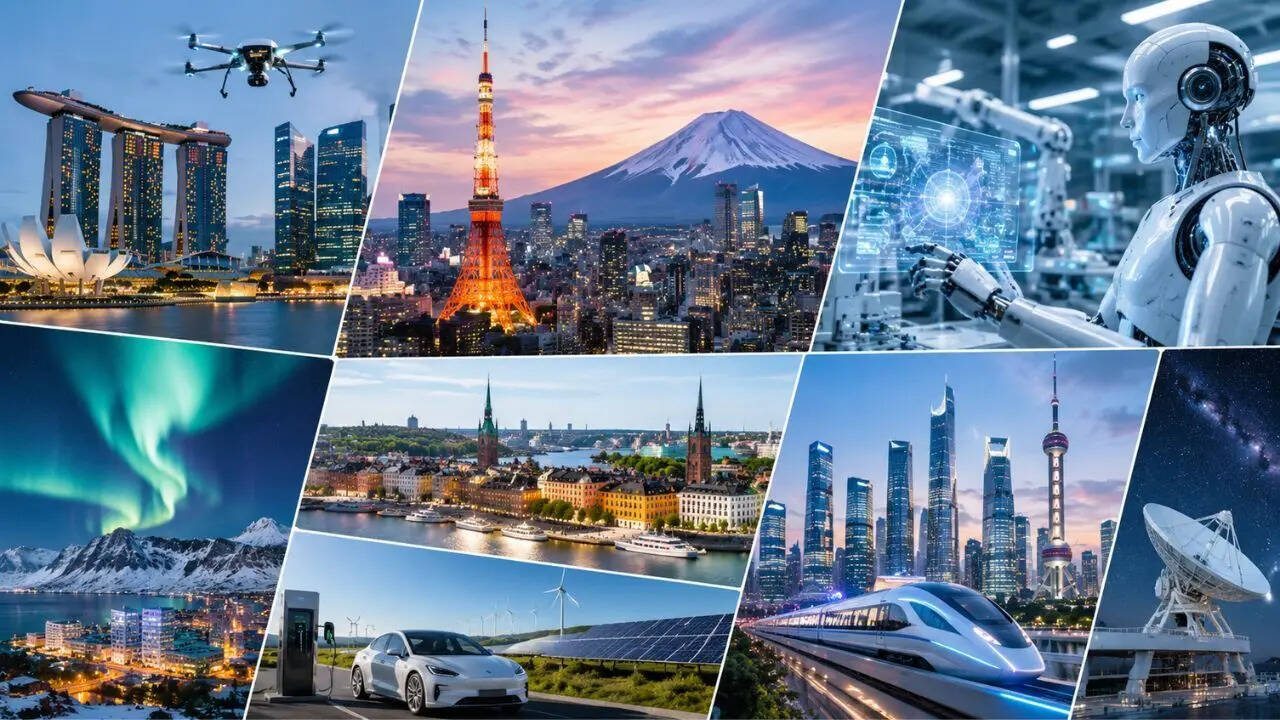
National advancement is frequently measured by superficial metrics. Silicon Valley tech brokers and Davos economists point to high smartphone penetration in South Korea or shiny biotech facilities in Denmark as definitive proof of global leadership. This view is flawed. True national advancement requires more than high consumer adoption of digital tools or a single thriving export sector. It demands structural resilience, the ability to control foundational supply chains, and a population capable of sustained productivity amidst demographic collapse. When you strip away the marketing gloss of "advanced economies," a more complex reality emerges.
The metrics used by global ranking bodies often confuse consumption with creation. A society where citizens pay for groceries via facial recognition is not inherently advanced; it is simply highly optimized for surveillance capitalism. True technological power rests further down the stack, at the level of basic scientific research, lithography, and energetic materials. Examining the machinery behind the curtain reveals that the global hierarchy of innovation looks radically different from the standard consensus. Don't forget to check out our earlier article on this related article.
The Silicon Trap
South Korea is often celebrated as the poster child for digital integration. Seoul looks like a city pulled from a science fiction novel, with ubiquitous high-speed connectivity and automated infrastructure.
That infrastructure relies on an incredibly fragile foundation. The South Korean economic model is dominated by massive, family-run conglomerates known as chaebols. While companies like Samsung and SK Hynix control a massive share of the global memory chip market, they are remarkably dependent on external inputs. If you want more about the background of this, Engadget offers an in-depth summary.
They do not own the entire stack. To build those advanced memory chips, South Korea relies heavily on Japanese specialized chemicals, photoresists, and fluorinated polyimides. A diplomatic dispute in recent years proved this vulnerability when Tokyo restricted these exports, bringing South Korean production lines to the brink of a standstill.
Furthermore, South Korea faces a structural crisis that no amount of digital adoption can solve. The country possesses the lowest fertility rate in the world. Infrastructure cannot sustain itself without humans to maintain, engineer, and iterate upon it. A nation cannot automate its way out of a missing generation. The glittering digital facade masks a deeper vulnerability: an economy hyper-specialized in a volatile hardware market, squeezed between an aggressive China and a technologically foundational Japan, while running out of people.
The Sovereign Wealth Illusion
Nordic nations like Denmark are frequently cited as paragons of balanced advancement. Denmark boasts a booming pharmaceutical sector, driven largely by Novo Nordisk, which became Europe’s most valuable company due to skyrocketing global demand for weight-loss and diabetes drugs.
This creates a dangerous economic distortion. When a single company’s valuation outgrows the GDP of its home country, national statistics become skewed. The Danish crown has faced unique pressures, forcing the central bank to keep interest rates artificially low to prevent the currency from strengthening too much, which would harm other exporters.
This is a structural vulnerability disguised as a success story. Denmark’s apparent advancement is heavily weighted toward a single therapeutic area. If a competitor develops a cheaper, more effective alternative to semaglutide, or if long-term safety concerns emerge, the Danish economic engine faces an immediate shock.
True advancement requires a broad ecosystem, not an isolated industrial peak. Relying on a single pharmaceutical giant to carry a nation’s innovation metrics is equivalent to an oil-dependent state claiming it has a diversified economy because it bought a fleet of electric police cars.
The Invisible Foundations of Power
If consumption metrics and single-industry booms do not equal advancement, what does? The answer lies in the unglamorous, capital-intensive layers of industrial production that the West largely abandoned over the last four decades.
Consider the Netherlands. It rarely tops consumer-facing tech lists, yet the entire global semiconductor industry relies on a single Dutch company: ASML. Without their extreme ultraviolet (EUV) lithography machines, no advanced chips can be manufactured anywhere on earth. Not in Taiwan, not in the United States, and not in South Korea. The Netherlands holds a strategic choke point because it retained the specialized, highly precise engineering capabilities required to build the most complex machines on the planet.
Global Semiconductor Supply Chain Dependency:
[Raw Wafers & Chemicals] -> Japan
[Lithography Equipment (EUV)] -> Netherlands (ASML)
[Chip Design] -> United States
[Advanced Manufacturing/Foundries] -> Taiwan
[Assembly & Packaging] -> China / Southeast Asia
Similarly, Japan retains immense, quiet leverage. While names like Sony and Panasonic no longer dominate consumer electronics the way they did in the 1980s, Japanese enterprises moved upstream. They control the production of specialized silicon wafers, internal high-capacity ceramic capacitors, and the precise manufacturing equipment needed to build everything from electric vehicles to aerospace components. They chose to own the inputs rather than the final consumer brand.
This represents the highest tier of national advancement. It is the ability to command a critical node in the global supply chain that cannot be easily replicated or bypassed. It is an advantage forged over decades of continuous industrial experience and heavy capital investment. It cannot be easily disrupted by a software startup or a new digital platform.
The Intellectual Property Delusion
For years, Western analysts comforted themselves with the belief that while emerging economies handled low-margin manufacturing, advanced nations would retain the high-margin intellectual property.
This view was arrogant. It ignored the reality of how technical competence is acquired.
Manufacturing is not a detached, lower-tier activity. It is a vital source of learning and innovation. When you outsource production, you eventually outsource the engineering expertise required to design the next generation of products. Over time, the entities doing the physical manufacturing develop their own intellectual property, optimize their workflows, and surpass the original designers.
We see this playing out in the renewable energy and electric vehicle sectors. China did not just scale production; they achieved dominant technical competence in battery chemistry, refining capacity, and vertical supply chain integration. Western automakers now find themselves trying to catch up to manufacturing processes that are cleaner, faster, and significantly cheaper than their own. The intellectual property argument collapsed because the West forgot that designing a product requires a deep, tactile understanding of how things are actually made.
The True Architecture of an Advanced State
To accurately evaluate global advancement, we must discard superficial metrics and look at the underlying structure. A truly advanced nation requires a specific blueprint.
- Sub-surface Industrial Depth: The capability to produce foundational components, specialized machinery, or advanced materials that cannot be commoditized.
- Demographic Resilience: A population structure or an immigration system that ensures a steady supply of skilled domestic labor and engineering talent to maintain complex infrastructure.
- Resource and Energy Security: The capacity to power industrial operations and secure critical raw materials without total reliance on volatile foreign supply lines.
- Institutional Flexibility: Regulatory environments that allow for rapid deployment of physical infrastructure, rather than just digital applications.
Without these pillars, high rates of smartphone adoption or a booming software sector are merely temporary advantages. They are easily disrupted by geopolitical shifts, supply chain blockades, or economic downturns.
The Myth of the Digital Panacea
The belief that software can replace physical infrastructure is a modern delusion. A country can have the most sophisticated digital governance platform in the world, but if its electric grid relies on aging transformers that take two years to replace, it is structurally fragile.
We have entered a period where physical constraints matter far more than digital optimizations. The nations that dominate the coming decades will not be those with the highest number of app downloads or fintech unicorns. Power belongs to the societies that maintain mastery over the physical world: the refineries, the foundries, the chemical plants, and the deep-tech research laboratories. Everything else is just consumer fluff built on borrowed time.
The global rankings will continue to praise countries for their high digital adoption rates and flashy corporate valuations. Wise observers will look past the screens and focus instead on the factories, the ports, and the specialized machinery that quietly run the world. This is where real national advancement lives, and it cannot be faked with an algorithm or a piece of software.