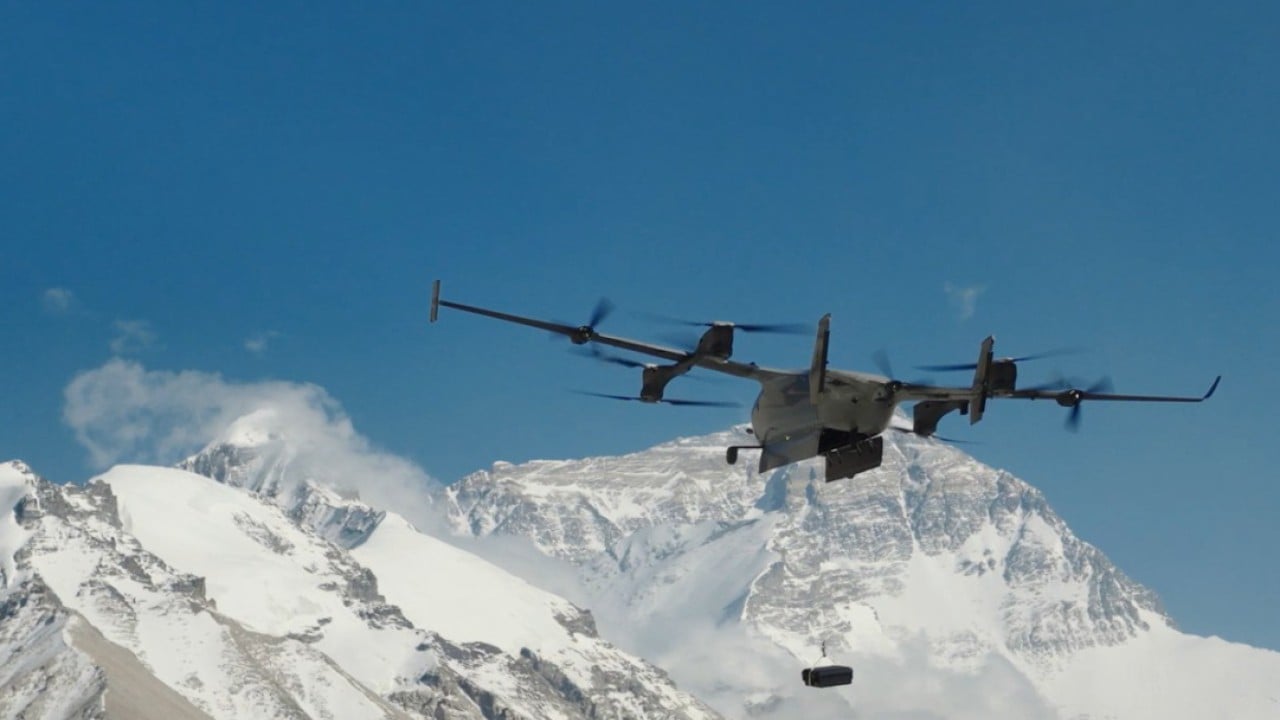
Thin air breaks machinery. At eight thousand meters above sea level, the atmosphere yields roughly one-third of the oxygen found at sea level, turning internal combustion engines into useless blocks of metal and forcing electric rotors to spin at frantic, battery-draining speeds just to generate lift. For decades, this vertical wasteland served as a natural barrier against commercial logistics. Climbers died on the slopes because supplies could not reach them quickly enough, and thousands of kilograms of trash accumulated in the death zone because carrying it down manually meant risking human lives.
That calculus changed permanently when a specialized drone hub launched on Mount Everest.
The installation of a permanent commercial drone operating base on the world's highest peak is far more than a local logistical upgrade for mountaineering expeditions. It is a calculated geopolitical and technological demonstration. Beijing has engineered a high-altitude logistics network that effectively solves the brutal physics of the Himalayas, utilizing domestic hardware manufacturers to prove a point about extreme-environment engineering. While Western aerospace firms focus on suburban package delivery and urban air mobility, Chinese state-backed industrial actors are quietly mastering the hardest operational envelope on Earth.
The Physics of Failure at Eight Thousand Meters
Standard aerodynamic principles collapse in the death zone. When air density drops precipitously, rotorcraft must increase their RPM exponentially to achieve the same thrust produced at sea level. Batteries suffer severe chemical degradation in sub-zero temperatures, losing up to half their operational capacity in minutes. Winds routinely exceed hurricane force without warning, turning a routine cargo run into an uncontrolled descent.
To overcome these obstacles, engineers had to abandon conventional commercial drone designs entirely. The units deployed on Mount Everest feature custom carbon-composite frames, oversized multi-blade configurations, and specialized thermal management systems designed to keep lithium-polymer cells from freezing solid. Navigation is another massive hurdle. Global Positioning System signals bounce erratically off sheer rock faces and glacial ice, requiring dense constellations of alternative positioning sensors, including inertial measurement units and terrain-following optical radar.
Gravity does not negotiate. When a heavy-lift cargo drone fails at seven thousand meters, it becomes an uncontrolled projectile capable of obliterating tents, equipment caches, or climbing teams below. The operational protocol requires absolute redundancy. Dual flight controllers, independent power buses, and ballistic parachute recovery systems are mandatory. Every kilogram of payload delivered to Camp 1 or Camp 2 represents a calculated risk against the probability of structural failure in winds that can shatter carbon fiber like glass.
Trash Retrieval and the True Cost of Commercial Climbing
The romanticized vision of Mount Everest as a pristine sanctuary of human endurance died decades ago. Today, the upper slopes resemble a high-altitude municipal landfill. Discarded oxygen cylinders, shredded tents, abandoned climbing ropes, and human waste freeze into the glacial ice, remaining preserved indefinitely in the sub-zero deep freeze. Manual cleanup operations are notoriously lethal. Sherpa guides risk their lives every season hauling refuse down the Khumbu Icefall, a shifting maze of crevasses and seracs that kills people with ruthless regularity.
The new drone hub was ostensibly built to solve this humanitarian and environmental crisis. Heavy-lift vertical takeoff and landing platforms can transport up to thirty kilograms of cargo per flight, making light work of hauling oxygen canisters up and garbage down.
A single aerial cargo run replaces a dangerous rotation of human porters through the most treacherous section of the mountain. From a utilitarian perspective, the technology saves lives. Fewer foot transits through the Khumbu Icefall mean fewer casualties among the indigenous workforce that carries the invisible burden of the global mountaineering industry.
Yet, efficiency introduces its own moral hazards. By lowering the logistical barrier to entry, these systems threaten to accelerate the commercialization of the peak. If elite climbers and wealthy tourists can rely on automated aerial supply chains for gourmet food, fresh equipment, and continuous medical support, the mountain loses whatever wilderness character it has left.
Dual-Use Realities in the Death Zone
Aerospace technology of this caliber is rarely singular in purpose. A heavy-lift drone capable of hauling thirty kilograms of emergency medical gear through hurricane-force winds at extreme altitude possesses inherent strategic utility.
High-altitude border disputes are notoriously difficult to supply. In contested mountain ranges where mechanized ground transport is impossible, moving ammunition, secure communications equipment, and reconnaissance payloads via autonomous aerial systems changes the tactical balance overnight. The infrastructure being tested on Mount Everest provides a live-fire laboratory for plateau warfare.
Western defense analysts have watched the rapid militarization of commercial drone technology in various conflicts around the globe, but the high-altitude theater presents an entirely distinct set of parameters. Operating effectively above five thousand meters requires specialized propulsion and thermal engineering that very few nations outside of China currently possess at scale. By deploying these systems in plain sight under the guise of environmental cleanup and mountaineering logistics, industrial architects are stress-testing military-grade hardware in the most hostile testing ground available.
The software running these drones is equally critical. Autonomous flight path generation, computer vision obstacle avoidance, and encrypted mesh networking do not care whether they are carrying a bundle of discarded climbing ropes or a secure tactical relay. The code is agnostic.
The Industrial Ecosystem Behind the Rotor Blades
The deployment on Everest is not the achievement of a single adventurous startup. It is the output of a deeply integrated manufacturing ecosystem based in Shenzhen and supported by state research grants aimed at dominating extreme-environment robotics.
When supply chains are optimized for volume, high-end engineering often gets neglected. The inverse is true here. The financial capital required to develop a rotorcraft capable of hovering in the thin air of the Himalayas has no immediate commercial payback within civilian markets. Civilian consumers do not need sub-zero battery heaters or military-grade encrypted telemetry links for wedding photography or real estate surveys.
This is where state-directed industrial policy diverges sharply from market-driven models. Governments can subsidize high-risk R&D that lacks a short-term commercial return. By establishing a permanent foothold on the roof of the world, these entities secure a dual victory: they solve a prominent local problem while establishing undisputed technological dominance in high-altitude aviation.
Competitors in the United States and Europe are structurally disadvantaged by this dynamic. Venture-backed aerospace firms must show a path to profitability within standard funding cycles, making multi-year investments in extreme-environment physics difficult to justify to risk-averse boards of directors.
What Happens When the Weather Turns
Technology remains ultimately subordinate to meteorology. No matter how advanced the carbon composites or how sophisticated the flight algorithms, the weather on Mount Everest remains the final arbiter.
During the monsoon season or sudden winter storms, the mountain closes its doors to all human and mechanical activity. Winds howl at speeds that strip paint from metal, and temperatures drop to levels where electronic components crack under thermal stress. The drone hub is not a permanent year-round panacea; it is a seasonal force multiplier that operates within narrow meteorological windows.
The illusion of complete technological mastery over nature is a modern trap. We look at autonomous systems conquering the death zone and assume that human vulnerability has been engineered away. It has not. Every successful cargo flight across the icefall is a temporary truce with a mountain that actively seeks to destroy anything placed upon it.
As these systems become permanent fixtures of high-altitude logistics, the regulatory landscape remains entirely unwritten. Who holds liability when an autonomous heavy-lift drone drops its payload onto a climbing party below? How do sovereign nations manage low-altitude airspace over shared mountain borders where radar coverage is practically non-existent?
The answers will not emerge from conference rooms in Geneva or Washington. They are being written right now on the slopes of Everest, one rotor spin at a time, high above the clouds where nobody can hear the machinery strain against the void.