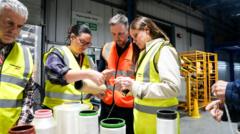
Aerospace executives are quietly spending time on textile factory floors because the next phase of space exploration cannot happen without advanced weaving tech. While public attention fixes on massive rocket boosters and carbon-fiber hulls, the survival of orbital hardware and human crews depends entirely on specialized fabrics. This isn't about spacesuits. It is about a critical supply chain bottleneck involving high-performance materials that shield electronics from extreme radiation and keep engines from melting.
The relationship between textile mills and aerospace corporations is shifting from a standard buyer-vendor transaction into a deep technical reliance. As launch costs plummet, the demand for satellites and orbital infrastructure is skyrocketing. This surge is exposing major vulnerabilities in how specialized fabrics are sourced, developed, and manufactured.
The Invisible Shield Protecting Modern Satellites
A satellite in low Earth orbit experiences temperature swings of hundreds of degrees every ninety minutes. Without multi-layer insulation blankets, the onboard electronics would fry or freeze instantly. These blankets are not simple sheets of foil. They are complex, multi-layered systems constructed from woven polymers, ceramic fibers, and gossamer-thin metallized films.
The manufacturing process requires extreme precision. A single microscopic flaw in the weave of a thermal blanket can cause localized thermal bleeding, destroying a hundred-million-dollar payload. Aerospace engineers are visiting textile factories to understand the physical limits of modern looms. They need to know how tightly a silica thread can be woven without breaking, and whether automation can eliminate human error from the assembly process.
Why Legacy Manufacturing is Struggling to Keep Pace
The traditional aerospace supply chain was built for low-volume, high-cost government contracts. A factory might spend six months crafting a single, custom thermal shield for a deep-space probe. Today, commercial mega-constellations require hundreds of satellites to be built every month. Legacy textile manufacturing facilities are simply not equipped for this level of throughput.
- Tooling limitations: Traditional looms lack the sensors required to monitor yarn tension in real-time at high speeds.
- Material scarcity: The specialized raw materials, such as liquid-crystal polymer fibers and high-purity alumina threads, have highly volatile supply chains.
- Skill gaps: Operating and maintaining automated weaving equipment for high-performance fibers requires specialized knowledge that is becoming increasingly rare.
Bridging this gap requires massive capital investment. Space companies are realizing that they cannot just order these materials out of a catalog anymore. They have to co-develop the manufacturing lines alongside the textile producers to ensure their own production schedules do not grind to a halt.
The Harsh Reality of Qualification and Testing
Getting a fabric certified for spaceflight is a brutal process. Materials must undergo rigorous testing to ensure they will not fail in a vacuum. One of the biggest hurdles is outgassing. In the vacuum of space, volatile compounds inside plastics and fabrics evaporate, creating a thin mist that can coat optical lenses and solar panels, ruining their efficiency.
[Material Selection] -> [Weaving & Coating] -> [Vacuum Outgassing Test] -> [Thermal Cycling] -> [Flight Certification]
Textile engineers must formulate specific chemical coatings that bind the fibers together without introducing elements that could outgas later. This requires a deep understanding of molecular chemistry and surface physics. When aerospace giants tour these facilities, they are vetting the chemical laboratories just as much as the weaving floor.
Beyond Thermal Blankets
The utility of advanced textiles extends far beyond insulation. Next-generation spacecraft are utilizing woven materials in structural ways that were unthinkable a decade ago.
Deployable Antennas and Reflectors
Modern communication satellites require massive radar dishes that cannot fit inside a standard rocket fairing. The solution is to fold them like origami. Engineers are using gold-plated molybdenum wire woven into an incredibly fine mesh. This fabric can be compressed into a tight package for launch and then spring open into a rigid, precise geometric shape once in orbit. The tension of the weave must be perfectly uniform across the entire surface, or the antenna will distort the signals it transmits.
Inflatable Orbital Habitats
Commercial space stations are moving away from heavy metallic modules in favor of expandable structures. These habitats use thick layers of Vectran and Kevlar woven into intricate webbings. When inflated, these fabric shells provide structural rigidity capable of withholding atmospheric pressure while offering superior protection against micrometeorite impacts compared to traditional aluminum hulls. When a tiny piece of space debris hits a multi-layered fabric shield, the energy is distributed across the woven fibers, blunting the impact.
The Geopolitical Stranglehold on Advanced Fibers
The market for high-grade technical ceramics and carbon precursors is heavily consolidated. A handful of facilities worldwide produce the specific grade of raw materials required for aerospace textiles. This concentration introduces a massive geopolitical risk into the commercial space sector.
If a trade dispute or a domestic factory fire disrupts a single chemical plant, the ripple effects can stall rocket launches globally. Space companies are actively looking to diversify their textile supply chains, urging domestic manufacturers to establish local production lines for critical fibers. It is an expensive insurance policy, but the alternative is letting an entire launch manifesto depend on a single point of failure.
The Friction of Merging Two Distinct Cultures
When silicon-valley style aerospace firms collaborate with century-old textile manufacturers, cultural friction is inevitable. Space startups move fast, iterate constantly, and expect rapid turnarounds. Textile manufacturing is a heavy industrial process where changing a loom configuration can take days of mechanical adjustments.
This mismatch can cause friction. Aerospace engineers often design components that look perfect in a digital simulation but are physically impossible to weave on a factory floor. Direct collaboration bridges this gap. By putting the aerospace designers in the same room as the master weavers, companies can design for manufacturability from day one, saving millions of dollars in aborted prototype runs.
The future of orbital infrastructure will not be forged solely in cleanrooms and propulsion labs. It will be spun, warped, and wefted on industrial looms. The companies that master the integration of textile science into their engineering pipelines will secure a massive competitive advantage, while those who treat fabric as an afterthought will find their ambitions grounded by the realities of the factory floor.