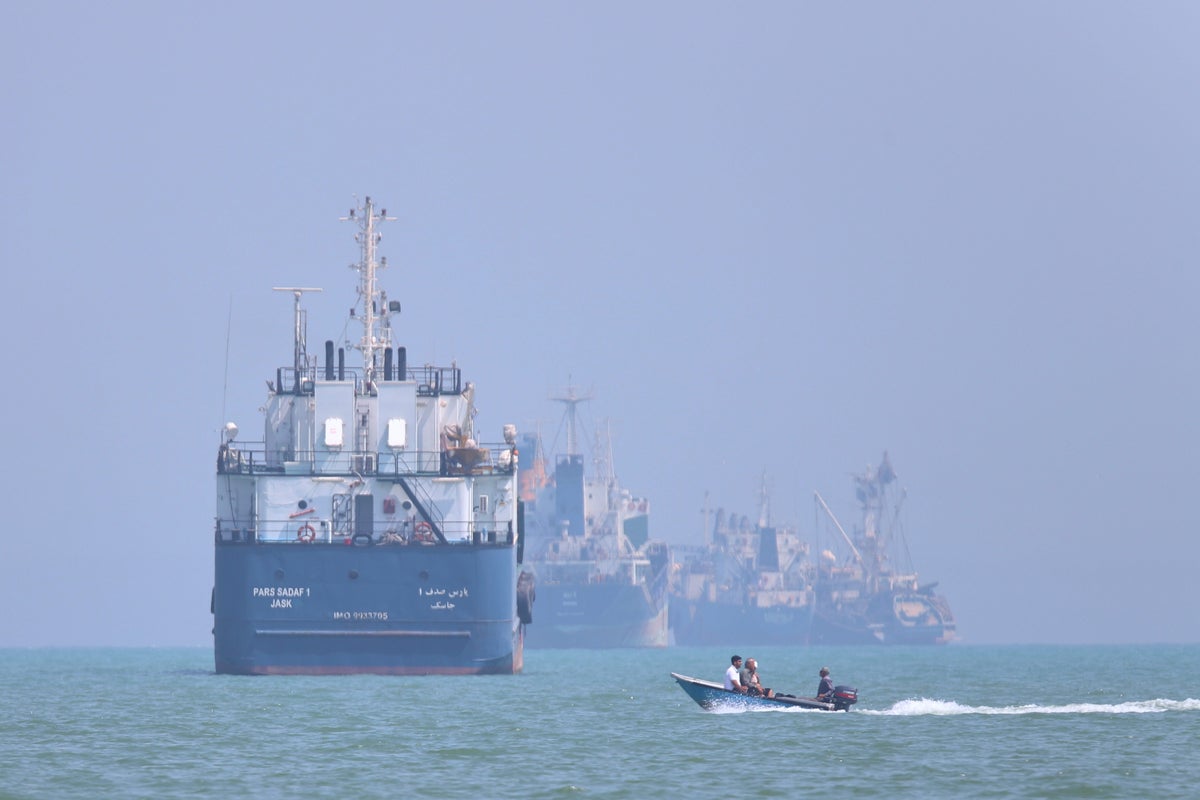
The radar screen does not care about geopolitics. It merely pulses with steady, green indifference, mapping out a world that has suddenly ground to a halt.
For Captain Marcus—a hypothetical composite of the merchant mariners currently floating in the Gulf of Oman—the ocean has never felt so small. His vessel is a ultra-large crude carrier, a steel leviathan three blocks long, laden with two million barrels of oil. Normally, his path is a carefully choreographed dance through the Strait of Hormuz, a narrow strip of water separating Iran from the Arabian Peninsula. For a different perspective, check out: this related article.
Today, he is drifting. The engine is idle. The crew is quiet.
Behind them, the Persian Gulf has transformed into a dead-end street. Ahead, past the jagged cliffs of the Musandam Peninsula, lies an invisible wall. Following a rapid, violent exchange of missile strikes between United States forces and Iranian military factions, the most critical maritime chokepoint on Earth has been declared closed indefinitely. Related analysis regarding this has been published by The Washington Post.
War is often measured in the language of throw-weight, payload, and strategic deterrence. But the true weight of this conflict is felt in the sudden, eerie silence of a stalled trade route, and the quiet panic beginning to ripple through a global economy that runs on just-in-time logistics.
The Twenty-One Mile Throat
To understand how a single flashpoint can paralyze global commerce, you have to look at the geometry of the map. The Strait of Hormuz is not a vast ocean. At its narrowest point, it is only twenty-one miles wide. The shipping lanes used by giant tankers are even narrower—just two miles wide in either direction, separated by a two-mile buffer zone.
It is a literal throat. Through this throat passes roughly one-fifth of the world’s petroleum consumption every single day.
When the strikes began in the pre-dawn hours, the sky over the strait lit up with the jagged glare of surface-to-air missiles and the dull thuds of drone impacts. Washington claimed its strikes were a necessary response to persistent harassment of commercial shipping. Tehran countered, viewing the Western military presence as an existential threat to its sovereignty.
The political arguments matter little to the sailors on the water. What matters is the reality of a burning sky and the immediate issuance of a Notice to Mariners: Passage denied.
Consider the immediate math. More than twenty million barrels of oil flow through this corridor daily. It is the lifeblood of industrial powerhouse economies in Asia—Japan, South Korea, China, and India rely on this specific water for the majority of their energy imports. When the gate slams shut, the supply does not merely slow down. It stops entirely.
The Ripple on the Shore
It is easy to view these events as a distant tragedy, a localized spasm of violence in a region long defined by tension. That is a profound mistake. The closing of the strait is not a regional crisis; it is a domestic event for every household on the planet.
The global energy market functions like a single, massive bathtub. If you pull the plug or block the faucet in one corner, the water level changes everywhere simultaneously.
Within hours of the confirmed closure, crude oil futures surged. For a family sitting at a kitchen table in Ohio or a commuter waiting for a train in Munich, this is not an abstract financial metric. It is the sudden, steep rise in the cost of a tank of gas. It is the creeping inflation that drives up the price of groceries, because every head of lettuce and gallon of milk must be trucked across a continent using fuel that has suddenly become a premium luxury.
The psychological shockwaves move faster than the tankers themselves. Insurance markets have entered a state of vertigo. Underwriters are refusing to cover hulls attempting to navigate the region, and those that do are demanding astronomical premiums.
But the real problem lies elsewhere, buried in the intricate web of global supply chains. Oil is not just fuel. It is the raw material for plastics, pharmaceuticals, fertilizers, and synthetics. A prolonged closure means factories in Europe and North America will soon face shortages of the basic chemical building blocks required to manufacture everything from medical devices to smartphones.
The Shadow of Miscalculation
For decades, the status quo in the Persian Gulf was maintained by a delicate, nerve-wracking balance of deterrence. Each side knew the costs of total disruption were too high to bear.
That balance has broken. The danger of modern asymmetric warfare is that it creates a momentum of its own. A drone strike triggers a retaliatory missile run; a targeted assassination provokes a barrage on a naval facility. Every action is viewed by the perpetrator as a defensive response, and by the recipient as an unprovoked escalation.
The human element is the wild card. Military strategists sit in climate-controlled rooms analyzing satellite imagery and calculating probability matrices. They speak of "managed escalation" and "proportional responses."
But on the water, the reality is defined by friction, fear, and human error. A nervous radar operator on a destroyer, a misfired anti-ship missile from a coastal battery, or an over-eager patrol boat commander can turn a tense standoff into an irreversible conflagration.
We are living through the consequences of that collective miscalculation. The indefinite closure means that the diplomatic off-ramps have been bypassed. Both sides have backed themselves into corners where compromise looks like capitulation, and continued belligerence looks like resolve.
The Ocean Remembered
The maritime world is largely invisible to the modern consumer. We live in an era of digital clouds and instantaneous data transfer, forgetting that ninety percent of the physical stuff we touch, wear, eat, and use still travels on old-fashioned boats across deep blue water.
The crisis in the Strait of Hormuz is a harsh reminder of that material reality. It exposes the fragility of a global civilization that has optimized for efficiency at the expense of resilience. We have built a world of hyper-connected supply lines that assume peaceful seas are a permanent feature of human existence, rather than a historical anomaly.
On board the idling supertanker in the Gulf of Oman, the sun begins to set, casting a long, crimson stain across the water. The crew watches the horizon, where the gray silhouettes of naval warships patrol the perimeter of the exclusion zone. They are waiting for news, for a breakthrough, for a sign that the gate will open.
But the radio remains silent, offering only the rhythmic, static hiss of an ocean that has suddenly become a fortress.