For over a century, the scientific community treated Tyrannosaurus rex bones as static puzzle pieces. We assembled the skeletons, estimated the muscle mass, and ran computer simulations to guess how the tyrant king hunted 66.5 million years ago. But bones only tell us what an animal was built to do, not what it actually did on a random Tuesday afternoon in the Cretaceous period.
That changed in the sun-baked badlands of southwestern North Dakota. Read more on a related topic: this related article.
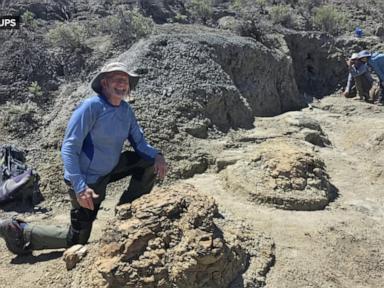
Kent Hups, a high school science teacher from Colorado spending his field time as a museum research associate, walked up to a weathered outcrop in the Hell Creek Formation. He spotted a subtle splash of reddish-brown rock breaking the monotonous gray and white sedimentary layers. Embedded in that stone were four massive, three-toed footprints stretching across a seven-meter path.
This was not just another isolated impression. It was the first-ever discovered adult T. rex trackway. Additional analysis by The Washington Post highlights similar views on the subject.
The Anatomy of a Rare Imprint
Footprint preservation requires a very specific geological accident. The mud must possess the precise moisture content to hold the shape of a multi-ton foot, followed by a gentle, non-destructive burial of fine sediment before wind or rain can erase the evidence. For a carnivorous dinosaur of this magnitude, the odds of leaving a continuous trackway are vanishingly small. Only two isolated T. rex footprints had ever been scientifically documented prior to this find—one in Montana, another in New Mexico.
A single footprint reveals a static moment. A sequence reveals behavior.
Working alongside paleontologists from the Denver Museum of Nature & Science, researchers utilized high-resolution three-dimensional surface scanning to map every millimeter of the discovery. Each print measures nearly a meter in length, featuring the characteristic slender digits and narrow heel geometry of a large tyrannosaurid. With a stride length measuring roughly four meters, the mathematical models began to paint a vivid picture of locomotion.
The animal was moving at a steady pace between 5.6 and 7.2 kilometers per hour. That translates to a brisk human walking speed. Far from charging at breakneck speeds across the floodplains, this apex predator was simply cruising.
Beyond the Hollywood Mythos
Popular culture has long obsessed over whether a human could outrun a T. rex. Action sequences often depict the predator moving like a sprinting flightless bird of prey, tearing through the brush at highway speeds. Biomechanical studies have frequently debated whether the massive skeletal frame of an adult tyrannosaur could even handle the structural stress of a full sprint without fracturing its own leg bones.
This trackway grounds the debate in empirical reality. By measuring the distance between consecutive left and right prints, researchers have concrete proof of how the animal shifted its weight during standard transit. It was energy-efficient, measured, and deliberate.
The Hell Creek Formation continues to serve as North America's final window into the Cretaceous world before the asteroid impact wiped the slate clean. Yet, major breakthroughs in this rugged terrain rarely come from high-funded corporate expeditions alone. They come from persistence, sharp observation, and amateur eyes looking closer at strange rock formations.
Preparation work is already underway at the Denver Museum of Nature & Science, where researchers hope to extract micro-details and potential skin impressions from the recovered fossil slabs. Every millimeter of preserved sediment brings us closer to understanding the physical reality of a vanished ecosystem, proving that the most profound discoveries often wait for the person willing to walk an extra mile in the dust.
Northglenn High School teacher makes colossal find in North Dakota
This video provides an on-the-ground look at the discovery and the physical scale of the North Dakota footprints.