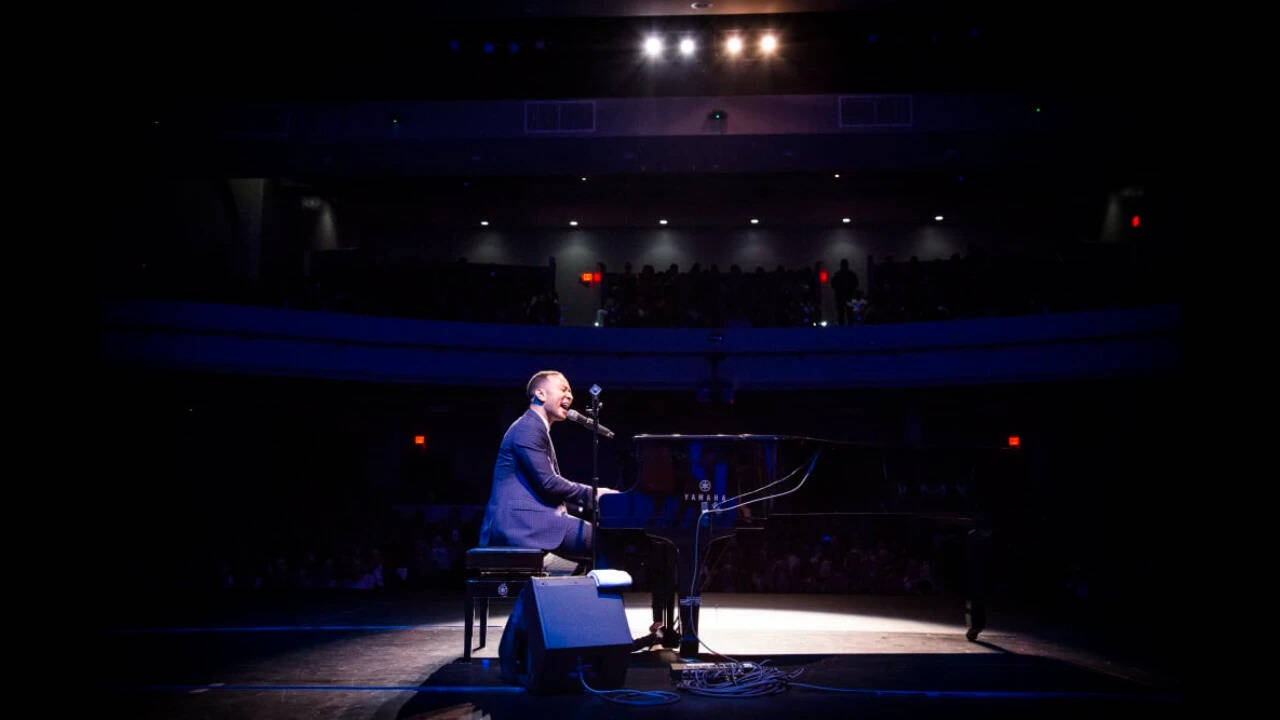
The smell of a high school auditorium after rehearsal is unmistakable. It is dust suspended in a single beam of work light, old wool curtains heavy with decades of Midwest humidity, warm resin from a violin bow, and the faint metallic tang of a microphone stand tightened one turn too many.
I spent enough of my own youth breathing that air to know how easily a teenager can feel invisible inside a building built for hundreds. You stand on scuffed maple boards while folding chairs echo back every misplaced breath. You wonder if the notes you are reaching for actually carry past the third row, or if they simply dissolve into the acoustic foam.
Then comes the kind of headline that looks small on a screen and feels enormous in a hallway. When John Legend donated $500,000 to give Ohio students a stage, a standard news brief might read like a ledger entry: celebrity gives half a million dollars, school arts program gets a boost, community celebrates.
Numbers are clean. Lives are messy.
A half-million dollars does not just buy lumber, rigging, or soundboard channels. It buys permission. It tells a kid growing up in an Ohio town—where factories hummed and shuttered, where budgets tighten around spreadsheets first and sheet music last—that their voice belongs under bright lights, not tucked into the margins of a school day.
The Quiet Cost Of Shrinking Rooms
Every school district has a story told through what gets cut first. When a budget squeezes, nobody holds a dramatic ceremony to announce that imagination is taking a hit. Instead, a choir accompanist's hours shrink. A theater department reuses the same three flats for four years in a row. A broken spotlight stays dark because replacing a bulb and climbing a ladder costs more than the district can spare.
Sometimes I wonder if adults underestimate how quickly a teenager reads those silences. Kids are sharp. They notice when the gymnasium doubles as a cafeteria, a pep-rally arena, and a makeshift theater all in the same week. They feel the friction of dragging a keyboard across concrete while varsity players wait for court time.
Let me offer a hypothetical scenario to make the stakes concrete. Picture Maya, a fictional tenth grader in a small Ohio town who has spent two years singing harmony in a cramped classroom with cinderblock walls and buzzing fluorescent tubes. Maya has a quiet, steady alto that makes people stop mid-sentence when she hits a bridge. Yet she has never sung into a monitor that actually feeds her own voice back cleanly, nor has she stood on a stage where the lighting cues match the emotional swell of a song.
In Maya's town, nobody hates music. Parents clap until their palms sting at winter concerts. Teachers stay late taping scripts together. Still, scarcity has a way of shrinking ambition before a kid even tries. If the room itself looks like an afterthought, it takes extra grit to believe your art matters.
That is the invisible stake behind a donation like John Legend's $500,000 gift to Ohio students. It is not merely about fixing hardware. It is about reversing the quiet message that creative kids only get "real" stages if they leave home, move to a coastal city, or somehow beat impossible odds on their own.
A stage is more than raised floorboards and velvet drapes. It is a physical promise that someone built a space expecting you to step into it.
Think of a stage as a magnifying glass for courage. When a student steps forward without a place to stand, their nerves stay locked inside their chest. When the floorboards are solid, the sound is clear, and the room is set for performance, fear does not vanish—it just has somewhere productive to go.
Why Home Roots Hit Different
John Legend grew up in Springfield, Ohio. That detail is not a throwaway biographical footnote; it is the gravitational center of the whole story.
When an artist who rose from Midwest roots to EGOT status—winning Emmy, Grammy, Oscar, and Tony awards—sends half a million dollars back toward students in his home state, the gesture carries a specific weight. He knows what it looks like to practice relentlessly when nobody in your zip code is handing you a record deal or a Broadway call sheet. He knows the gap between raw talent and professional polish.
Critics sometimes ask whether celebrity philanthropy is a band-aid on structural school funding. That is a fair question, and I do not pretend private donations replace steady public investment. Schools need reliable budgets year after year, not one-time windfalls that leave teachers scrambling once the grant money runs out.
Still, dismissing a major gift because it cannot solve every systemic flaw misses how momentum starts. Funding often moves in ripples. A half-million-dollar commitment can unlock matching community support, modernize technical theater gear that teaches students real-world stagecraft, and attract visiting artists who show kids what a working creative life actually looks like up close.
Consider what happens next:
A student who joins stage crew because a new lighting console arrives might discover a path into sound engineering, broadcast production, or live event management. Not every kid who steps near a stage wants to be a front-row singer. Some want to run the cue sheet. Some want to build sets. Some want to write the songs that other people sing.
That breadth is easy to overlook when headlines focus on a famous musician. Music and theater are collaborative ecosystems. One stage pulls dozens of different temperaments into the same orbit—the meticulous organizer, the restless dreamer, the shy kid who speaks clearest through a trumpet or a paintbrush.
The Invisible Curriculum Of The Spotlight
People outside the arts sometimes treat performance as extra fluff after "real" learning ends. Anyone who has ever stood backstage thirty seconds before curtain knows better.
Stagecraft is applied discipline. You have to memorize lines or lyrics so deeply that panic cannot erase them. You have to listen to the person beside you—really listen—so your entrance lands on the exact beat. If you rush a tempo or miss a cue, nobody can hit Ctrl+Z in front of three hundred people.
Mistakes happen. Voices crack. Prop doors stick.
And then the show keeps moving.
That recovery is one of the sharpest life skills a young person can learn. In a classroom, a rough day might mean a lower quiz score you can retake next week. On a stage, if your mic cuts out or your stomach knots up mid-verse, you learn how to breathe, adjust, and finish the phrase with poise.
Let us use a metaphor here, explicitly flagged as one: think of a student's confidence like a house foundation. Academics lay out the rooms, sports test how the walls handle wind, and the arts pour the concrete under the corners that are hardest to see. When a school invests in a real stage, it reinforces that foundation for kids who might otherwise feel unmoored.
Even students who never pursue a career in entertainment carry that training into adulthood. Presenting in a boardroom, pitching an idea, speaking up in a tense meeting, reading a room—all of it draws on the same muscle memory forged when you first stood under hot lights and held your ground.
What A Half-Million Dollars Actually Changes
Money alone does not sing a single note. Let us be honest about that. A check is just paper or wire numbers until human hands turn it into action.
So what shifts on the ground when a major gift targets student performance spaces in Ohio?
First, dignity shifts. Walk into a renovated or well-equipped space and you feel cared for. Better acoustics mean students do not have to strain their vocal cords just to be heard over chatter. Proper rigging and lighting mean young technicians learn safe, modern equipment rather than jerry-rigged relics.
Second, expectation shifts. When a community sees a high-profile artist invest seriously in local youth, adults pay closer attention. Parents who once viewed band or drama as a harmless pastime start seeing a serious training ground. Local businesses and alumni often step up alongside high-profile donors when they see tangible progress.
Third, possibility widens for kids who have never left their county line. A kid in Ohio might scroll past videos of giant arenas and polished studios every evening on a phone, feeling miles away from any real entry point. Having a legitimate stage down the hall bridges part of that distance. It turns a distant dream into a concrete next step: audition for the spring musical, run sound for the ensemble, write an original piece for the showcase.
I still remember the first time I stood on a stage where the sound mix felt warm and balanced instead of harsh and hollow. My shoulders dropped an inch I did not even realize I had been holding up. Suddenly I could focus on phrasing and feeling instead of fighting the room.
Multiply that feeling across hundreds of students over years of classes, rehearsals, and opening nights. That compound interest is harder to measure on a balance sheet than $500,000, yet it is the exact reason people keep fighting for school arts programs.
The Curtain Rises On What Comes Next
No single check settles the future of arts education. Budgets will keep tightrope-walking. Towns will keep debating priorities. Some kids will still struggle with stage fright, self-doubt, or tough home lives that follow them right up to the dressing room door.
Yet every time a space opens up where young voices can ring out clearly, the odds tilt slightly toward wonder. A kid who once mumbled in the back row steps forward. A spotlight clicks on.
Somewhere in Ohio right now, a teenager is humming a melody under their breath between classes, not quite knowing yet what a real stage will feel like beneath their shoes.