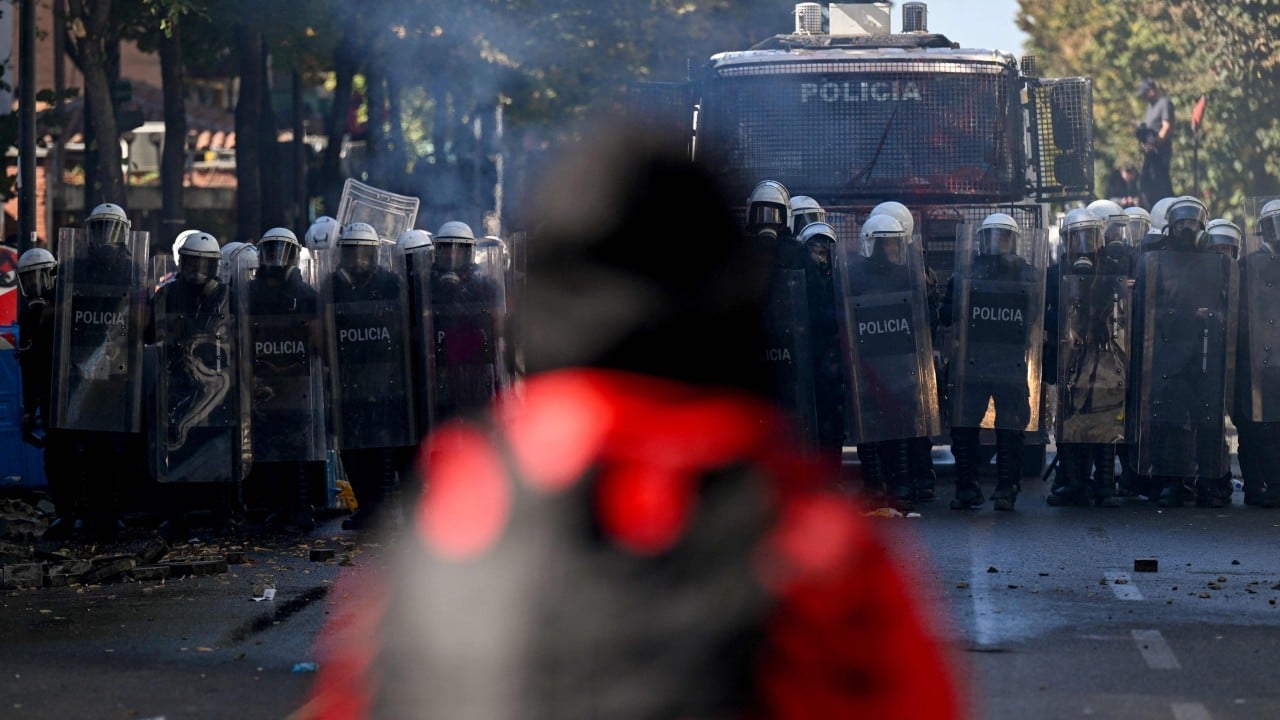
The sound of a rubber round hitting concrete is sharper than people expect. It does not ring out like a brass rifle cartridge, clean and metallic, nor does it thud softly like a beanbag dropped from a pantry shelf. It cracks. It snaps against stone and skin with a dry, percussive violence that makes birds lift off plane trees and sends twenty-year-olds scrambling backward with notebooks still clutched against their chests.
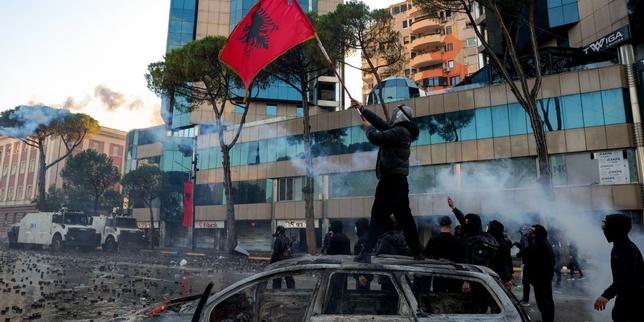
On a boulevard in Tirana, smoke from dispersing canisters curls around autumn leaves while chants rise again from behind a line of shields. Students are calling for the prime minister to step down. Police are firing rubber bullets to push the crowd back from government buildings. On a wire feed, that reduces to a single clean sentence: Albanian police fire rubber bullets as student protesters call for PM to quit.
Short. Tidy. Easily scrolled past between a recipe and a quarterly earnings summary.
Yet headlines like that are doors left half-ajar. Walk past them, and you miss the weight behind the glass. Step inside, and you start hearing what a crowd is actually saying when it stands in front of armored vests with nothing between its ribs and the pavement except shared anger and a refusal to pack up and leave.
I have stood near enough to street clashes in the Balkans and neighboring capitals to know the smell that lingers after the first volley. It is not cinematic. It is acrid tear gas mixed with damp wool, cheap espresso from plastic cups, and the sharp copper tang of stress sweat on young necks. You watch eyes water behind clear lenses. You see a student who came out at noon thinking she would hold a cardboard sign for two hours suddenly calculating how fast she can run in sneakers that were never meant for sprinting away from riot gear.
Sometimes, when a story moves this fast, it helps to step back and look at what happens in ordinary lives before the cameras arrive. The following scene is a hypothetical composite built to illustrate how grievances gather in a family long before they hit the asphalt.
Picture Arben, twenty-one, studying history and political science in Tirana, sitting at a kitchen table that wobbles on one leg. His mother, Lindita, works long hours for wages that stretch thin before the third week of the month. His older cousin left for Germany two years ago, sending home money that helps cover rent and groceries while promising, on every Sunday video call, that things look better from Frankfurt than they do from a cramped apartment in a city where prices climb faster than entry-level pay. Arben loves his country with the fierce, complicated love of someone who grew up on stories of endurance—who knows the weight of past isolation, the hope of European integration, and the sting of watching young friends pack suitcases because staying feels like volunteering for stagnation.
When Arben walks toward the protest line, he is not carrying a grand manifesto written in a back room. He is carrying frustration that has been marinating for months: tuition and living costs that squeeze families, frustration over governance and accountability, a sense that promises of reform move at a glacial crawl while everyday bills sprint ahead. When students demand that a prime minister resign, they are rarely asking for a single signature on a piece of paper. They are asking for a reckoning. They are asking who answers when the social contract feels frayed.
Why "Less-Lethal" Rarely Feels Gentle on the Street
People who have never stood ten paces from a crowd-control line often hear the phrase rubber bullet and picture something bouncy, almost toy-like. A comforting illusion.
Think of a rubber projectile like a heavy skipping stone thrown hard across water. On a calm pond, the stone skips cleanly and loses energy with every hop. Hit a jagged rock or a child's ankle at the wrong angle, and the physics turn unforgiving fast. Rubber-coated or solid elastomer rounds used in riot control are engineered to transfer kinetic energy without penetrating like a lead slug—yet at close range, or when aimed carelessly, or when striking eyes, throats, or temples, they cause severe bruising, fractures, ruptured globes, and life-altering trauma. Medical researchers and human rights monitors across multiple countries have documented for years that "less-lethal" does not mean harmless. It shifts the odds; it does not erase danger.
Consider what happens next in the heat of a standoff:
A line of officers faces hundreds of shouting citizens. Orders crackle over radios. Tension builds in calves and jaws. Some protesters throw stones or bottles; others sit cross-legged or chant through megaphones, demanding accountability from the government. Once projectiles fly from either side, nuance evaporates in seconds. A commander worries about a breached perimeter. A student worries about a friend clipped in the ribs. Everyone is reacting to fear and adrenaline, and fear has terrible aim.
That is why street clashes between students and state security carry such high political temperature in countries like Albania. Young people in the streets are not an abstract interest group like a trade association negotiating tariffs behind closed doors. They are daughters and sons. When footage circulates of university students running from rubber rounds or batons, the shock ripples straight into living rooms where parents had just finished dinner. Even citizens who distrust opposition politicians or worry about property damage often feel a sudden cold knot in their stomachs when state force lands on twenty-year-olds.
The Invisible Stakes Behind Every Chanted Slogan
To understand why student-led calls for a prime minister's resignation resonate far beyond a single afternoon in Tirana, you have to look at what is at stake beneath the noise.
In democracies—and in democracies still wrestling with institutions, corruption perceptions, economic migration, and political polarization—protests are a barometer. When young people flood the streets, they are signaling a breakdown of trust. Trust is like mortar between bricks. You barely notice it when the wall is sound, and every draft tells you where it is crumbling when the wind picks up.
Students occupy a strange, powerful position in public life. They have less to lose than middle-aged workers paying mortgages, yet they have the most years ahead of them to live with the consequences of today's decisions. If graduates look at the job market, housing costs, healthcare quality, or public institutions and conclude the game is rigged against merit and fairness, that conclusion shapes a whole generation's horizon. Some stay and fight in the streets. Others quietly decide their real future begins at an airport gate.
At the same time, governments facing mass demonstrations rarely see them in a vacuum. Leaders and officials argue that public order matters, that roads and ministries cannot simply be occupied at will, and that violent clashes cross a line from lawful dissent into disorder. That clash of priorities—the right to protest and demand political change versus the state's mandate to maintain order—is ancient, messy, and unresolved in almost every country on earth. No constitutional textbook makes that friction disappear on a rainy Tuesday.
I will admit something candidly: watching these confrontations unfold from afar—or even reporting near them—can leave you feeling unsettled and occasionally at a loss for tidy answers. You see genuine passion on one side and real state machinery on the other, and you know that slogans rarely fix broken systems overnight, just as batons and rubber rounds never build civic trust. If you look at a crowd demanding a prime minister quit and feel torn between sympathy for angry youth and wariness of street chaos, you are not alone. That tension is real.
History Has a Long Memory in the Balkans
You cannot read a street clash in Tirana without feeling the long shadow of history under your shoes.
For decades during the twentieth century, Albania lived under one of Europe's most rigid, isolated authoritarian regimes, where dissent was crushed and outside contact was heavily policed. After communism collapsed in the early 1990s, millions of people suddenly had to learn democracy, market economics, and open borders all at once—often amid severe economic shock, political turmoil, and painful growing pains.
Because that history is recent enough that parents and grandparents lived through it, freedom of assembly and the right to challenge leaders carry a particular charge. People know what silence looked like. They also know how fragile institutions can be when politics turns into a zero-sum battle where every election and every street protest feels existential.
Over the past three decades, Albania has made unmistakable strides in modernizing its economy, building ties with European partners, and drawing visitors to its dramatic coastline and mountain towns. Yet progress in outward appearances does not automatically heal every domestic grievance. When students take to the streets demanding a prime minister's resignation, they are testing whether democratic accountability is strong enough to hear harsh criticism without reaching for force.
What the Camera Captures—and What It Misses
A photograph of a police officer raising a launcher or a protester raising a fist freezes a fraction of a second. It is dramatic. It travels fast on social media. It tells you what collided in that frame, though rarely why those two people ended up facing each other.
Behind every uniform is a person on a shift schedule, likely under pressure from above, perhaps worrying about rocks flying toward their face or wondering how long the deployment will last. Behind every placard is a person with a name, a family group chat blowing up with anxious messages, a thesis deadline or a part-time shift waiting tomorrow, and a conviction that staying quiet will not fix what feels broken.
When force enters that equation—especially rubber bullets, which sit in that gray zone between deterrence and severe injury—the stakes jump immediately. A single serious injury can turn a tense demonstration into a rallying cry that pulls thousands more people off the sidewalks. Conversely, restraint and de-escalation can lower the temperature even when the political demands remain sharp.
The core tension of the story does not vanish when the smoke clears from the boulevard. Students want sweeping political change and a prime minister out of office; authorities move to contain unrest and hold the line; families watch anxiously, hoping nobody ends up in an emergency room or a police station.
A young protester washes tear gas from her eyes at a street corner fountain, tilting her face toward cold water while distant sirens rise and fall across Tirana.