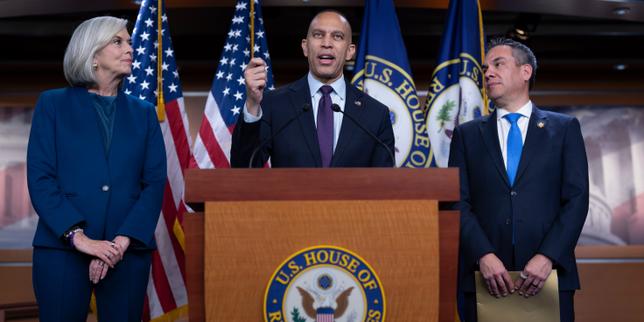
Democrats secured roughly 258 to 259 House seats in the November 2026 midterm elections—their largest sweep since 1992—and nominated Hakeem Jeffries on November 18, 2026, to become the first Black Speaker of the United States House of Representatives when the 120th Congress convenes on January 3, 2027. Winning the gavel is not a ceremonial crowning; it is an institutional stress test where symbolic representation meets razor-thin procedural levers, ideological friction, and divided-government friction.
Conventional coverage frames Jeffries's likely elevation as an inevitability driven by historic demographics and wave-election momentum. That framing misses the structural mechanics of the speakership. A Speaker does not rule by title alone. Control depends on vote math on the floor, agenda control through the Rules Committee, committee gavel allocation, and the ability to hold together a sprawling coalition ranging from swing-district moderates to democratic socialists.
The Four Pillars of Speakership Viability
To evaluate whether Hakeem Jeffries can govern effectively as Speaker rather than merely hold the title, we can break the role down into four operational pillars: Coalition Breadth, Floor Arithmetic, Agenda Gatekeeping, and Executive Friction.
- Coalition Breadth: A massive majority—projected near 258 to 259 seats—gives a Speaker cushion against defections, yet it also widens the ideological spread inside the caucus. Members elected in conservative-leaning or purple districts face different electoral incentives than safe-seat members from urban centers like Brooklyn.
- Floor Arithmetic: Under House rules, winning the Speaker's election on opening day requires a majority of votes cast for a named candidate—typically 218 votes when all 435 seats are filled and voting. Even with a large nominal majority, absences, illness, or protest votes compress the margin for error on contested bills.
- Agenda Gatekeeping: The Speaker sets the legislative calendar by working with party leadership and controlling committee assignments and floor scheduling. Controlling what reaches the floor determines which fault lines become public votes.
- Executive Friction: A Democratic House facing a Republican executive branch or Senate confronts statutory vetoes, budget standoffs, oversight subpoenas, and impeachment debates. Every bill must balance partisan messaging with constitutional reality.
The first bottleneck Jeffries faces occurs before a single policy bill is debated: turning a large caucus nomination into a floor majority on January 3, 2027. In the November 18 caucus vote, Jeffries won 251 of 262 votes cast, with 11 Democrats voting against him. That opposition signals that internal dissent has not vanished despite the electoral wave.
Cause and Effect in Caucus Management
Superficial commentary treats party unity as a personality trait or a product of disciplined messaging. In legislative politics, unity is an incentive structure. When a party holds a narrow majority—such as the 222–213 Republican majority after 2022—small blocs of dissenters hold outsized leverage to extract concessions or stall floor votes. A wave majority like 258–259 seats reduces the leverage of any single faction on routine quorum calls, yet it creates a different risk: overconfidence and centrifugal pull.
Consider the cause-and-effect chain across three pressure points identified in post-election analysis: healthcare policy, Israel, and military conflict involving Iran.
- Foreign Policy Divides: Sharp disagreements over Israel and escalation with Iran cut across generational and ideological lines within the Democratic coalition. If leadership brings non-binding resolutions or war-powers measures to the floor without prior whip counts, public fracture lines widen in front of voters and donors.
- Healthcare and Domestic Spending: Broad wave coalitions often include candidates who campaigned on lowering out-of-pocket costs alongside members pushing structural overhauls. A bill that satisfies progressive spending targets may alienate swing-district members who must defend fiscal discipline in 2028.
- Oversight and Impeachment Pressure: Base voters and activist wings frequently demand aggressive investigations or impeachment articles against a rival president. Yet pursuing high-profile impeachments without Senate conviction prospects can consume floor time and risk voters' focus on cost-of-living issues.
The second limitation of a large majority is signaling complexity. In economics, principal-agent friction occurs when an agent (a lawmaker or party leader) must satisfy multiple principals (local constituents, national donors, and caucus factions) whose preferences conflict. A Speaker acts as a clearinghouse among these competing principals. Bringing a bill to the floor is a costly signal: if it passes with zero Republican support and loses twenty Democrats, it exposes weakness; if it never reaches the floor, activists accuse leadership of timidity.
Known Facts vs. Educated Hypotheses
Separating verified institutional facts from analytical projections prevents misreading early post-election coverage.
Known Facts:
- Hakeem Jeffries has represented New York's 8th Congressional District since January 3, 2013, and became House Democratic leader in the 118th Congress.
- In the November 3, 2026 midterm elections, Democrats won roughly 258 to 259 House seats, marking their largest House seat gain since 1992.
- On November 18, 2026, House Democrats formally nominated Jeffries for Speaker for the 120th Congress, receiving 251 votes out of 262 cast, with 11 against.
- The formal floor vote for Speaker of the 120th Congress is scheduled for January 3, 2027.
Educated Hypotheses:
- Jeffries is likely to prioritize disciplined, incremental legislative packages and committee oversight over sweeping partisan roll-call traps that force vulnerable moderates into difficult votes.
- Progressive lawmakers who opposed him in the November caucus vote are likely to test his willingness to grant committee slots, amendment votes, or floor hearings on foreign policy and healthcare rather than mount a floor defection that could complicate his election.
- If divided government persists across the executive and legislative branches, the House majority's primary legislative leverage will center on appropriations riders, oversight subpoenas, and public messaging rather than unilateral enactment of major domestic laws.
The Cost Function of Legislative Strategy
Every legislative choice carries an opportunity cost measured in floor time, political capital, and electoral exposure. During the 118th and 119th Congresses, House Republicans experienced repeated floor bottlenecks and leadership turnover when small factions used procedural motions to block bills or challenge the chair. Jeffries's organizational background—including serving as House Democratic Caucus chair starting in 2019 and leading the minority through high-stakes shutdown and leadership battles—shaped a cautious, process-heavy management style.
Yet caution carries its own cost function. If a large majority moves too slowly or avoids contentious debates entirely, restless factions may use discharge petitions or media pressure to force issues into the open. Conversely, if leadership rushes partisan messaging bills to the floor just to score headlines, swing-district members bear the electoral cost in 2028.
Operational Playbook for Governing a Wave Majority
Turning a historic nomination into durable legislative control requires disciplined execution across four concrete steps:
- Run Early Whip Audits Before Scheduling: Require committee chairs to verify vote counts across both moderate and progressive caucuses before placing contested bills on the floor calendar. Never treat a 258-seat cushion as a substitute for coalition building.
- Segment Oversight From Core Economic Legislation: Keep appropriations, healthcare affordability measures, and infrastructure implementation on a steady procedural track while ring-fencing high-friction oversight or impeachment inquiries so they do not crowd out must-pass legislation.
- Use Committee Hearings to Channel Factional Energy: Grant dissenting or progressive members visible oversight hearings and markup opportunities on priorities like healthcare and foreign policy so grievances are aired inside committees rather than through floor rebellions.
- Calibrate Messaging to Divided-Government Realities: Set clear expectations with voters and party activists about what a House majority can pass unilaterally versus where bicameral or executive negotiation is required, avoiding overpromising outcomes that depend on another branch of government.
No procedural playbook eliminates ideological conflict inside a 258-member caucus. Historic representation opens the door to the rostrum, but enduring authority as Speaker will depend on how tightly Jeffries manages floor arithmetic, channels internal dissent, and converts a sweeping midterm wave into measurable legislative leverage starting in January 2027.


