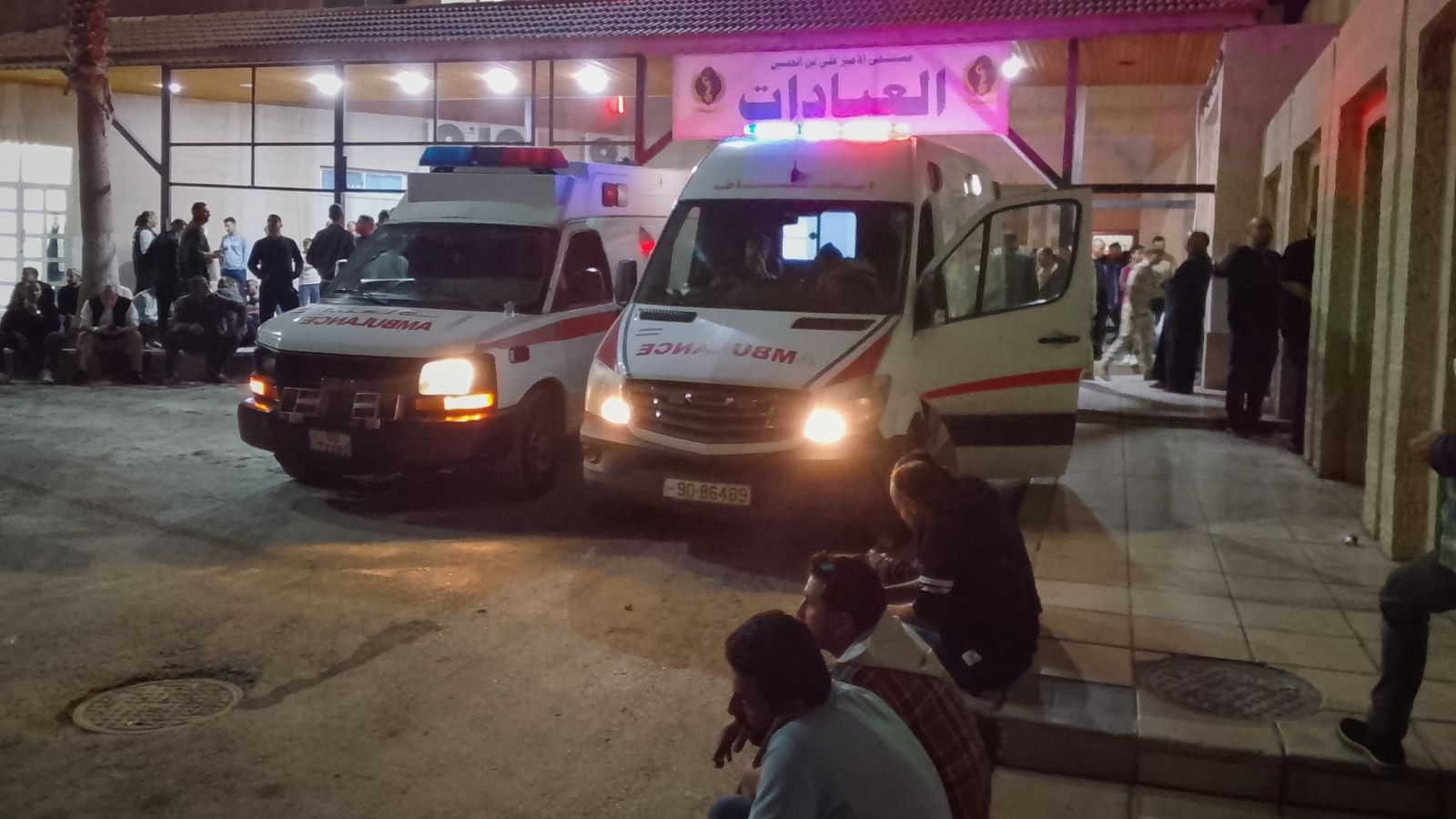
Silence.
In the middle of a funeral, silence is not an absence of sound; it is a physical weight, pressed down onto the shoulders of every person sitting in the wooden pews, heavy with incense, low sobs, and the quiet shuffling of black-clad mourners trying to say goodbye.
Then the glass shatters.
Surveillance cameras do not feel grief. Mounted high on the stone walls of a church in Jordan, a lens simply records pixels changing color in real time, capturing the exact millisecond when three armed men step into the frame and turn a house of mourning into a slaughterhouse. Seven people died that day. Dozens of lives were fractured permanently in the span of a few breathless seconds. When you read a standard news wire about a church attack in Jordan, those seven souls are compressed into a single digit, tucked neatly behind a semicolon in a headline designed for rapid scrolling.
Look closer at the footage, though, and the numbers dissolve into something unbearable.
The Architecture of a Broken Afternoon
To understand what happened inside that sanctuary, you have to strip away the sterile distance of a police blotter and step into the shoes of someone sitting in the third row. Let us call him Tariq—a hypothetical composite drawn from the testimonies of survivors who have lived through sudden, targeted violence in places meant to be untouchable.
Tariq is there because his neighbor’s father passed away after a long illness. His biggest worry when he walked through the heavy timber doors that morning was whether he had parked too far down the narrow street, or whether he would have time to pick up his daughter from school before traffic clogged the main roundabout. He smelled frankincense. He heard the familiar cadence of ancient liturgical chants bouncing off limestone walls that have stood for generations.
In the Middle East, a funeral is never a private affair. It is a communal covenant. Neighbors of every background show up to stand shoulder-to-shoulder with the bereaved, offering their physical presence as a shield against loneliness. A church during a funeral is supposed to be the safest room in the city—an unspoken truce zone where even bitter rivalries pause at the threshold out of respect for the dead.
That is why nobody flinched when the footsteps echoed near the entrance.
Three figures appeared on the closed-circuit feed. They did not hesitate, and they did not shout demands. Raising their weapons, they opened fire directly into the congregation.
Panic moves through a crowded room like water hitting hot oil. Pews that were designed for quiet reflection suddenly became obstacles to scramble over. Elderly men who had walked in leaning on canes were dragged behind stone pillars by younger cousins. Mothers threw their bodies over children on the cold tile floor, listening to the deafening crack of gunfire echoing off vaulted ceilings that were engineered to amplify prayers, not rifle rounds.
Within moments, seven people lay motionless on the stone floor. The gunmen vanished back into the street, leaving behind the acrid sting of cordite mixed with melting beeswax candles.
Why Surveillance Footage Lies to Us
We live in an era obsessed with video proof. Whenever tragedy strikes, authorities release the CCTV clip, media outlets loop the grainy frames on evening broadcasts, and millions of viewers watch the horror unfold from the safety of their kitchen tables.
Watching that footage gives us the illusion of comprehension. We see the three gunmen enter. We see the muzzle flashes. We see the crowd scatter. We think we know what happened because we saw it with our own eyes.
We are wrong.
A security camera operates like an autopsy report: it tells you the exact mechanism of death while revealing nothing at all about the life that was extinguished. It cannot capture the ten years a grandmother spent saving money to send her grandson to university in Amman. It cannot record the quiet inside joke shared between two brothers five minutes before the doors burst open. Most dangerously, a silent video clip tricks the human brain into treating an act of profound moral collapse as an inevitable, mechanical event—just another violent blip on an endless news ticker.
When I first studied violent incidents across the Levant years ago, reviewing case files and speaking with families left behind in the aftermath of public shootings, one pattern stood out above every tactical analysis. Survivors rarely talk about the gunmen first. They talk about the threshold. They talk about the exact moment their brain refused to accept that the sound they were hearing was gunfire, because gunfire belonged to another universe—not the room where their cousin was baptized, not the aisle where their sister was married.
That cognitive freeze is not weakness. It is the hallmark of a civilized society suddenly ambushed by barbarism.
The Fragile Truce of Ordinary Life
Jordan has long occupied a unique, precarious position in a turbulent neighborhood. Bordered by regions scarred by decades of civil war, insurgency, and sectarian fracture, the Hashemite Kingdom built its national identity on a deliberate, hard-won stability. In cities like Amman, Madaba, and Karak, church bells and the call to prayer have coexisted on the same city blocks for centuries, weaving a shared social fabric that Jordanians fiercely protect.
Because of that reputation for calm, an attack on a Jordanian church carries a shockwave that travels far beyond the immediate casualty count.
Think of a community’s sense of safety like a pane of tempered glass. Under normal circumstances, it is remarkably strong, capable of absorbing the everyday bumps and frustrations of economic strain, regional anxiety, and political debate without cracking. People go to work. Children walk to school. Families gather on Fridays and Sundays to bury their elders and celebrate their newborns.
Targeted violence at a funeral is a diamond-tipped hammer struck directly at the center of that glass. It does not just break the point of impact; it sends a spiderweb of fractures racing all the way to the edges of the frame.
When gunmen choose a funeral, they are making a cold, calculated statement. They are declaring that no ritual is sacred, no grief is off-limits, and no boundary will be honored. The invisible target is never just the seven people who fell on the church floor. The real target is the trust between neighbors. The killers want every citizen walking past a house of worship the next morning to hesitate, to glance over their shoulder, to wonder whether gathering in public is worth the risk.
Questions Carved Into Stone
In the hours and days after the CCTV footage circulates, a predictable wave of questions rises from the public, spoken in hushed tones over bitter coffee in living rooms across the country.
People ask how three armed men could approach a crowded gathering unnoticed. They ask whether the shooting was driven by extremist ideology, a localized blood feud spiraling out of control, or a deliberate attempt to ignite sectarian tension where none existed before. They want to know what security forces are doing to track down the perpetrators, and whether tightening guards outside churches and mosques will turn places of peace into armed fortresses.
Each of these questions reflects a deeper, unspoken fear: Could this happen when I bury my own father?
Security experts and local investigators immediately dissect the trajectory of the bullets, the make of the weapons, the escape route caught on neighboring storefront cameras, and the digital footprints left behind by the attackers. Those investigations matter. Accountability is the bedrock upon which public faith is rebuilt; without swift, transparent justice, rumors fill the vacuum and poison the streets.
Yet even when the perpetrators are identified, cornered, and brought before a court, a stubborn truth remains. Police checkpoints can deter an attack, and intelligence networks can dismantle cells before they strike, but no state apparatus can station an armed guard inside every room where human beings gather to weep.
What Survives the Smoke
Walk into that church a week after the forensic teams have packed up their evidence markers and the stone floors have been scrubbed clean, and you will witness something no surveillance camera knows how to measure.
You will see the chairs set back in straight rows.
In the aftermath of sudden, senseless bloodshed, the most radical act available to ordinary people is refusal—the stubborn, quiet refusal to abandon the rituals that make them human. Across Jordan, whenever violence has threatened to drive communities behind locked doors, the response has repeatedly defied the expectations of those who sow terror. Neighbors of different faiths show up in larger numbers at the next memorial. Blood donation lines stretch around hospital blocks within hours of an emergency broadcast. Families refuse to let fear dictate how they honor their dead.
Consider what happens next in our hypothetical survivor’s life.
Tariq goes home that evening with dust on his shoes and a ringing in his ears that will not fade for days. He hugs his daughter longer than usual at the front door, saying nothing about the blood on the limestone tiles three miles away. For weeks, every slamming car door makes his shoulders stiffen. Every time he passes a church or a mosque, his eyes instinctively scan the street corners for three men walking too fast.
And yet, when another neighbor passes away six months later, Tariq irons his dark shirt, walks down the street, and steps back across that threshold.
He goes because staying home would mean handing the keys of his city to three men with rifles. He goes because grief shared is the only antidote to terror ever invented.
Seven names were added to the cemetery rolls after that afternoon, each representing an unfinished story, a vacant chair at a Friday dinner table, a voice that will never again rise in song beneath those stone arches. The CCTV footage will remain archived on a hard drive somewhere, a cold, grainy record of three men who believed that pulling a trigger could erase a community.
They captured seven lives on that tape. They missed everything else.