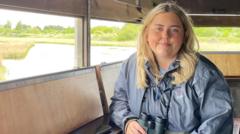
Maya is twenty-four, and her neck aches. It is a specific, modern ache born from the habitual tilt of the head toward a glowing rectangle. Every morning, before her eyes even fully adjust to the light, she checks her notifications. The digital world is loud, demanding, and perpetually on fire. By 9:00 AM, she has already processed three global crises, four targeted advertisements, and a dozen curated photos of people she hasn't spoken to since high school. It is exhausting. It is a treadmill with no "off" switch.
Then, she bought a pair of secondhand binoculars.
The trend reports call this a "demographic shift in avian interest." They cite statistics about the rising membership in the National Audubon Society among those under thirty. They talk about the "gamification" of nature through apps like eBird and Merlin. But these dry data points miss the heartbeat of the movement. Gen Z isn't just looking at birds because an algorithm told them to. They are looking at birds because they are starving for something that doesn't require a login.
The Analog Resistance
The marsh at dawn is cold. It doesn't care about your aesthetic. It doesn't have Wi-Fi. For someone like Maya—a hypothetical but very real representation of her generation—the silence of a nature reserve is initially terrifying. We are used to a constant stream of "content." In the woods, content is replaced by presence.
There is a specific tension in waiting for a bird to appear. It is the opposite of a TikTok scroll. On a screen, if you are bored for a microsecond, you flick your thumb and the world changes. In a bird blind, if you get bored, you have to sit with that boredom. You have to breathe through it. And then, something shifts. Your ears start to tune out the distant hum of the interstate. You begin to hear the difference between the wind in the pines and the wind in the oaks.
This is the hidden stake of the birdwatching craze: the reclamation of the human attention span.
Small Weights and Feathered Stakes
Consider the physical reality of a bird. A Goldcrest weighs about the same as a nickel. It is a tiny, fragile pulse of life that has traveled thousands of miles, guided by the stars and the magnetic pull of the earth, just to land on a specific branch in a specific swamp. When Maya finally spots one, she isn't just "viewing wildlife." She is witnessing a miracle of physics and endurance that makes her own daily stressors—the unread emails, the rent hikes, the social media posturing—feel suddenly, blessedly small.
The "why" behind the migration to reserves is often framed as a hobby, but it functions more like a radical act of mental health preservation. Statistics from the U.S. Fish and Wildlife Service show that birding is one of the fastest-growing outdoor activities, but for the younger crowd, it’s a form of "soft fascination." This is a psychological term for an environment that captures your attention without draining your energy.
Screens offer "hard fascination." They grab you by the throat and demand focus. Nature asks for your attention gently. It invites you to notice the blue-grey smudge of a Nuthatch spiraling down a trunk. It doesn't punish you if you look away, but it rewards you deeply if you stay.
The Community of the Quiet
There is a misconception that birding is a solitary, lonely pursuit for the retired. Watch a group of twenty-somethings at a local reserve, and you’ll see a different story. They aren't talking much. They are communicating in whispers and pointed fingers. There is a profound, low-stakes intimacy in sharing a sighting.
"Did you see the Harrier?"
It’s a question that requires no backstory. It doesn't matter what your job is or how many followers you have. In that moment, you are both just two humans acknowledging a raptor. This is the "invisible synergy" the business journals fail to capture. It is a community built on shared observation rather than shared opinion.
The rise of apps like Merlin has certainly lowered the barrier to entry. In the past, you needed a mentor or a heavy field guide to know what you were looking at. Now, you can record a sound on your phone, and the AI (ironically) tells you exactly who is singing. But the phone is just the gateway. Once the bird is identified, the phone usually goes back into the pocket. The bird remains.
The High Cost of the View
We have to talk about the reality of the land. Gen Z is the first generation to grow up with the "climate clock" ticking loudly in the background of every life decision. For them, visiting a reserve isn't just a weekend trip; it is a pilgrimage to a disappearing world.
There is a grief attached to modern birdwatching. You learn the names of the birds just as you learn how many of them are vanishing. According to a landmark study published in Science, North America has lost nearly three billion birds since 1970. That is a staggering decline. When Maya looks through her binoculars, she is seeing survivors.
This creates a sense of urgency that didn't exist for previous generations. For a boomer, birding might have been about ticking a species off a life list. For a Gen Zer, it is often about witnessing a species while it still exists. The stakes are existential. The reserve is a fortress against a world that is becoming increasingly paved and predictable.
A Different Kind of Wealth
The shift toward birding reflects a broader move away from "stuff" and toward "states of being." You cannot own a bird. You cannot control it. You can only be where it is.
Imagine the feeling of finally seeing an Indigo Bunting. It is a blue so intense it looks like it was photoshopped into the forest. It feels like a secret meant only for you. In a world where everything is recorded, re-shared, and monetized, that unmediated moment is the ultimate luxury.
Maya realizes she hasn't checked her phone in three hours. Her neck doesn't ache. The tension in her shoulders, which she usually carries like a suit of armor, has evaporated. She is tired, but it is a "good" tired—the kind that comes from sun and wind rather than blue light and anxiety.
She watches a Great Blue Heron stand perfectly still in the reeds. It is a masterclass in patience. The heron isn't worried about its personal brand. It isn't trying to optimize its morning. It is simply waiting for the right moment to strike.
The heron moves. A flash of silver. A successful hunt.
Maya walks back to her car as the sun begins to dip. She knows that tomorrow the digital noise will return. The emails will be there. The headlines will be just as grim. But she carries the image of that blue-grey bird in her mind now. She has seen something real, something ancient, and something that doesn't need her for validation.
She drives away, and for the first time in weeks, she doesn't turn on the radio. She just listens to the wind.
The birds are still there, even when we aren't looking. But it’s much better when we are.