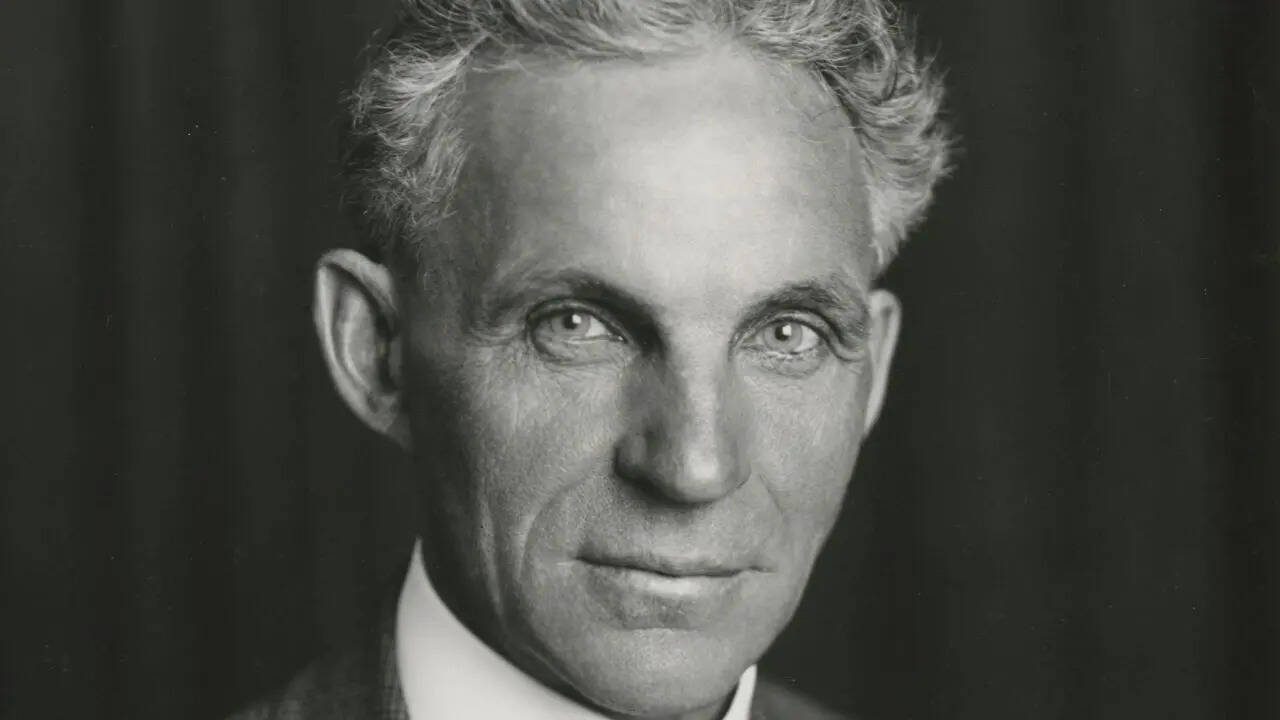
The rain in Detroit doesn’t just fall; it bleeds into the pavement, turning the asphalt into a slick, grey mirror that reflects nothing but old brick and heavy smoke. It was October 1942. Inside the walls of the Ford Motor Company, the atmosphere was just as suffocating. The assembly lines weren’t churning out sleek V8 coupes anymore. They were building B-24 Liberator bombers.
An engineer sat at a mahogany desk, his knuckles white against a stack of blueprints. His name was Arthur. That is a hypothetical name, but his problem was entirely real, shared by thousands of workers who poured their sweat into the concrete floors of Willow Run. The blueprints demanded a level of precision that felt impossible. Machining parts to tolerances of less than a thousandth of an inch, at a scale the world had never seen, while the sky over Europe was burning.
Arthur’s hands shook. He didn’t believe the factory could meet the quota. He had checked the math. He had reviewed the supply chain bottlenecks. Intellectually, his mind said no.
A shadow fell over the desk. Henry Ford, aged and slowing but still possessing eyes that could drill through armor plate, looked down at the paper. He didn’t offer a pep talk. He didn’t quote Scripture or hand out an inspirational pamphlet. He just tapped a calloused finger on the blueprint and said something that would take Arthur decades to truly understand.
Most people think that faith means believing something. It doesn't. Oftener it means trying something.
We have turned faith into a psychological soft cushion. We treat it like an intellectual contract: you look at a set of facts, you decide they are agreeable, and you give them your mental assent. You sit in a chair, convinced the chair will hold you.
But that isn't faith. That is just passive agreement. Real faith is the terrifying moment your feet leave the floor.
The Trap of Intellectual Assent
Look at how we live now. We are drowning in data, paralyzed by the need for certainty before we take a single step. We scroll through endless case studies, cross-reference reviews, and wait for the perfect alignment of market conditions before we launch the business, write the book, or fix the broken relationship.
We tell ourselves we just need to believe in the vision first.
This is a lie. It is a defense mechanism disguised as wisdom.
Consider a modern counterpart to Arthur. Let’s call her Sarah, a mid-level software manager in Austin. For three years, she has harbored an idea for a decentralized supply chain platform. She has the expertise. She has the market data. Every night, she sits at her kitchen table, staring at a glowing monitor, trying to build up the "faith" to quit her stable corporate job and dive in. She reads biographical profiles of founders. She looks for signs. She wants to feel 100% certain that the venture will succeed before she signs the incorporation papers.
Sarah is trapped in the modern heresy of belief. She thinks faith is a feeling of confidence that precedes action.
If Henry Ford walked up to her kitchen table, he would tell her she has the equation entirely backward. The confidence she is looking for does not exist in the vacuum of contemplation. It is a byproduct of friction. You do not build a bridge by staring at the river until you are emotionally convinced it can be crossed. You build it by driving the first pile into the mud.
The Cold Anatomy of Action
When Ford spoke about trying, he wasn't talking about reckless gambling. He was a mechanic at heart. He understood the physics of momentum.
Think about the first time you tried to ride a bicycle. You didn't sit on the curb, read a manual on angular momentum, and suddenly achieve an internal epiphany of balance. You got on the seat. Your knees wobbled. Your heart hammered against your ribs. You fell into the gravel, scraped your palms, and cursed the two-wheeled contraption.
The faith wasn't in the belief that you wouldn't fall. The faith was in the restarting. It was the willingness to place your feet back on the pedals while your hands were still bleeding.
The human brain is wired to avoid this specific type of discomfort. Neurologically, uncertainty registers in the same regions of the mind as physical pain. When we face an unproven path, our amygdala screams at us to retreat to the familiar. To combat this, we try to think our way out of the fear. We plan. We optimize. We hold meetings to plan the next meeting.
But execution has a logic that planning can never replicate. When you actually try a thing—when you write the first terrible line of code, when you make the cold call that ends in a dial-tone, when you show up at the gym when you are exhausted—something shifts. You move from the realm of abstract theory into the world of tangible data.
You learn that the failure didn't kill you. And that realization is the only thing that actually builds genuine confidence.
The Ghost in the Assembly Line
There is an inherent ugliness to this process that we prefer to sanitize. When we look back at industrial triumphs or personal success stories, we drape them in a narrative of inevitable genius. We look at the Ford Model T or the massive production lines of World War II and imagine a seamless march of progress led by men who knew exactly what they were doing every second of the day.
They didn’t.
The early days of the Willow Run plant were a disaster. They called it "Will-It-Run." Components didn't fit. The machinery broke down. Workers quit in droves because the pace was brutal and the living conditions were squalid mud-flats. There was no grand, beautiful harmony. It was a chaotic, screaming mess of trial and error.
If Ford had waited for his engineers to have absolute faith in the design of the factory, the sky over Europe would have stayed dark. The faith was found in the willingness to tolerate the mess. It was the grim determination to fix the broken die at 3:00 AM, knowing it might break again at 4:00 AM.
This is the invisible stake in our own lives. When we delay action in the name of seeking clarity, we aren't just wasting time. We are letting our capacity for grit atrophy. We become consumers of other people's risks, watching from the sidelines while convincing ourselves that we are just "waiting for the right moment."
There is no right moment. There is only this moment, and the terrifyingly inadequate tools currently in your hands.
Shifting the Internal Metric
How do we actually apply this without collapsing under the weight of our own anxiety? It requires an intentional demotion of our emotions.
Your feelings of doubt are not a stop sign. They are merely background noise, the hum of the engine as you drive down a rough road.
| Old Model of Growth | The Ford Model of Action |
|---|---|
| Certainty $\rightarrow$ Action $\rightarrow$ Success | Action $\rightarrow$ Failure/Adjustment $\rightarrow$ Clarity |
| Waiting for the fear to vanish before beginning. | Moving forward while the fear is at its peak. |
| Treating doubt as evidence of incapacity. | Treating doubt as a natural tax on ambition. |
Consider the difference in these two approaches. The first model is a prison. It locks you in a loop of perpetual preparation. The second model is a liberation. It allows you to be messy. It allows you to be wrong. It takes the pressure off your intellect and places it squarely on your willingness to endure the attempt.
Imagine Sarah again. What happens if she stops trying to force herself to feel confident? Instead, she decides to spend exactly two hours every Saturday morning building the absolute simplest version of her platform. No grand announcements. No quitting her job yet. Just the raw, clumsy act of creation.
The first version fails. It crashes. The interface looks like it was designed in 1995. But something strange happens on Sunday morning. She isn't as afraid anymore. The monster in her mind has a shape now. It isn't a vague, terrifying ghost called "Failure"; it’s just a specific bug in line 42 of her code.
She has traded a massive, paralyzing existential dread for a small, practical problem that she can solve with a wrench and some patience.
The Weight of the First Step
We have a choice in how we construct our lives. We can build them around the preservation of comfort, waiting for a day when the clouds part and we are handed a map with every pothole clearly marked. Or we can accept the dirty, exhausting reality that the map is only drawn after we walk the path.
The next time you find yourself stuck, analyzing every angle, waiting for the internal green light of total belief, remember the old man in the wet Detroit twilight.
Do not look for faith in your head. Your head is a lawyer; it can argue both sides of the case forever, leaving you dead locked in your own tracks.
Instead, look at your hands. Look at the immediate, unglamorous task right in front of you. The small phone call you don't want to make. The paragraph you are afraid to write because it might be garbage. The conversation you are avoiding because it might be uncomfortable.
Put your weight into the pedal. Let the frame wobble. Let the cold air hit your face. The belief you are screaming for won't meet you in the quiet safety of your room. It is waiting for you out in the rain, somewhere in the middle of the mess.