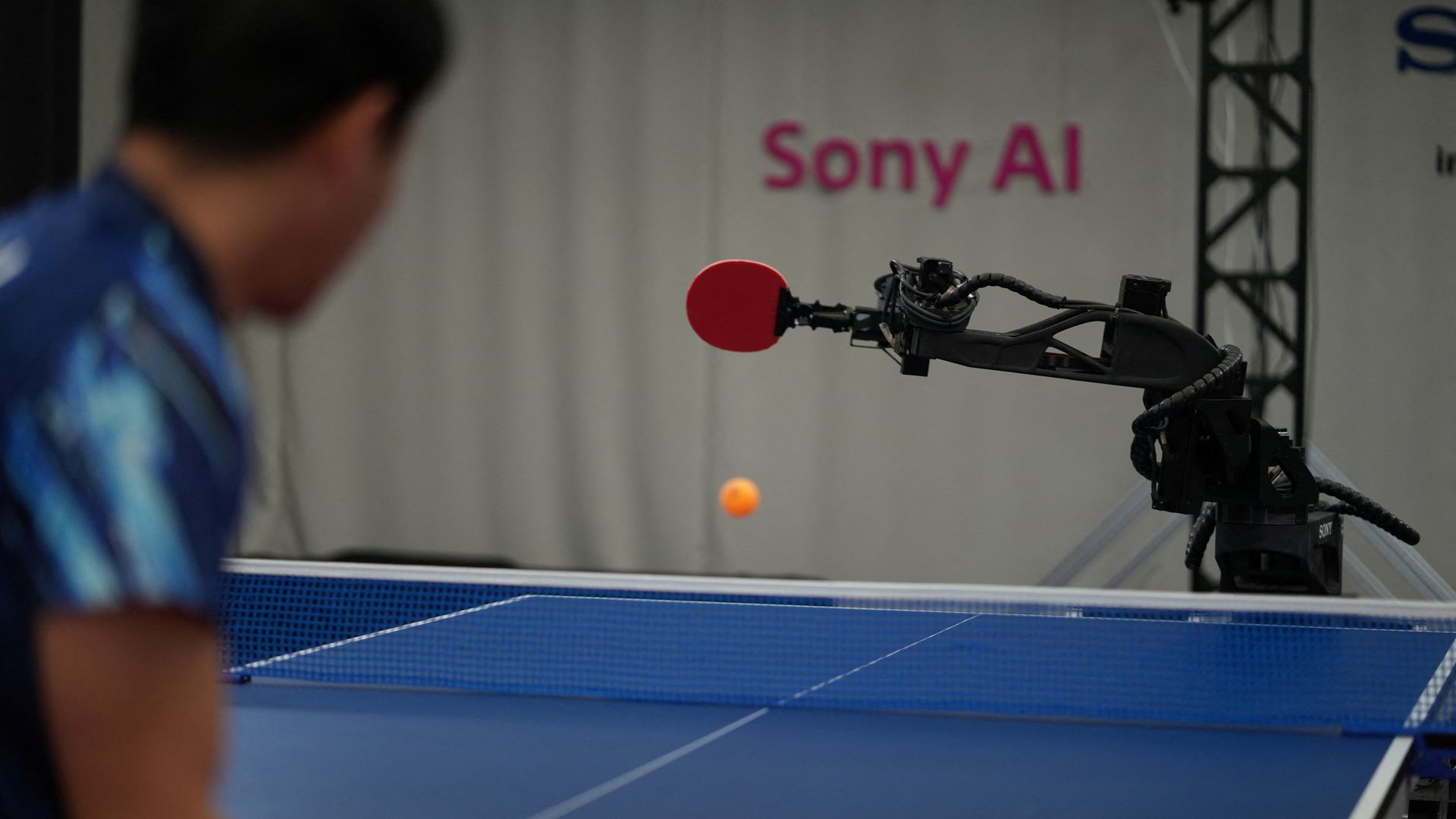
Google DeepMind just proved that we’re closer to a physical AI revolution than most people realize. For years, robots have been great at chess or Go because those games are purely logic based. They don't require sweat, reflexes, or the ability to read a human's body language. Table tennis is different. It's fast. It's brutal. It requires you to track a tiny ball moving at 60 miles per hour while simultaneously deciding how to twist your wrist to counter a heavy topspin.
DeepMind's new robot reached an "intermediate" level of play, which doesn't sound impressive until you see the data. In a series of matches against human opponents ranging from beginners to elite players, the machine won 45% of its games. It absolutely crushed beginners. It held its own against intermediate players. While it lost to the pros, it managed to snatch games from them. This isn't just a mechanical arm swinging at a target. It’s a complex system that learns, adapts, and occasionally messes up just like we do.
The struggle with high speed physics
You can’t just program a robot to play table tennis with simple "if-then" logic. The physics are too messy. When a ball hits a rubber paddle, the friction and spin create variables that are incredibly hard to simulate perfectly. This is the classic "Sim-to-Real" gap. What works in a computer simulation usually fails in the real world because air resistance or a slightly worn-out paddle changes everything.
DeepMind solved this by using a two-part approach. First, they trained the AI in a simulated environment to master the basics. Then, they fed it real-world data to help it understand the nuances of human play. The robot uses a standard industrial arm mounted on a rail system, allowing it to move left and right to cover the table. Two cameras track the ball, while a third monitors the opponent.
It’s surprisingly effective. The robot doesn’t just react; it predicts. It calculates the ball's trajectory and the opponent’s likely return before the ball even crosses the net. If you’ve ever played a sport at a high level, you know that's exactly what humans do. We don't watch the ball hit the paddle; we watch the person's shoulders.
Why the robot still loses to the pros
If you’re a professional table tennis player, your job is safe for now. The robot has a glaring weakness: it can’t handle high-speed "smash" shots or heavy backspin effectively. In the matches against elite players, the humans quickly figured out that the robot struggled with low, slow balls that had a lot of spin.
Humans are masters of exploitation. Once a pro player realized the robot’s sensors had a slight lag in processing vertical spin, they just kept hitting the same shot. The robot would consistently swing over or under the ball. It also lacks "lateral speed" in its decision-making when the ball is hit directly at its body—a common tactic in the sport.
Here is the breakdown of how the robot performed across different skill levels:
- Against beginners, it won 100% of the matches. It didn't even break a sweat.
- Against intermediate players, it won about 55% of the time.
- Against advanced and "pro" level players, it won 0% of the total matches, though it did win individual games within those matches.
The fact that it can take even one game off a professional is a massive leap forward. A few years ago, robots struggled to just return the ball twice in a row. Now, they're executing backhand loops and cross-court winners.
Teaching AI to have a strategy
Most people think of robots as purely reactive machines. You hit the ball, it hits it back. But table tennis is a game of strategy. You try to force your opponent into a position where they have to give you a weak return.
The DeepMind team implemented a "hierarchical" AI model. One part of the brain handles the low-level motor skills—how to move the arm to hit the ball. The other part handles the high-level strategy—where to place the ball to win the point. During a match, the robot collects data on its opponent. If it notices you're weak on your backhand, it will start targeting that side relentlessly.
This is where it gets slightly creepy. The robot isn't just playing the game; it’s playing you. It adjusts its style based on your mistakes. If you start getting tired and your footwork slows down, the robot will start aiming for the corners to make you run. It’s a cold, calculated version of competitive spirit.
The hardware limitations are the real bottleneck
We often talk about AI as this nebulous cloud of code, but in sports, the hardware matters just as much. The industrial arm used by Google is fast, but it isn't "human" fast. Humans can flick their wrists in milliseconds. A mechanical arm has to deal with inertia and the physical limits of its motors.
There's also the issue of the "eye." While the cameras used are high-speed, they still have a frame rate. A human eye and brain process visual information in a way that is still more fluid than a digital sensor. When the ball moves faster than the camera can capture clearly, the AI has to guess. Most of the time it guesses right, but against a pro who can mask their intent, the AI gets confused.
The robot also can't "feel" the ball. A human player feels the vibration of the ball hitting the paddle, which tells them instantly how much spin was on it. The robot relies entirely on vision. It’s playing the game with one sense tied behind its back.
This is about more than just games
You might wonder why some of the smartest people on earth are spending millions of dollars to teach a robot to play a basement parlor game. It isn't about the sport. It’s about dexterity and real-time problem-solving.
If a robot can learn to hit a spinning ball at high speeds, it can learn to do almost anything in a dynamic environment. Think about warehouse work, emergency response, or even delicate surgeries. These are all fields where the environment changes every second and the machine has to react instantly.
Table tennis is the perfect "lab" for this research. It's a controlled environment with clear rules, but the physical demands are extreme. It’s a stress test for both the software and the hardware.
How to play against a robot and win
If you ever find yourself across the table from a DeepMind arm, don't try to out-speed it. You’ll lose. The robot has better endurance than you and its "intermediate" level shots are incredibly consistent. Instead, you need to use variety.
- Change the pace constantly. Hit a fast shot, then a very slow, short shot. The AI’s "sim-to-real" training often fails when the physics of the ball deviate from the standard "fast" rally.
- Use heavy side-spin. The robot's vision system is great at tracking the ball's position, but it’s less effective at judging the rotation of the ball.
- Aim for its "elbow." In table tennis, the hardest spot to return a ball from is right at the player's playing-hand hip or elbow. The robot has a physical "dead zone" where its arm joints have to rotate awkwardly to reach the ball.
The DeepMind team is already working on reducing the latency in the system. They’re also looking at ways to incorporate better sensors so the robot can "see" the spin better. We aren't at the point where a robot will win an Olympic gold medal, but that day is no longer a sci-fi fantasy.
If you want to see this in action, look for the technical paper "Achieving Human-Level Competitive Robot Table Tennis" published by the Google DeepMind team. It details the specific neural networks used and the thousands of hours of play data they collected. For now, keep practicing your serve. You’re going to need it once the hardware catches up to the software.
The next step for this tech isn't just better sports. It's robots that can move through our world with the same grace and adaptability as a human athlete. We're watching the birth of machines that don't just follow instructions—they have "touch."
Stay updated on the latest AI research by following the official Google DeepMind blog or checking the robotics section on arXiv. The pace of development is moving so fast that today’s "intermediate" robot will likely be tomorrow’s grandmaster. Keep your paddle ready.