Ash tastes like wet copper and dead leaves.
If you have ever stood in a eucalyptus forest forty-eight hours after a mega-fire has torn through the canopy, you know the silence is the worst part. Birds leave. Insects burn. Even the wind sounds different when there are no leaves left to catch it, whistling straight over blackened trunks like breath across the mouth of an empty bottle.
During the Australian Black Summer bushfires of 2019 and 2020, more than twenty-four million hectares burned. Nearly three billion animals were killed or displaced. In the aftermath, conservationists walked through the smoking ruins of New South Wales and Victoria expecting to find bone.
Instead, in a handful of shallow, soot-choked creeks, they found movement.
Tiny, dark tadpoles—no bigger than a fingernail—were still swimming beneath a crust of floating charcoal. They belonged to Heleioporus australiacus, the giant burrowing frog. And the story of how those fragile survivors were pulled from the ashes, raised behind locked biosecurity doors, and finally carried back into the regenerating bush isn't just a nice piece of wildlife news.
It is a blueprint for how we keep the natural world alive when the climate stops playing by old rules.
The Invisible Architects of the Forest Floor
Most people have never seen a giant burrowing frog. Honestly, even biologists who spend their entire careers in the wet sclerophyll forests of southeastern Australia rarely spot one.
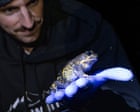
They are masters of disappearance. Growing up to ten centimeters long, heavy-bodied with thick, muscular limbs and golden-flecked eyes that bulge out of a broad, blunt head, they look less like the sleek green tree frogs on postcards and more like small, mottled stones that decided to grow legs. For months at a time, they stay buried deep beneath the leaf litter and sandy soil, waiting for heavy autumn rains to wake them up.
Think of them as the quiet plumbing engineers of the coastal bushland. By digging deep burrows into creek banks and forest soils, they aerate the earth, mix organic nutrients, and create microscopic subterranean highways for insects, fungi, and plant roots. Above ground, they sit right in the middle of the food chain—gorging on beetles, cockroaches, and centipedes, while serving as a vital meal for snakes, owls, and quolls.
When an ecosystem loses a creature like this, nothing collapses overnight. It is slower than that. More insidious.
Imagine a hypothetical town where all the sanitation workers and night-shift maintenance crews simply vanish without a word. For the first few weeks, the streetlights still turn on and the storefronts still look clean. Then the drains clog. Then the foundations rot. By the time anyone notices the smell, the structural damage is already irreversible.
That is what happens when amphibians disappear. Frogs breathe and drink directly through their skin, making them living litmus tests for environmental health. If the water turns toxic, or the soil dries out, or a fungal plague sweeps through the valley, frogs are the first to die. And before the Black Summer fires even sparked, the giant burrowing frog was already listed as vulnerable—squeezed by urban sprawl around Sydney, choked by invasive weeds, and battered by chytrid fungus, a microscopic skin disease that has wiped out dozens of amphibian species across the globe.
Then came January 2020.
Forty-Eight Hours in the Ash
To understand the desperation of that rescue mission, put yourself in the boots of a field ecologist standing at the edge of a burnt catchment in East Gippsland or the Blue Mountains just days after the fire front passed.
The ground is still warm through the soles of your boots. Above you, the sky is a bruised, choking yellow. You are looking at a creek where giant burrowing frogs were recorded breeding six months earlier, and your stomach drops because the water doesn't look like water anymore. It looks like cold coffee.
When a bushfire strips a hillside bare, the first rainstorm doesn't heal the land—it poisons the rivers. Tons of ash, charred topsoil, and heavy metals wash straight down the slopes into the gullies. As that organic matter decomposes in the water, bacteria consume all the available oxygen. Fish suffocate by the thousands. Tadpoles, trapped in isolated pools with nowhere to swim, face a slow death by asphyxiation or boiling heat as the sun beats down on water stripped of its protective tree canopy.
Biologists from Zoos Victoria, the New South Wales Department of Planning and Environment, and partner universities knew they had a razor-thin window. Leave the tadpoles in those blackened pools, and the next heavy downpour would wash them away in a slurry of mud and ash.
So they waded in with nets and plastic buckets.
It is unglamorous, nerve-wracking work. You can't see through the black water. You scoop gently along the sandy bottom, lifting the net into the smoky air, picking through wet charcoal and drowned beetles until you spot a tiny, muscular tail flicking against the mesh. Every tadpole scooped out of that creek carried an absurd weight on its microscopic shoulders. Giant burrowing frog tadpoles grow agonizingly slowly—sometimes taking up to a full year in the wild before they absorb their tails and crawl onto land as tiny froglets. Each survivor in those buckets represented a genetic bloodline that had endured in those valleys for millions of years, right down to the wire.
Inside the Biosecurity Ark
Rescuing an endangered animal from a burning forest is only half the battle. Keeping it alive in captivity without accidentally killing it with kindness is another beast entirely.
You cannot simply drop a wild tadpole into a glass fish tank with tap water and flake food. Amphibian skin is so permeable that trace amounts of chlorine, heavy metals, or foreign bacteria can trigger fatal organ failure within hours. Worse still, bringing wild frogs into a zoo facility carries the terrifying risk of introducing chytrid fungus to existing captive populations—or sending captive-raised frogs back into the wild carrying a pathogen that wipes out the very remnant population you are trying to save.
Inside specialized quarantine rooms at Melbourne Zoo and Taronga, technicians suited up like surgeons. Dedicated footwear. Disposable gloves changed between every single enclosure. Water filtered, remineralized, and chilled to mimic the exact seasonal temperature swings of a mountain stream in winter.
For months, keepers monitored every variable with obsessive precision. They tweaked diets of boiled greens and specialized protein pellets. They watched tadpoles slowly sprout hind legs, then front legs, their mottled golden-brown skin thickening as their gills closed and lungs took over.
I used to think conservation was mostly about romantic moments—releasing eagles off mountaintops or tracking whales across open oceans. Seeing how amphibian rescue actually works cured me of that illusion fast. Real conservation is fluorescent lights, spreadsheets, water-quality test strips, and terrified biologists holding their breath every morning when they check the tanks, praying nobody rolled over in the night. Because when a species has already been pushed to the edge, there is no margin for error.
The Return to the Scarred Valley
Years passed before the forests were ready.
In the wild, time moves on a different clock than human news cycles. While the headlines moved on from the Black Summer fires to pandemics, wars, and elections, the burnt valleys of southeastern Australia slowly began to stitch themselves back together. Epicormic buds—bright green tufts of leaves bursting straight out of blackened eucalyptus bark—turned charred skeletons into fuzzy green pillars. Tree ferns uncurled new fronds from their fire-blackened crowns. Rains flushed the worst of the ash out of the creeks, leaving clear, cold water running over clean sand once again.
Finally, the acoustic monitors and habitat surveys gave the green light.
Imagine the morning of the release. You hike down a steep, damp gully where the smell of wet earth and eucalyptus oil has finally replaced the stench of smoke. You carry ventilated plastic containers packed with damp moss, cradling dozens of young giant burrowing frogs that have never known a world outside a temperature-controlled room.
When the lids come off and the containers are tilted toward the leaf litter, there is no cinematic triumph. No swelling orchestral score.
A frog sits at the edge of the plastic lip. Its golden eyes blink once in the dappled sunlight. Its throat pulses—thrum, thrum, thrum—sampling the scent of wild moss, damp sand, and rotting wood. Then, with a clumsy, heavy-bodied hop, it drops onto the forest floor, kicks its powerful hind legs, and begins digging backward into the dirt until the earth closes over its head.
Gone. Just like that.
Why This Matters Beyond One Frog
It is fair to ask a blunt question here. With megafires becoming hotter, faster, and more frequent across the globe—from the boreal forests of Canada to the scrublands of the Mediterranean and the eucalyptus ranges of Australia—can we really save biodiversity one bucket of tadpoles at a time?
Honestly? No. Not if we treat captive breeding as a substitute for fixing the underlying causes of climate breakdown and habitat fragmentation. You cannot put an entire continent inside a quarantine room.
But writing off "ark" interventions as futile misses what actually happened in those blackened creeks. Every single frog that burrowed back into that regenerating soil is a living genetic bridge across an ecological catastrophe. Without human intervention in those frantic days after the fire, local populations in the worst-hit catchments would have vanished completely—leaving empty niches in the forest floor that might have taken centuries to recolonize, if they ever recovered at all.
Conservation in the twenty-first century isn't about locking nature behind a glass fence and pretending humans aren't there. That world is gone. Today, keeping ecosystems intact requires active, messy, hands-on triage—stepping in during the worst moments of crisis, holding the line in laboratories and zoos while the land heals, and giving wild things a fighting chance to reclaim their ground.
Somewhere beneath the damp leaf litter of a coastal valley tonight, a small, mottled frog with golden eyes is waiting in the dark. Above it, the forest is still scarred, crooked, and incomplete. The bark is still black on the windward side of the old gums.
Yet when the autumn rain finally begins to drum against the new canopy, the earth will shift, a blunt nose will push up through the wet leaves, and a low, resonant owl-like call—ou-ou-ou—will echo through a valley that was supposed to be silent forever.