The coffee on a research vessel at three in the morning tastes like battery acid and hyper-focus.
You sit in a darkened control room, the steady hum of the ship’s engines vibrating through the soles of your shoes, watching a high-definition monitor flicker with feed from a remotely operated vehicle dangling thousands of feet beneath the hull. Outside, the South Atlantic is a black, impenetrable void. But on the screen, illuminated by a halo of artificial light, a world of pure glass and starlight drifts by.
Most people look at the ocean and see a flat, blue surface. If they think of the life within it, they picture the top—the sunlit shallows where dolphins leap and coral reefs bake in the sun. Or they picture the absolute bottom—the abyssal plains where monstrous anglerfish crouch in the mud.
We forget the middle.
Oceanographers call it the midwater. It is the vast, twilight column of ink hanging between the sunlit waves and the crushing seafloor. It is, by volume, the largest habitable ecosystem on our planet, containing roughly ninety percent of all living space on Earth. Yet, we know less about it than we do the dark side of the moon. It is a planetary layer cake of the unknown, and we have spent centuries blind to its ingredients.
Until now.
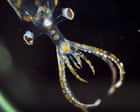
Off the coast of Brazil, aboard the research vessel Falkor (too), a small international collective of marine biologists and engineers just did something that should have been impossible. In the span of exactly fourteen days, they pulled back the curtain on this twilight zone and discovered thirty-one entirely new species.
To anyone who does not spend their life staring into the abyss, that number might sound like a standard statistical update. A neat little headline. But in the agonizingly slow world of marine taxonomy, confirming a single new species can take decades of archiving, dissecting, and academic arguing. Uncovering thirty-one in a fortnight is the scientific equivalent of breaking the sound barrier.
The frantic pace of discovery left the crew breathless. Dr. Karen Osborn, the expedition’s chief scientist from the Smithsonian National Museum of Natural History, could barely contain the shock of what they were witnessing. The midwater was not a barren desert. It was crowded. It was loud with silent life.
But the real triumph was not just that they found these creatures. It was how they looked at them without destroying them.
For generations, marine biology had a dirty secret: to study the ghosts of the deep, you had to murder them first. You dropped massive, heavy nets into the dark, dragged them through the water, and hauled up whatever got tangled. By the time the nets reached the deck, the change in pressure and the brutal scraping of the mesh had done their work.
The midwater is populated largely by gelatinous organisms. They are creatures made of water, holding themselves together through delicate, evolutionary architecture. When a net catches a deep-sea jellyfish, it doesn't bring up a specimen. It brings up a bucket of clear, featureless slime. To study the anatomy, scientists would pickle this slime in jars of formaline, trying to reconstruct a living marvel from a preserved clump of jelly.
Imagine trying to understand the majesty of a bird by studying a feathered rock that fell out of a plane.
The team on the Falkor (too) threw out the old playbook. Instead of nets, they brought lasers.
Attached to their underwater vehicle, SuBastian, were instruments engineered to see the invisible. One tool, a particle image velocimetry system, cast a thin sheet of laser light across the translucent bodies of passing creatures. The laser illuminated the internal fluid dynamics of the animals while they swam undisturbed in their native freezing darkness. Another system scanned the outer structures, building flawless, three-dimensional digital clones of the animals in real time.
Suddenly, scientists didn't need to capture the animal to keep it. They could leave the living creature in the deep and take its digital ghost home.
On the monitors in the main lab, the results were mesmerizing. They found nine new species of jellyfish, pulsing through the dark like beating hearts made of crystal. They mapped seven new comb jellies, their bodies lined with rows of microscopic, hair-like cilia that beat in rhythm, scattering the ROV’s light into shimmering, rainbow neon strips.
Then came the siphonophores.
These are not single animals, but colonial organisms—biological cooperatives where hundreds of independent, specialized units called zooids link together to form a single, functioning entity. One zooid handles propulsion like a tiny jet engine; another handles digestion; another handles reproduction. They are entirely dependent on one another, a shifting, living rope of clones navigating the black. The expedition identified seven new variations of these cooperative empires, each solving the problem of survival in ways that defy traditional definitions of individuality.
They watched a fast-moving gossamer worm dart through the beam of the camera, moving with a bizarre, frantic speed that its body shape suggested should be impossible. They watched a pelagic octopus, deep in the shadows at eight hundred meters, quietly devouring a brilliant, crimson jellyfish.
Every dive was a reminder of how blind we have been.
The technology grew even more intimate when they brought the few microscopic samples they did collect up to the ship’s laboratory. Historically, viewing the cellular structure of a marine microbe meant weeks of staining, mounting, and chemical preservation back on dry land. The creature was long dead before its secrets were revealed.
But the engineers had brought a secret weapon: an open-source, spinning-wheel confocal microscope affectionately nicknamed the Squid.
For the first time in the history of oceanography, scientists on a rolling ship at sea were able to look through a lens and watch the three-dimensional, living internal cellular structure of deep-sea life. They focused the Squid on a giant, single-celled microbe called a protist—an organism large enough to be seen with the naked human eye. On the screen, they watched live cells interacting, exchanging material, and actively secreting a glass-like mineral skeleton to protect themselves against the crushing weight of the Atlantic.
They were witnessing the very machinery of life, operating under pressures that would flatten a human ribcage, running completely live on a vessel tossing on the waves.
Yet, underneath the electricity of these discoveries, a quiet anxiety haunted the ship.
The midwater layer cake is not an isolated wilderness. It is an engine that keeps our atmosphere breathable. Every single night, the largest migration on Earth occurs in total darkness. Billions of midwater creatures rise from the depths, traveling hundreds of meters toward the surface to feed on plankton under the safety of night. Before the sun rises, they sink back into the freezing dark.
This massive vertical heartbeat drives the ocean’s carbon cycle. By eating at the surface and breathing, defecating, and dying in the deep, these fragile, gelatinous entities draw immense amounts of carbon out of the atmosphere and bury it in the deep ocean. They are the planet's unsung climate regulators.
And we are on the verge of losing our eyes on them.
As the crew of the Falkor (too) was cataloging this explosion of life, news rippled through the scientific community that governments were moving forward with plans to defund and dismantle major deep-sea observation networks, including the Ocean Observatories Initiative. Systems designed to track ocean health, current patterns, and long-term changes are being weighed on financial balances and found expendable.
It is a terrifying paradox. Just as we finally develop the eyes to see the marvelous, fragile machinery of our planet's largest habitat, we are threatening to pull the plug on the life support monitoring it.
We live on a planet where what we know is merely a thin, sunlit crust. Beneath it lies a shifting, glittering world of glass structures, cooperative colonies, and creatures that move like light itself. They have spent millions of years evolving elegant, bizarre solutions to the simple problem of existing in the dark.
The expedition off Brazil proved that the wilderness is not empty. It is waiting. But as the Falkor (too) turns back toward the coast, its wake fading into the vast Atlantic, the question remains whether we will choose to keep looking into the dark, or let the ghosts of the midwater slip back into the unseen.


