Silence.
That is the specific sound an English pub makes at 10:47 p.m. when a penalty kick sails into the Parisian night, or when a golden boot sits next to an empty shelf, or when a quarter-century of collective longing finally, impossibly, exhales.
I remember the sticky floorboards of a North London local in 2001. Michael Owen was twenty-one, baby-faced, and suddenly holding a golden orb in Paris. We spilled warm lager on our trainers and assumed it was the start of a dynasty. We thought English football had cracked the code. We were wrong. For twenty-five years after that night, the Ballon d'Or became a private club with a velvet rope that no Englishman could cross. Frank Lampard stood outside it in 2005. Steven Gerrard watched from the curb. Wayne Rooney scored bicycles into Manchester skies and never even got a seat at the table.
Then came the kid from Walthamstow who looked too slow, too awkward, and too ordinary to ever belong in that room.
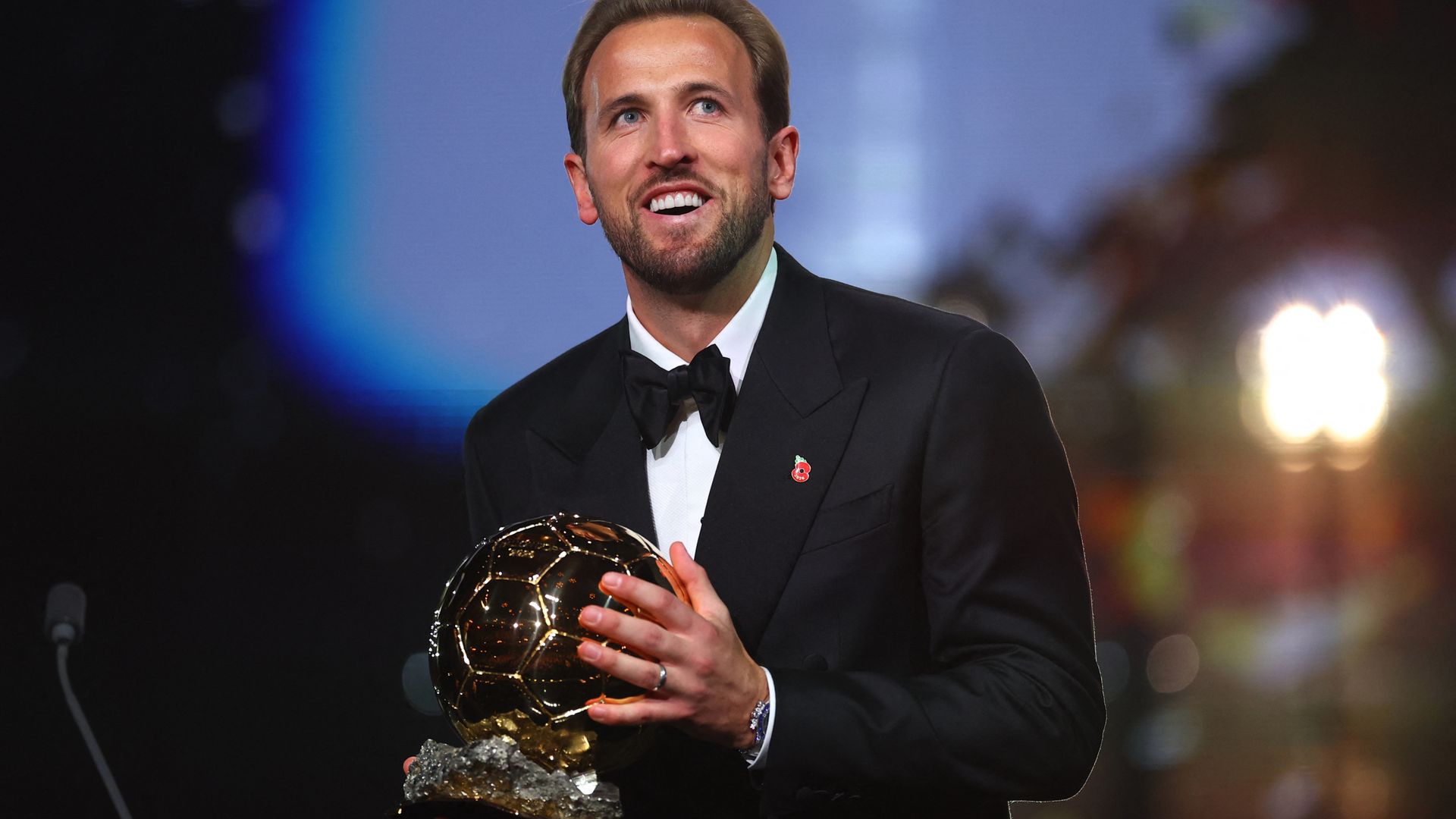
When Harry Kane stood under the chandeliers of the Theatre du Chatelet in Paris and wrapped his hands around the 2026 Ballon d'Or, he did not just win an individual trophy. He exorcised a twenty-five-year ghost that had haunted every conversation about English football, every pub argument about legacy, and every quiet doubt lingering in the back of Kane's own mind.
The Architecture of a Punchline
To understand why that golden sphere feels so heavy in Kane's hands, you have to remember what it felt like to watch him lose.
For over a decade, Harry Kane was the finest tragic hero in modern sport. Think of a master watchmaker—let us call him Arthur, a hypothetical craftsman working in a quiet Swiss workshop—who spends fifteen years assembling the most intricate, accurate timepiece in the world, only for the watch to stop ticking every single time the town clock strikes midnight. That was Kane's career in North London. He scored thirty goals a season with the rhythmic certainty of a metronome. He broke Jimmy Greaves's record at Tottenham Hotspur. He shattered Wayne Rooney's all-time goalscoring mark for England.
And what did he have to show for it? Silver medals. Runners-up ribbons. A collection of Golden Boots that critics weaponized against him like participation trophies.
"Zero trophies," the internet chanted. It became the easiest joke in football. A striker who could pass like Kevin De Bruyne and finish like Alan Shearer was reduced to a punchline because he had the audacity to remain loyal to a club that forgot how to win.
I felt that frustration in my own chest every time I watched him trudge off a pitch after another final defeat. The 2019 Champions League final in Madrid, where he looked half-fit and haunted. The Euro 2020 final at Wembley, where the weight of fifty-five years of hurt crushed an entire nation in a penalty shootout. The Euro 2024 final in Berlin, where Spain danced while Kane watched from the bench, substituted early, his body failing him at the exact moment his country needed him most.
You start to wonder if some athletes are simply cursed by timing. You begin to accept the cruel logic that greatness without silverware is just a very loud tree falling in an empty forest.
The Bavarian Gamble
Leaving Tottenham in the summer of 2023 was supposed to be the easy part. Bayern Munich won the Bundesliga every single year. They had won eleven straight titles before Kane arrived in Germany. Moving to Munich was widely mocked as a shortcut—a desperate dash to buy a medal before his legs gave out.
Except the universe has a dark sense of humor.
In Kane's first season in Bavaria, he scored forty-four goals in forty-five appearances. He played the best football of his life. And Bayern Munich went completely trophyless for the first time in twelve years. Bayer Leverkusen went unbeaten, and the curse rumors turned from a joke into an eerie superstition. People genuinely started asking if Harry Kane was a statistical anomaly who repelled silverware by sheer proximity.
Imagine sitting in a hotel room in Munich at thirty years old, having uprooted your young family, learned a new language, and scored more goals than anyone on the continent, only to read headlines calling you a jinx. Most players would have fractured. They would have started forcing shots, chasing individual glory, or shrinking when the pressure spiked.
Kane did the opposite. He stayed in the gym. He studied tape of his own movement, realizing that as his thirty-first and thirty-second birthdays approached, his sprint speed would never match the twenty-two-year-old wingers buzzing around him. So he reinvented himself.
How a Poacher Became a Quarterback
Watch Kane play over the last eighteen months, and you are not watching a traditional number nine. You are watching a deep-lying playmaker wearing a striker's shirt.
In football, players usually age like cars—they lose acceleration first, then top speed, until they are eventually parked in the garage. Kane aged like a chess grandmaster. Because he never relied on blistering pace, losing half a yard meant nothing to him. Instead, he dropped ten yards deeper into the pockets of space between the opposition's midfield and defense.
Consider what happens when a center-back follows Kane into midfield: a massive cavern opens up behind him. If the defender stays put, Kane turns with the ball at his feet and pings a sixty-yard diagonal pass onto the toes of a sprinting winger with the precision of a laser-guided missile.
During the 2025-26 campaign, that tactical evolution became unstoppable. Under Vincent Kompany at Bayern Munich, Kane did not just lead the line; he orchestrated the entire symphony. He shattered the Bundesliga's combined goal-and-assist records, dragging Bayern back to the summit of German football and deep into the spring nights of the Champions League.
Then came the summer of 2026.
The Summer Everything Changed
World Cups are ruthless editors. They strip away ten months of club brilliance in ninety minutes of knockout panic. For an English captain, a World Cup is less of a tournament and more of a public trial.
Before the 2026 tournament kicked off across North America, the whispers had grown loud again. Critics wondered if England needed a younger, faster focal point. They questioned whether Kane's legs could survive the brutal summer heat in Dallas, Atlanta, and New York. Even I had my doubts. Watching him labor through tournaments in the past had conditioned me to expect heartbreak. It felt safer to brace for impact than to believe.
Kane answered those doubts not with words, but with cold, clinical inevitability.
In the sweltering heat of July, when younger players were cramping and gasping for air in the eighty-fifth minute, Kane's heart rate never seemed to rise above a resting pulse. He scored in the group stage. He buried a pressure-cooker penalty in the quarterfinals. In the semifinals, with the match locked in a suffocating tactical stalemate, he dropped into the center circle, absorbed a crunching tackle, and threaded a pass through the eye of a needle to unlock the winner.
By the time the summer dust settled, the narrative had completely flipped. The "nearly man" had finally conquered the biggest stages on earth. The trophy cabinet was no longer empty. The punchline was dead.
Why Voters Finally Looked Past the Flash
To win the Ballon d'Or in the modern era, you usually have to blind the voters with spectacle. The award spent fifteen years as a private tennis match between Lionel Messi and Cristiano Ronaldo, followed by a brief era of dazzling, high-velocity superstars like Vinicius Junior, Rodri, and Lamine Yamal.
Voters love fireworks. They love step-overs, twenty-yard curlers into the top corner, and viral clips that rack up ten million views before the final whistle even blows.
Harry Kane does not do fireworks. He does architecture.
His brilliance is subtle, almost invisible if you only watch the ball. It is the half-step he takes away from a defender's blind shoulder just before a cross is delivered. It is the way he shields a bouncing ball with his hip so a teammate can breathe. It is the penalty technique—head down, laces locked, driving the leather into the side netting with such violent certainty that goalkeepers dive the right way and still cannot touch it.
For years, that lack of flash hurt him in Ballon d'Or voting. Journalists from around the world looked at his highlight reels and saw tap-ins, penalties, and sensible passes. They mistook simplicity for ease. Anyone who has ever stepped onto a pitch knows the opposite is true: making the hardest game in the world look boringly simple is the highest form of mastery.
In 2026, the sheer weight of his numbers made him impossible to ignore. Over fifty goals and twenty assists across club and country. Major silverware finally resting in his hands. The captain's armband worn through every storm without a single public complaint, scandal, or moment of ego.
The Weight of Twenty-Five Years
When Kane stepped onto the stage in Paris, wearing a sharp black tuxedo that looked far more comfortable on him than the oversized suits of his early twenties, he looked around the room with a quiet, almost stunned gratitude.
He thanked his wife, Kate, his childhood sweetheart who had been there since he was a chubby teenager loaned out to Leyton Orient and Millwall, wondering if he would ever make a single Premier League appearance. He thanked his teammates in Munich and London. He spoke without theatrics, his voice carrying that familiar, slightly nasal East London cadence that has never changed despite his global fame.
Let us pause and appreciate the sheer improbability of that journey.
In 2013, Harry Kane was sitting on the bench for Leicester City in the second tier of English football, unable to get into the starting lineup ahead of Jamie Vardy and Chris Wood. At twenty years old, Arsenal had already rejected him from their youth academy for being "a bit chubby" and "not very athletic." Tottenham loaned him out four separate times. Most players in that position quietly drift down the football pyramid, ending their careers in semi-professional leagues with a handful of stories about the time they almost made it.
Kane refused to leave. He stayed after training when the pitches were frozen and the floodlights were flickering off, hitting hundreds of balls into an empty net until his ankles bruised.
That is the invisible thread connecting the twenty-five years between Michael Owen in 2001 and Harry Kane in 2026. Owen was a prodigy—a bolt of lightning who arrived fully formed at eighteen and burned bright before injuries dimmed his speed. Kane was a bricklayer. He built his career one stone at a time, enduring every mockery, every missed penalty, and every heartbreaking final until the structure stood taller than anyone else's.
The New Standard for English Football
Walk past any Sunday league pitch in England this weekend, and you will see the ripple effect of this night.
For a generation, young English players were taught to apologize for their ambition or brace for inevitable failure. Whenever a tournament arrived, the national mood swung wildly between delusional arrogance and fatalistic dread. We loved our heroes, yet we secretly expected them to break our hearts.
Now, a generation of kids in Hackney, Manchester, Birmingham, and Bristol will grow up knowing that an English striker—a kid who was told he was too slow, too awkward, and too unlucky—stood on top of the world and claimed the highest individual honor in the sport.
He did not do it by changing who he was. He did not become a flashy celebrity or manufacture fake drama for the cameras. He stayed relentlessly, stubbornly himself.
Late at night, long after the cameras in Paris were packed away and the champagne glasses were cleared from the tables, Harry Kane finally sat down in a quiet room with a small golden ball resting on the table in front of him, the ghost of every empty shelf finally gone, leaving nothing behind but the quiet, undeniable proof that patience still wins.


