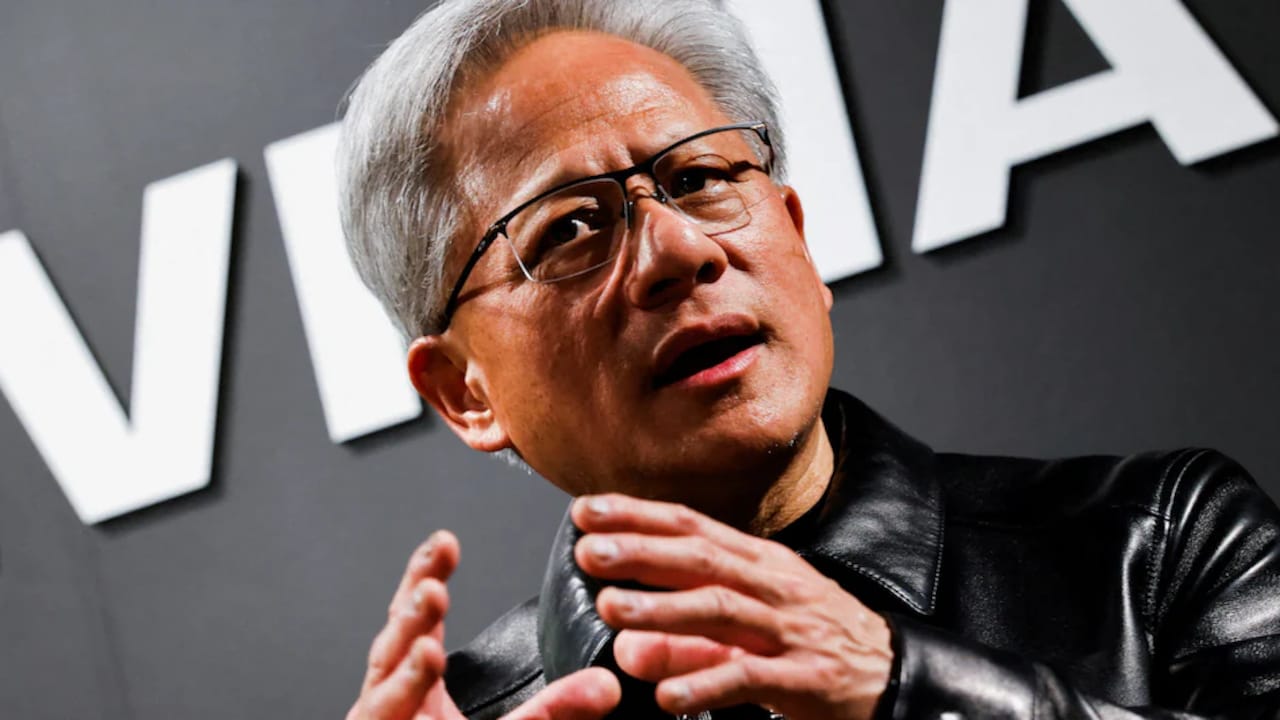
Silence.
That is the first thing you notice when a founder steps down from a three-trillion-dollar empire, not the noise of the press releases or the frantic clicking of algorithmic traders adjusting their positions in the dark, but the sudden, suffocating vacuum left behind in a conference room where one man used to oxygenate every single decision. Expanding on this topic, you can also read: Stop Celebrating Cheap Prosthetic Hands That End Up in Closets.
For thirty-three years, Jensen Huang wore the same black leather jacket. It was a uniform, certainly, a piece of branding so effective that any Silicon Valley executive who reaches for a moto zipper today looks like an understudy auditioning for a role already cast. Yet the jacket was never really about fashion. It was armor. Inside it stood a man who famously operated without a traditional organizational chart, maintaining up to sixty direct reports because he believed middle management was a filtration system that diluted truth before it reached the top.
Now, look at the boardroom in Santa Clara. The chair at the head of the table is empty, or at least occupied by someone whose name does not carry the mythic weight of the co-founder who pulled a graphics chipmaker back from the brink of bankruptcy in 1996. On paper, Jensen Huang is out of Nvidia. The filings are clean. The succession plan, rehearsed in whispers among institutional investors for half a decade, has finally executed its cold, mechanical turn. Observers at CNET have also weighed in on this situation.
Except the strings are still taut. And if you watch closely, the puppets haven't missed a beat.
The Architecture of an Invisible Hand
To understand how a chief executive leaves a company without ever actually vacating its soul, you have to stop thinking about corporate governance as a set of rules and start seeing it as physics. Mass warps space. Even after a star collapses, its gravitational well continues to dictate the orbit of every planet, moon, and stray asteroid within light-years.
Consider a hypothetical scenario inside Nvidia’s executive suite on a Tuesday morning in late autumn. Let us call the new chief executive Marcus—a brilliant, battle-tested operator who spent fifteen years running data center architecture before taking the corner office. Marcus is sitting across from the head of global supply chain, staring at a wafer allocation crisis out of Taiwan. The numbers are brutal. Demand for next-generation accelerators outstrips capacity by forty percent, and three hyperscalers are threatening to divert capital expenditure toward custom in-house silicon if delivery windows slip by a single quarter.
Marcus knows the spreadsheet answer. He knows what a McKinsey consultant would advise: raise prices on the spot market, prioritize the highest-margin contracts, and smooth out quarterly earnings predictability.
Then Marcus looks at the empty chair. He remembers a Thursday afternoon four years earlier when Jensen stood at a whiteboard for six hours straight, refusing to let anyone break for lunch, dismantling a similar allocation model because it optimized for next quarter's Wall Street beat at the expense of a ten-year developer moat. Marcus remembers the exact cadence of Jensen's voice—quiet, almost conversational, right up until the moment he asked a question that exposed a foundational flaw in your thinking. Are we building a tollbooth, Jensen had asked that day, or are we building the highway?
Marcus doesn't take the McKinsey route. He sacrifices short-term margin to flood the ecosystem with developer kits. He makes the Jensen choice, even though Jensen is three thousand miles away, nominally retired from day-to-day operations, holding nothing more than a non-executive board seat and a block of voting shares that speaks louder than any quarterly earnings call.
This is not speculation; it is the documented mechanics of founder-led tech dynasties. When Bill Gates stepped away from Microsoft's daily helm in 2000, and later as chairman in 2014, his architectural DNA remained embedded in the company’s product reviews for over a decade. When Steve Jobs took medical leave from Apple, every industrial designer in Cupertino still measured the curve of an aluminum chassis against what Steve would say when he walked through the door.
In Nvidia’s case, the gravitational pull is even stronger because Huang didn't merely run the company—he engineered its nervous system.
Why Wall Street Misreads the Exit
I spent twelve years covering semiconductor supply chains and sitting in the back rows of analyst days from San Jose to Taipei, watching institutional fund managers try to price human charisma into discounted cash flow models. They always fail. Finance is built on the comforting illusion that corporations are interchangeable machines: swap out the driver, keep the engine, and the car maintains sixty miles per hour down the highway.
That illusion shatters the moment you walk onto the floor of a hardware company where product cycles take four years to gestate and a single architectural bet can cost ten billion dollars before a single customer swipes a credit card.
When the headlines broke that Jensen Huang was stepping down from his operational throne, the market did what the market always does when confronted with sudden mortality in the C-suite. The stock wobbled. Algorithms dumped shares on the keyword departure. Pundits on financial television immediately began drafting obituaries for the artificial intelligence boom, asking whether Nvidia’s stratospheric valuation could survive without its chief evangelist pacing the stage at GTC in front of twenty-foot screens.
They were looking at the wrong ledger.
If you want to know who actually runs a public company, ignore the org chart on the investor relations website and read the proxy statement. Look at the board composition. Look at the tenure of the directors sitting around that mahogany table.
At Nvidia, the board is not a collection of activist hedge fund managers looking to strip assets for a quick dividend buyback. It is a phalanx of loyalists, veterans, and hand-picked allies—men and women who survived the dark years when Nvidia’s stock traded for pennies on the split-adjusted dollar, who watched Huang bet the entire company on CUDA in 2006 while Wall Street mocked him for wasting R&D money on a software layer nobody wanted.
Think about what CUDA actually is, stripped of the jargon. An analogy helps here: imagine building the world’s fastest sports car, and then realizing there are no paved roads anywhere on earth. Most carmakers would focus on making the engine slightly faster and selling to wealthy collectors on private tracks. Huang spent fifteen years paving the roads for free, handing out asphalt to every university researcher, garage tinkerer, and graduate student on the planet. By the time the rest of the world realized they needed to drive somewhere, Nvidia owned every highway, every on-ramp, and every traffic light.
You do not dismantle a toll-free empire built on a thirty-year grudge against obsolescence just because the founder changes his title on LinkedIn.
The Invisible Stakes of the Succession Trap
There is a quieter, sharper anxiety humming beneath the surface of Santa Clara right now, and anyone who has ever worked inside a founder-dominated institution recognizes the smell of it instantly. It is the fear of the shadow.
Succession in a founder-led titan is rarely a clean handoff; it is an exorcism that never quite finishes. Consider what happens to the engineers—the thirty-five-year-old principal architects designing the next generation of interconnects and optical networking fabrics. For their entire careers, their North Star was singular. If you built something extraordinary, Jensen found out about it. He didn't care about your title or which vice president you reported to. He emailed you directly at two in the morning with three bullet points and a demand to see the schematic by noon.
That direct line to the top creates a terrifying level of accountability, yes, but it also creates intoxicating clarity. Politics dies in the presence of an absolute monarch because there is no point lobbying a duke when the king reads every scroll himself.
The moment the king steps down—even when he remains in the castle walls, holding the purse strings and whispering to the council—the dukes begin to measure the curtains.
I remember talking to a mid-level chip designer at a rival firm in Austin years ago, shortly after their legendary founder transitioned to "Executive Chairman." Within six months, the designer told me, the meetings doubled in length. Not because the engineering problems got harder, but because every decision now required two layers of translation: first, what made sense for the silicon, and second, what would survive a board review where the former CEO still held veto power over capital allocation.
This is the hidden cost of the puppet-master boardroom. When a founder is all in, their skin is exposed to every daily humiliation, every supply delay, every software bug. When they retreat to the boardroom, they retain the power to say no without the daily friction of having to execute yes.
Let us be honest about how unsettling that is. Even seasoned institutional investors admit privately that the "founder-as-chairman" model walks a razor’s edge. On one side lies continuity—the preservation of a fierce, paranoid culture that famously operated under the unofficial motto Our company is thirty days from going out of business. On the other side lies paralysis, where a new chief executive becomes a ceremonial figurehead afraid to pivot away from the founder’s sacred cows, even when the market shifts beneath their feet.
What Really Happens Behind Closed Doors
So how does Jensen Huang actually pull the strings without sitting in the operational chair? Not through memos. Not through frantic phone calls barking orders at junior vice presidents. That would be clumsy, and whatever else you might say about Huang, the man is never clumsy.
The mechanism is far subtler: it lives in capital allocation, strategic M&A, and the cultural immune system he spent three decades inoculating.
First, look at the purse strings. In any major technology company, the CEO runs the current business, while the board approves the bets that determine whether the company still exists in ten years. Every multi-billion-dollar acquisition, every sovereign AI data center partnership, every sweeping pivot in foundry relationships with TSMC or Samsung must pass through the board's strategic committee. With Huang anchoring that table, no deal gets signed unless it passes his brutal, first-principles interrogation. If a proposed acquisition smells like financial engineering rather than deep technological moat-building, it dies in committee before the ink dries on the term sheet.
Second, look at the talent layer. The executives running Nvidia’s core divisions—data center, gaming, automotive, enterprise software—are not mercenaries hired from outside conglomerates last Tuesday. They are lifers. Many of them have worked alongside Huang for twenty years. They speak his shorthand. When they walk into a quarterly board presentation, they do not need Huang to issue a directive; they already know what questions he is going to ask before he opens his mouth. They have internalized the algorithm of his mind.
Third, and most crucially, there is the external gravity. When sovereign nations—from Tokyo to Riyadh to Paris—commit tens of billions of dollars to build domestic artificial intelligence infrastructure, they are not buying boxes of silicon. They are buying geopolitical alignment. Heads of state do not want to take a meeting with a newly minted chief operating officer. They want the man in the black leather jacket. By remaining the strategic face of the board and the primary architect of global partnerships, Huang ensures that Nvidia’s highest-level diplomatic moat remains firmly in his grip.
The Human Equation in an Automated Age
It is deeply ironic that a company whose entire existence revolves around replacing human drudgery with accelerated computing is itself a case study in the irreplaceability of a single human psyche.
We love to believe that great institutions outgrow their creators. We tell ourselves comforting stories about processes, playbooks, and corporate values etched onto glass walls in shiny lobbies. Yet history suggests otherwise. Disney floundered for decades after Walt died, surviving on nostalgia until outsiders came in and rebuilt the engine. Apple nearly vanished into bankruptcy twelve years after firing Steve Jobs, saved only when he returned to strip the product line down to four quadrants.
Perhaps the truth is simpler and far less reassuring for modern management theorists: great technology companies are not machines at all. They are extensions of a founder's specific neurosis.
Jensen Huang’s neurosis—his obsessive fear of complacency, his refusal to accept that hardware and software are separate disciplines, his willingness to endure years of Wall Street ridicule while building an ecosystem nobody else could see—turned a scrappy graphics card maker into the foundational utility of the twenty-first century. Stepping out of the CEO title changes his calendar. It removes him from the grind of weekly supply-chain status updates and quarterly earnings prep. It gives him room to breathe, to think in twenty-year arcs instead of ninety-day sprints.
It does not, however, loosen his grip on the wheel.
Imagine walking past the Nvidia campus in Santa Clara late at night. The buildings—Endeavor and Voyager—glow against the California dark like massive triangular spaceships landed in the middle of Silicon Valley. Inside, thousands of engineers are writing code, testing thermal limits, and simulating neural networks that will write the next chapter of human industry.
The nameplate on the corner office door has changed. The press releases are filed. The analysts have updated their spreadsheets and moved on to the next earnings cycle.
Yet somewhere high above the server racks, in a quiet room where the future of computing is decided billions of dollars at a time, the leather jacket is still hanging on the back of the chair.


