Rust tastes like copper and old pennies when the wind whips off the Delaware River.
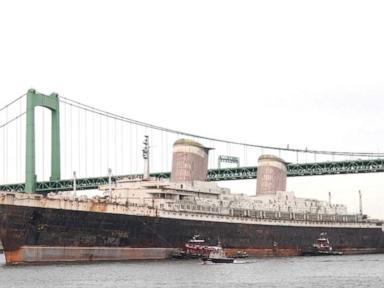
For nearly thirty years, if you drove past Pier 82 in South Philadelphia—perhaps on your way to grab a cheesesteak or run errands at the big-box stores across Columbus Boulevard—you saw her. A massive, silent titan of steel and peeling red-and-blue paint, towering over the Ikea parking lot like a hallucination from another century. The SS United States.
She didn't move. She didn't smoke. She just sat there, a 990-foot monument to American ambition slowly flaking into the brackish water.
Then, off the Gulf Coast of Florida, the silence finally shattered. Charges detonated deep within her gutted hull. Plumes of white water erupted against the emerald horizon near Destin-Fort Walton Beach. And just like that, the fastest ocean liner ever built began her final, vertical voyage—straight to the bottom of the sea.
Gone.
To watch the footage of her sinking is to feel a strange, conflicting ache in your chest. On one hand, it looks like an execution. We took a national treasure—a vessel longer than the Titanic, a ship that carried four U.S. presidents, the Mona Lisa, and millions of breathless travelers across the Atlantic—and we blew holes in her bottom. On the other hand, if you look closer at what happens beneath the waves in the weeks and years after the bubbles clear, you realize something astonishing.
We didn't kill the SS United States. We set her free.
The Speed of a Vanishing Era
To understand why grown men wept on the docks of Mobile, Alabama, as she was towed out to her final coordinates, you have to understand what this ship meant in July 1952.
Picture a hypothetical passenger—let’s call her Clara—standing at the rail in New York Harbor on that maiden voyage. World War II is a fresh, jagged memory. The jet age hasn't arrived yet. To cross the Atlantic is an ordeal, a slow slog through gray, pitching swells.
Then comes naval architect William Francis Gibbs. Gibbs was obsessed with speed and terrified of fire. He designed the SS United States with a hull sleeker than a navy destroyer and stripped out almost every scrap of wood to make her fireproof. Even the grand piano in the ballroom was made of aluminum, specially engineered after Steinway initially refused to build it. Only the butcher blocks in the galley and the mahogany propellers of the ship’s lifeboats were made of wood. Everything else was cold, gleaming, indestructible metal.
When Clara felt those engines engage, the ship didn't just sail; she flew.
She crossed the Atlantic in three days, ten hours, and forty minutes, shattering the westbound record by over ten hours and averaging an unthinkable 35.59 knots—more than 40 miles per hour on open water. She claimed the coveted Blue Riband, an honor no American ship had held in a century, and one no ocean liner has ever taken from her since.
For seventeen years, she was the floating embodiment of mid-century swagger. She was the Concorde of the waves.
Until the Boeing 707 arrived.
Progress is ruthless. Why spend four days crossing an ocean when you can do it in seven hours? By 1969, the passengers vanished. The SS United States was withdrawn from service, stripped of her luxury furnishings, gutted down to bare steel during a failed 1990s asbestos-remediation project in Ukraine, and eventually towed to Philadelphia in 1996.
There she rotted.
For decades, preservationists fought valiant, heartbreaking battles to save her. Proposals flew around like confetti: turn her into a floating hotel in New York, a casino in Miami, a museum in San Francisco, a tech hub in Brooklyn. Every single plan crashed against the same brutal math. Restoring a 1,000-foot, stripped-out hull to modern safety codes would cost hundreds of millions of dollars—perhaps close to a billion. Nobody had the money. Nobody had the stomach for the liability.
I remember standing near the chain-link fence in Philadelphia a few winters ago, staring up at her twin funnels. Up close, the scale is terrifying. Those funnels are sixty-five feet tall—the height of a six-story building—yet from the street, she looked exhausted. Her paint was streaked with rust tears. Pigeons nested in the shattered portholes of the promenade deck. Watching a masterpiece decay in slow motion isn't romantic. It is agonizing. It feels like watching a sprinter trapped in a glass box, forced to watch the world jog past while their muscles atrophy.
The Invisible Crisis Beneath the Gulf
While the SS United States was dying a slow death on a concrete pier, another quiet catastrophe was unfolding miles beneath the warm, turquoise waters of the Florida Panhandle.
If you visit Destin or Fort Walton Beach, the water looks like liquid glass, stretching over sugar-white sand. To a tourist, it looks like paradise. To a marine biologist, that endless expanse of flat, sandy bottom is something else entirely: a desert.
Coral reefs—the rainforests of the ocean—are collapsing globally under the weight of warming waters, acidification, and disease. Without complex, three-dimensional structures to hide in, small baitfish have nowhere to escape predators. Without baitfish, larger reef fish like red snapper, grouper, and amberjack disappear. Without those fish, the entire coastal ecosystem unravels, taking the livelihoods of local charter captains, dive shops, and coastal communities down with it.
Think of an artificial reef like an apartment building suddenly dropped into the middle of a barren prairie.
In the open sand of the Gulf of Mexico, a small damselfish or a juvenile snapper is completely exposed—a sitting duck for passing sharks or barracuda. Drop a massive, steel structure onto that sand, and within hours, the physics of the ocean change. Currents hit the vertical walls and push nutrient-rich water upward. Microscopic algae cling to the rough steel surfaces. Barnacles, sponges, and soft corals follow, carpeting the hull in living color. Small fish dart into the dark corridors of old passenger cabins, safe from predators. Larger fish arrive to hunt along the perimeter.
Okaloosa County, Florida, understood this equation better than almost anywhere else. For years, they had been building a network of artificial reefs, watching dead zones bloom into thriving marine metropolises. They needed a flagship. They needed something monumental.
And in Philadelphia, a landlord had finally evicted the SS United States over unpaid pier rent.
The Anatomy of a Controlled Surrender
Sinking a ship the size of a skyscraper isn't as simple as pulling a plug and walking away. If you get it wrong, you don't create an ecosystem; you create an environmental hazard.
When Okaloosa County struck the deal—spending over $10 million to buy the ship, tow her 1,800 miles down the Atlantic coast and around the Florida peninsula, remediate her, and sink her—the skeptics were loud. Many lovers of maritime history viewed it as sacrilege. How dare you sink America’s flagship? they asked. Why not scrap her, or keep trying to raise money?
Consider what happens next when you actually look at the alternatives. Scrapping her meant cutting her into pieces with blowtorches in a Brownsville, Texas, shipyard—reducing the fastest liner in history to razor blades and rebar, erased from the earth forever. Keeping her afloat meant waiting another decade until her hull plates rusted through and she sank uncontrollably at her pier, blocking a major shipping channel and spilling pollutants into the Delaware River.
Sinking her intentionally off the coast of Florida was the only way to keep her whole.
Before she could touch the Gulf floor, crews spent months in Mobile, Alabama, performing surgery on a giant. Every trace of fuel, oil, loose debris, and hazardous material—from residual PCBs in old wiring to grease in the machinery spaces—had to be meticulously scrubbed clean. Environmental engineers mapped out her interior like a labyrinth, cutting massive diver-access holes through her steel bulkheads so future scuba divers could swim through her grand corridors without getting trapped.
Even her position on the seafloor had to be choreographed. The goal was to land her upright, resting on her keel in roughly 180 feet of water, about twenty nautical miles south of Destin-Fort Walton Beach. At that depth, her main deck sits around 130 feet below the surface, while the tops of her iconic red-and-blue funnels rise to roughly 60 feet—well within reach of recreational divers, yet deep enough that passing cargo ships won't scrape her crown.
When the demolition crews finally wired the charges along her hull, the tension on the support boats was suffocating. You only get one shot at physics on this scale.
The detonation wasn't a Hollywood fireball; it was a deep, muffled thud that vibrated through the hulls of the surrounding vessels, followed by towering geysers of white foam shooting skyward from her waterline.
For a few agonizing minutes, the great ship hesitated. She listed slightly, as if taking one last breath of the salt air she hadn't truly tasted since 1969. Then, water rushed into her lower compartments. Her bow dipped. Her stern rose briefly against the sky, revealing the massive curves of her hull that had once sliced through Atlantic gales at forty miles an hour.
And then, with a majestic, terrifying grace, she slipped beneath the surface.
What Lives in the Dark
It is easy to mourn the end of an object. We are wired to attach our memories to physical things—to want to touch the steel rail where our grandparents stood, to walk the decks where history happened. Watching the SS United States disappear beneath the Gulf feels like losing a physical anchor to a prouder, bolder chapter of our past.
I won't pretend it doesn't sting. When you look at the photos of her empty berth in Philadelphia, there is a hollowness there that a land-based museum—even one built with her salvaged funnels and artifacts in Destin—can never entirely replace.
Yet, if you slip beneath the surface of the Gulf of Mexico right now, the grief evaporates.
Down there, in the cobalt hush 130 feet below the chop, the SS United States is no longer a rusty, decaying relic waiting for a handout. She is the largest artificial reef on the planet, eclipsing the USS Oriskany off Pensacola.
Already, the pioneers have arrived. Clouds of silvery baitfish shimmer like liquid mercury around her aluminum bridge. Amberjacks patrol the length of her 990-foot promenade deck like sleek, muscular ghosts. Within a few years, her bare steel hull will vanish beneath a thick, vibrant coat of orange cup corals, purple sea fans, and encrusting sponges. Goliath groupers the size of small cars will lurk in the shadows of her grand ballroom.
Divers descending down the mooring line won't see a dead ship. They will see a vertical reef pulsating with frantic, brilliant life—a city built out of American steel, humming with a different kind of speed.
The SS United States was designed to conquer the ocean, to race across its surface faster than anything humanity had ever built. In the end, the ocean claimed her anyway. Not as a conqueror, and not as a grave, but as a cradle—turning the fastest vessel in history into a permanent sanctuary where millions of new lives will begin.