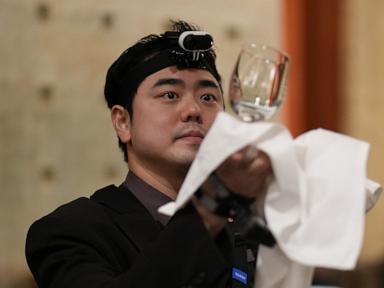
The air in the small workshop smells of ozone and sanded cedar. Kim, a man whose hands bear the map of thirty years in manual labor, isn't holding a chisel today. Instead, he wears a pair of sleek, sensor-laden gloves and a lightweight exoskeleton that tracks every tremor of his wrists. He is performing a task he could do in his sleep: fitting a dovetail joint. But as he works, a silent observer watches.
Behind a glass partition, a bank of processors hums. They aren't just recording his movements; they are inhaling his intuition.
For decades, the world of robotics has been hitting a brick wall made of "common sense." We’ve grown accustomed to the sight of industrial robots—orange-painted behemoths—bolted to factory floors, repeating the same three-inch arc with millimeter precision. They are fast. They are strong. They are also spectacularly stupid. If you move their target two inches to the left, they will continue to crush the empty air where the part used to be.
The problem isn't mechanical. We have the metal. We have the motors. What we’ve lacked is the "brain"—the split-second, subconscious adjustments a human makes when a screw is slightly stripped or a piece of wood has an unexpected knot.
A South Korean startup named Changmago is betting that the secret to the next generation of labor isn't found in a line of code, but in the muscle memory of the people who are currently being told they are obsolete.
The Tragedy of the Rigid Robot
Traditional programming is a series of "if-then" statements. If the sensor sees a red box, then the arm picks it up. This works in the sterile, controlled vacuum of a semiconductor lab. It fails miserably in the messy, unpredictable reality of a construction site or a nursing home.
In these environments, variables are infinite. The lighting changes. A floor is uneven. A person moves unexpectedly. Writing a script for every possible variable is a fool’s errand. It would take a billion lines of code to teach a robot how to properly fold a fitted sheet, a task a ten-year-old can master in an afternoon.
This gap is what engineers call the "Hard Problem" of robotics. While we were busy trying to build artificial intelligence from the top down—using logic and math—we forgot that human intelligence is built from the bottom up, through touch, failure, and repetition.
Changmago’s approach turns the entire hierarchy on its head. They aren't trying to program a robot to be a carpenter. They are letting a carpenter "possess" the robot.
Teaching the Machine to Feel
Consider the way you catch a falling glass. You don't calculate the velocity of the object, the gravitational constant, and the required friction coefficient of your skin. You just move. Your brain has a "world model" built on years of dropping things.
The South Korean team utilizes a technique known as imitation learning, but with a visceral twist. By capturing the high-fidelity kinetic data of skilled tradespeople—the exact pressure applied during a weld, the subtle tilt of a hand during a pour—they create a digital twin of human expertise.
This data is fed into a neural network that functions less like a computer program and more like a nervous system. The robot doesn't just learn the path of the hand; it learns the intent behind the movement.
When Kim slows down because he feels the wood grain resisting his blade, the AI notes that correlation. It learns that resistance equals a need for caution. It begins to develop a "digital intuition." This is the transition from a machine that executes a command to a machine that understands a craft.
The Invisible Stakes of the Grey Wave
This isn't just about making cooler gadgets. There is a desperate, quiet urgency behind this technology, particularly in East Asia. South Korea is currently facing a demographic cliff. The working-age population is shrinking at a rate that threatens the very infrastructure of the country.
Walk through the shipyards of Ulsan or the small manufacturing hubs in Gyeonggi Province. The masters of these crafts—the people who know exactly how a certain metal should sound when it’s tempered—are retiring. And there is no one standing behind them to take the tools.
When a master craftsman retires without a successor, that knowledge doesn't just leave the building. It vanishes from the world. It is a form of cultural and industrial amnesia.
The "AI brains" being developed are, in a very real sense, a way to bottle lightning. By digitizing the movements of these workers, the startup is creating a library of human capability. They are ensuring that when the last of the master welders hangs up his mask, his "soul"—at least the part of it that understands the flow of molten steel—stays on the floor.
Beyond the Factory Gates
If this technology matures, the implications ripple far beyond the assembly line. Think of the specialized labor that currently requires a human presence in dangerous environments.
Imagine a robot tasked with clearing debris after an earthquake. Today, such a machine would likely get stuck on the first jagged piece of rebar it encountered. But a robot trained on the movements of a seasoned search-and-rescue professional? It would navigate the rubble with the same predatory grace, feeling out the stability of the ground before committing its weight.
We are moving toward a future where "programming" a robot looks less like typing at a keyboard and more like coaching a student. You don't tell the robot where to put its feet; you show it how to balance.
The Friction of Ethics
Of course, this journey is fraught with a tension that can't be ignored. There is a profound irony in asking a worker to wear a suit that will eventually allow a machine to take their job.
Is it a partnership or a harvest?
The startup argues that this tech will actually empower workers, allowing one master craftsman to oversee a fleet of twenty "apprentice" robots, amplifying their productivity rather than replacing it. But history has a habit of favoring the bottom line over the heartbeat.
We must ask ourselves what happens to the dignity of work when the "knack"—that unexplainable, magical quality that makes someone an expert—is boiled down into a set of weights in a neural network. If a machine can mimic the "human touch," is the touch still human?
The Texture of the Future
One afternoon in the lab, a robot arm equipped with the new AI brain was tasked with a simple but delicate test: peeling an orange.
In previous years, this would have resulted in a sticky explosion. The robot would either squeeze too hard and crush the fruit or not hard enough and slip. But this time, the arm moved with a strange, eerie fluidity. It hesitated at the tough part of the rind. It adjusted its grip as the orange shifted. It worked with a gentleness that felt... familiar.
It looked like Kim.
The technicians watched in silence. For a moment, it wasn't a piece of hardware performing a task. It was a bridge. On one side of the bridge was a generation of humans whose bodies are wearing out after a lifetime of labor. On the other side was a generation of machines that are finally learning how to feel the world they inhabit.
The goal isn't to build a world without workers. It is to ensure that the wisdom of the hand is never lost, even when the hand itself is gone.
In a quiet corner of the facility, the robot finished the orange and set the peel aside. It waited for the next lesson. Somewhere nearby, a human worker took a deep breath, adjusted his sensor-rigged sleeves, and went back to work, teaching the ghost how to be alive.
The chisel meets the wood. The sensors flare. The hum of the processor deepens.
The machine is learning to care.