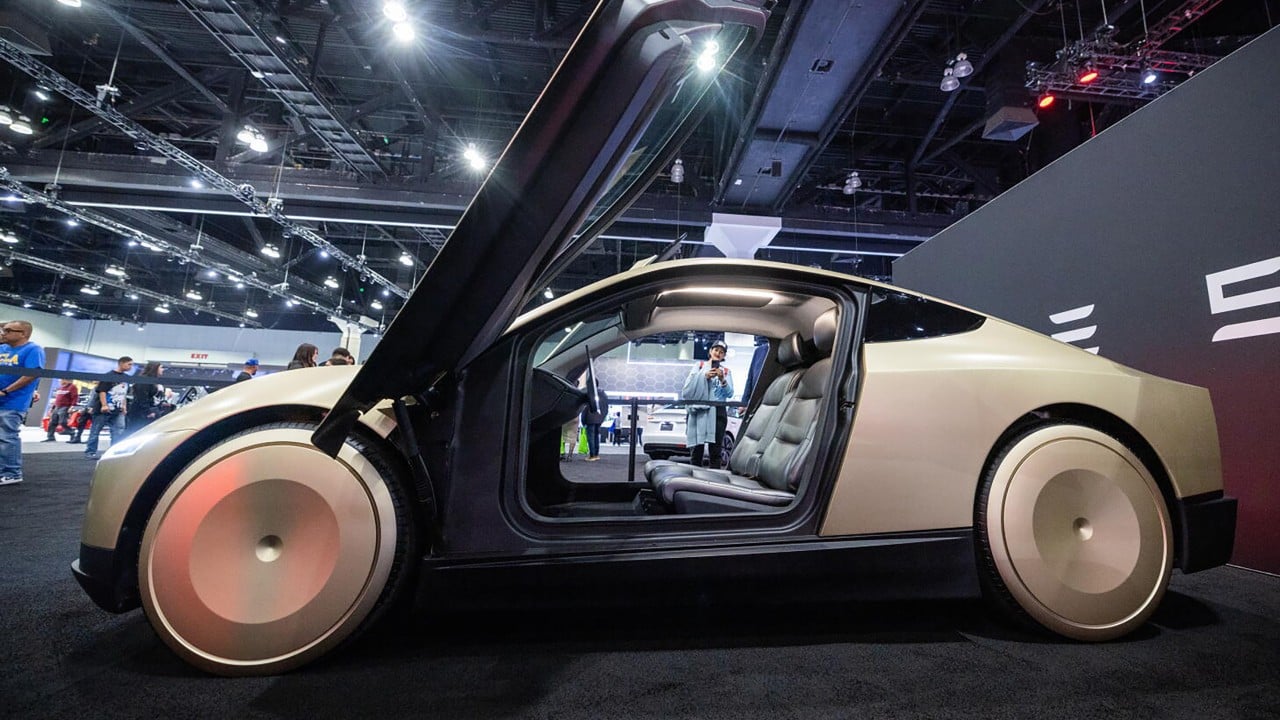
The rain in Shanghai does not fall so much as it suspends itself, turning the air into a gray soup that clings to the wool of your coat and the glass of every skyscraper along the Huangpu River. Standing beneath the sprawling steel ribs of the National Exhibition and Convention Center, you can smell the damp concrete mixed with the faint, sharp tang of roasted chestnuts from a street vendor fifty yards away. It is November, or perhaps it feels like November, that endless season of damp chill where every promise of warmth feels deferred.
Inside the cavernous hall, beneath banks of white halogen lights that hum with a low, medicinal frequency, stands a vehicle with no steering wheel.
Let me be precise. This is the Cybercab. It is small, crouching low to the linoleum like a metal insect waiting for a signal that only it can hear. Its silver paint catches the overhead glare and throws it back as a hard, unyielding white. People press against the velvet ropes. They murmur. They take photographs with devices glowing blue in the dimness. They lean in close, trying to catch a glimpse of the interior, hunting for a place where human hands might intercede if the machine suddenly decides to drive them into a concrete abutment.
There are no pedals. There are no stalks. There is only a screen, black and dark as a pond at midnight.
To understand why this little silver pod matters—why executives in Austin and engineers in Shenzhen are holding their breath while the exhibition hall murmurs—you have to look past the shiny metal and look at the ledger.
Sales are slowing.
That is the dry, clinical phrase used by analysts sitting in air-conditioned offices six thousand miles away. But numbers on a spreadsheet do not capture the texture of the shift. In the narrow alleys of Beijing, where the old men play mahjong beneath the skeletal branches of plane trees, and in the neon-drenched canyons of Chengdu, the air has changed. For years, driving a foreign electric car was a statement. It meant you were modern. It meant you had arrived. It meant you understood the future before the guy in the apartment next door.
Now, the guy in the apartment next door is driving a BYD that costs half as much, talks to his smartphone with the familiarity of an old college roommate, and handles the chaotic, lane-ignoring choreography of a Chinese ring-road with casual indifference.
The throne is wobbling.
Tesla did not conquer the world by being polite. They conquered it by being first to prove that electric vehicles could be fast, desirable, and arrogant. But in the Middle Kingdom, speed is the baseline. Everyone is fast now. The local competitors are not just catching up; they are iterating in months while legacy manufacturers take years. They are updating software while the car is parked in the garage, adding features that feel less like automotive upgrades and more like digital magic tricks.
So what do you do when your advantage starts to evaporate like morning fog over the Yangtze?
You bring out the ghost.
You ship a vehicle that defies the fundamental premise of personal transportation. You tell the world, and more importantly, you tell a skeptical Chinese regulatory apparatus, that the steering wheel was merely training wheels.
Consider what happens next.
Imagine a hypothetical software engineer named Lin, sitting at her desk on the twelfth floor of a tech park in Haidian District. It is 9:00 PM. The office smells of lukewarm oolong tea and recycled air conditioning. Her eyes are dry from staring at lines of code designed to parse the unpredictable trajectory of an electric bicycle weaving through three lanes of traffic without lights.
Lin does not own a car. In Beijing, owning a car is a tax on your sanity. The license plate lottery is a game of chance where the house always wins, and parking spaces cost more than a decent meal. She takes the subway. She takes Didi. She calculates her life in transit times.
When she looks at news of the Cybercab arriving in Shanghai for exhibition, she does not see a gadget. She sees a gamble.
Can this machine, born from the boardrooms of Texas and built on a global supply chain that stretches from Inner Mongolia to the ports of Rotterdam, actually survive the crucible of Chinese traffic? This is not suburban Austin with its wide lanes and polite pedestrians. This is Shenzhen during a Tuesday afternoon downpour, where delivery drivers on scooters treat traffic laws as gentle suggestions, and pedestrians cross six-lane boulevards by sheer collective will.
The technological hurdle is immense. It is monstrous. Every autonomous vehicle company that has ever ventured into the Middle Kingdom has found out that Western logic is ill-equipped for Eastern chaos. The AI must learn not just rules, but psychology. It must understand the subtle language of a hand flicked from a scooter handlebar, the slight hesitation of a grandmother carrying a basket of radishes, the aggressive squeeze of a delivery driver who values his five-minute bonus more than his mortality.
And yet, the buzz is palpable.
Why? Because the market is starving for a narrative that goes beyond price cuts.
For the past year, the automotive press has been a funeral march of declining margins. Price wars waged across dealership floors have battered balance sheets. Every quarter brings a new headline about shrinking market share in the world's largest electric vehicle ecosystem. The old magic—the spectacle of Elon Musk dancing on a stage in Shanghai while breaking ground on a Gigafactory—feels like a dispatch from another century.
The Cybercab exhibition is an attempt to rewrite that script. It is a calculated distraction, yes, but it is also a declaration of intent. It says: We are not playing the discount game. We are playing the paradigm game.
Whether China will let them play is an entirely different question.
Beijing does not look kindly on foreign-controlled navigation data floating across its borders. The regulatory framework for full autonomy is a labyrinth of red tape, national security concerns, and domestic favoritism. Local champions like Baidu with its Apollo Go service are already plying the streets of Wuhan and Beijing, logging millions of miles under the watchful eye of local authorities. They speak the language of the bureaucracy. They share their data with the right servers.
Can an American-branded robotaxi carve out a space in a market that increasingly views domestic technology as a matter of national sovereignty?
That is the invisible stake behind the exhibition ropes in Shanghai.
Walk through the exhibition hall as the lights begin to dim and the crowds thin out. The cleaning crews move in with their heavy industrial vacuums, their white uniforms glowing in the gloom. The Cybercab sits there, silent, bathed in the amber wash of a spotlight.
It looks lonely.
Or perhaps it looks like the future—isolated, incomprehensible, waiting for someone to turn the key that no longer exists.
The sales figures will stutter or they will climb. The analysts will adjust their models. The stock price will tick up or down by a few fractions of a percentage point based on a tweet or an earnings call. But none of that matters to the woman standing outside the venue, pulling her coat tighter against the wind as she waits for her ride-hail to pull up to the curb.
She doesn't care about market share. She cares about getting home before the rain turns to sleet.
And as the small silver car sits motionless in the dark, humming its quiet, electric song, the question hangs in the damp air, unanswered and heavy:
Who will get there first?


_000062.jpg)