Sarah watches the blue light of the scanner flicker against the warehouse walls, a rhythmic pulse that has governed her life for six years. Lately, that light feels different. It feels like an eye. Rumors started in the breakroom—whispers about a new software update that doesn't just track where the boxes go, but how Sarah’s hands move, how long she pauses to catch her breath, and how many seconds it takes for her brain to register a zip code.
She isn't afraid of a robot taking her job. She is afraid of becoming one. Don't forget to check out our earlier coverage on this related article.
This isn't a scene from a sci-fi paperback. It is the lived reality for millions of American workers currently standing at a crossroads. While headlines obsess over whether Silicon Valley’s latest "miracle" will replace us, a much quieter and more urgent struggle is happening on the shop floor. It is a battle for agency. According to recent polling data, the American workforce is sending a clear, loud message to the people in the corner offices: if you’re going to bring AI into our workspace, you aren't doing it without our consent.
The data is startlingly unified. A massive majority of workers—nearly four out of five—now support policies that would give them a seat at the table when automation is introduced. They aren't asking for a total ban. They are asking for a leash. To read more about the background here, Ars Technica offers an in-depth summary.
The Algorithm is Your New Manager
Consider a hypothetical driver named Marcus. For a decade, Marcus drove a delivery route based on his knowledge of the city’s potholes, the shortcuts through the school zones, and the times when the sun hits the windshield just right. Today, an algorithm tells him where to turn. It predicts his bathroom breaks. If he falls behind the "optimal" pace set by a mathematical model, he receives an automated warning.
There is no human to talk to. There is no manager to explain that a stalled car blocked the alley. There is only the math.
This is the "invisible stake" that traditional reporting often misses. When we talk about AI in the workplace, we usually focus on the binary of "employed" versus "unemployed." But there is a middle ground that is far more haunting: the degradation of the work itself. Workers feel the walls closing in as their professional intuition is traded for data points.
The push for union-backed AI protections isn't just about preserving paychecks; it is about preserving the "human" in human resources. When workers say they support AI oversight, they are supporting the right to be judged by a person who understands what a bad day feels like, rather than a line of code that only understands efficiency.
The New Social Contract
For a long time, the unspoken agreement was simple: you give the company your time and sweat, and they give you a living. But AI has rewritten the fine print. Now, the company also wants your data. It wants to harvest the way you solve problems so it can eventually teach a machine to do it for less.
It is essentially asking workers to build their own replacements.
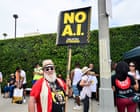
This explains why the support for AI regulation crosses nearly every demographic divide. It doesn't matter if you are a coder in Seattle or a welder in Ohio; the sensation of being watched by an unblinking digital eye is the same. The recent surge in labor activity—from Hollywood writers to hospitality workers—shows a shift in the American psyche. We are seeing the birth of a new kind of digital literacy, where "protection" means more than just a hard hat and steel-toed boots. It means a "Right to Know."
- Transparency: Workers want to know exactly what data is being collected and how it influences their performance reviews.
- Consent: The demand that AI cannot be implemented without a collective bargaining process.
- Human Oversight: A "kill switch" for automated firing, ensuring a human being must make the final call on someone’s livelihood.
These aren't radical demands. They are the digital equivalent of a fire exit.
The Productivity Trap
There is a lie that often circulates in corporate boardrooms: that AI will "free" workers from the mundane. The promise is that by automating the boring stuff, we will all have more time for "creative" pursuits.
The reality for the person on the assembly line is often the opposite. When the "boring" parts of a job are automated, the pace of the remaining work accelerates to a frantic, unsustainable speed. If a machine handles the heavy lifting, the human is expected to move twice as many small parts. It creates a vacuum of rest.
The poll numbers reflect a deep-seated skepticism toward this "productivity" narrative. Workers see the record profits. They see the stock buybacks fueled by automation. And they see their own wages stagnating while the intensity of their workday spikes. They are beginning to realize that if they don't fight for a share of the "AI dividend," all that extra wealth will simply vanish into the pockets of shareholders, leaving the workers with nothing but more stress and less security.
A Seat at the Table or a Spot on the Menu
We often treat technology as if it were a natural disaster—something like a hurricane or an earthquake that we can only prepare for, not prevent. We speak of "the march of progress" as if it has its own legs.
It doesn't.
Technology is a series of choices made by people in rooms. Usually, those rooms are very far away from Sarah’s warehouse or Marcus’s delivery truck. The overwhelming support for union-backed AI policies is an attempt to kick the door to those rooms open.
When a union negotiates over AI, they aren't just haggling over cents per hour. They are debating the future of human dignity. They are asking: does the machine serve the worker, or does the worker serve the machine?
The tension is palpable. In every breakroom where the blue light flickers, there is a growing realization that the future isn't something that happens to us. It is something we build. And right now, the people building the world are tired of being treated like the raw material.
The Invisible Line
There is a specific kind of exhaustion that comes from being managed by a ghost. It’s a weight in the shoulders, a tightness in the chest when you realize that your "manager" is actually a server farm in Virginia. It’s the feeling of shouting into a void and hearing only the hum of a cooling fan in response.
The American worker is drawing a line in the sand. This line says that our skills are not just data sets to be scraped. It says that our time is not just a metric to be optimized.
As we move deeper into this decade, the conflict won't be between those who love technology and those who hate it. It will be between those who believe that efficiency is the highest possible good, and those who believe that a society is only as strong as the agency it grants its citizens.
The poll results are just the beginning. They are the first tremors of a much larger shift. We are moving toward a world where "labor rights" must include "algorithmic rights."
Sarah turns off her scanner at the end of her shift. Her hands are sore, and her mind is tired, but as she walks to her car, she sees her colleagues gathered near the gate. They aren't talking about the boxes. They are talking about the contract. They are talking about the "eye" in the warehouse.
The light is still blue, but for the first time in years, the shadows it casts look like they are starting to move together.