Silence.
That is the deadliest symptom of hepatitis C, a microscopic saboteur that slips into the human body without a fever, without a rash, and without a single warning siren until decades later, when the liver has quietly turned to stone.
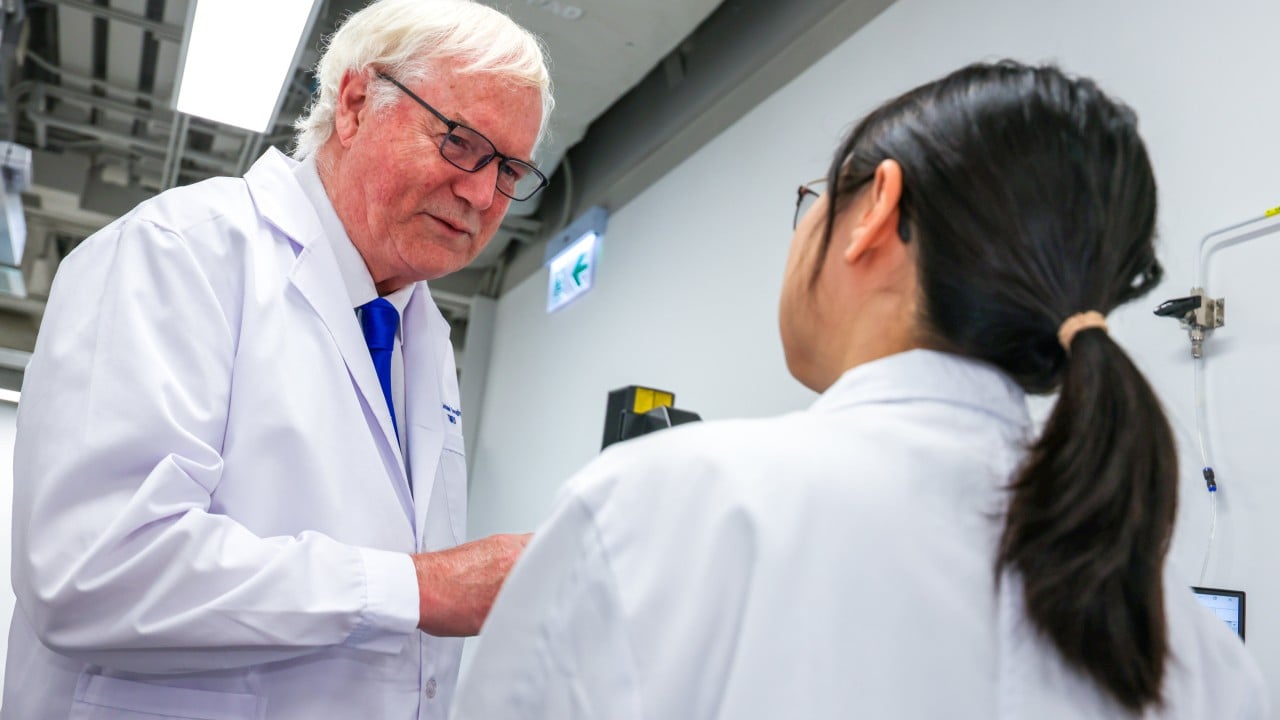
For thirty-five years, a British virologist named Michael Houghton has been haunted by that silence. Most people know him as the man who helped unmask the virus in 1989, a triumph that eventually earned him the 2020 Nobel Prize in Physiology or Medicine alongside Harvey Alter and Charles Rice. By all conventional logic, Houghton’s story should have ended in Stockholm, wrapped in velvet, applause, and retirement. Instead, he packed his decades of unfinished business and looked toward a gleaming laboratory hub on the edge of the South China Sea.
Hong Kong.
To understand why a Nobel laureate is launching an ambitious vaccine development program in Hong Kong right now, you have to step away from press releases and step into the waiting room of a hepatology clinic. Picture a hypothetical patient—let us call him David, a fifty-two-year-old carpenter from Kowloon who had a routine blood transfusion in his twenties, years before universal screening existed. David feels fine. He lifts timber, eats dinner with his family, and sleeps soundly. Yet inside his bloodstream, billions of viral copies are replicating every single day, slowly replacing soft, regenerative liver cells with rigid scar tissue. By the time David notices a faint yellow tint in the whites of his eyes or a dull ache beneath his right ribs, the damage is already advanced.
I have sat across from too many people like David over the years, watching the blood drain from their faces when a routine blood panel reveals decades of invisible injury. You learn quickly that the hardest part of chronic liver disease is not the physical pain at the beginning; it is the psychological whiplash of discovering you have been carrying a ticking clock inside you for half your life without knowing it.
Why a Cure Was Never Enough
Wait. Didn't we already solve hepatitis C?
That is the question almost everyone asks, and on the surface, it makes complete sense. Over the past decade, pharmaceutical science delivered direct-acting antivirals—miraculous pills that can clear the hepatitis C virus from a patient’s body in eight to twelve weeks with cure rates exceeding ninety-five percent. When those drugs arrived, public health officials celebrated. Many assumed the war was over.
They were wrong.
Treatment is not prevention, and a cure does not build a wall. According to the World Health Organization, roughly fifty million people worldwide still live with chronic hepatitis C infection, and around one million new infections occur every single year. Hundreds of thousands of people die annually from cirrhosis and hepatocellular carcinoma—primary liver cancer—driven by this single pathogen.
Consider what happens next in the real world, far away from clinical trial spreadsheets. Direct-acting antivirals are expensive, requiring diagnostic infrastructure, cold-chain logistics, regular blood monitoring, and patients who actually know they are sick. Even in wealthy healthcare systems, the vast majority of infected individuals remain undiagnosed because the virus hides so well. Worse still, curing someone with pills leaves them with zero immunity. If a cured patient is exposed again through unsterile medical equipment, contaminated needles, or accidental blood contact, the virus marches straight back in as if nothing ever happened.
Think of it like bailing water out of a leaking boat with a golden bucket. The bucket works brilliantly. You can empty the hull in minutes. Yet if nobody plugs the hole in the floorboards, the boat keeps filling up, day after day, year after year, exhausting everyone aboard.
A vaccine is the plug.
The Master of Disguise Inside Your Veins
If we can build vaccines against polio, measles, hepatitis A, hepatitis B, and SARS-CoV-2, why has hepatitis C resisted every attempt for nearly four decades?
The answer lies in the biology of an extraordinary shape-shifter. To grasp what Michael Houghton and his researchers are up against, use a simple analogy: imagine trying to train a security guard to recognize a bank robber who changes his face, hair, height, and clothing every thirty seconds.
Hepatitis C is an RNA virus with an astonishingly sloppy copying mechanism. Every time it duplicates its genetic code inside a human liver cell, it makes mistakes. Most viruses die when they mutate too heavily, yet hepatitis C thrives on chaos. Within a single infected person, the virus does not exist as one uniform enemy; it exists as a swarming cloud of millions of slightly different genetic variants, known scientifically as quasispecies. Add to that the fact that there are at least seven major global genotypes and dozens of subtypes circulating across different continents, and the scale of the problem becomes dizzying.
Traditional vaccines work by showing the immune system a mugshot of a pathogen—usually a surface protein—so antibodies can lock onto it and neutralize it upon entry. With hepatitis C, the outer envelope proteins mutate so rapidly that antibodies generated against one strain simply bounce off another. Even worse, the virus cloaks itself in human lipoproteins, essentially wrapping itself in our own cholesterol and fat molecules like a wolf wearing a sheepskin coat, slipping past immune sentries undetected.
I remember reading early vaccine trial failures in the late 2000s and feeling a genuine sense of dread. Brilliant teams threw recombinant proteins, viral vectors, and DNA candidates at the problem, only to watch candidate after candidate stall in phase one or phase two trials. For a long time, the prevailing whisper in virology corridors was that a universal hepatitis C vaccine might simply be biologically impossible.
Houghton refused to accept that verdict.
Why Hong Kong Became the Launchpad
So why take this fight to Hong Kong?
Look at a map of global liver disease, and the logic snaps into sharp focus. Asia carries the heaviest burden of viral hepatitis on Earth. Across East and Southeast Asia, chronic liver inflammation and liver cancer remain leading causes of premature death, placing immense strain on families and public hospitals alike.
Hong Kong sits at a unique crossroads of biomedical ambition, clinical density, and regional connectivity. Over the past several years, the city has poured billions of Hong Kong dollars into life sciences infrastructure, establishing specialized research clusters—most notably through its InnoHK initiative—designed to bring international scientific pioneers together with local universities, translational clinicians, and biotech manufacturing pipelines.
Under the new program backed by Hong Kong’s innovation ecosystem and academic medical centers, Houghton’s team is not starting from a blank whiteboard. Before this launch, Houghton and his colleagues at the University of Alberta had already developed a promising adjuvanted recombinant protein vaccine candidate derived from the envelope glycoproteins—specifically E1 and E2—of a single hepatitis C strain. Against all early skepticism, preclinical and early human immunogenicity studies revealed something remarkable: when formulated properly, antibodies triggered by this candidate could cross-neutralize multiple distinct genotypes of the virus in laboratory assays.
Let that sink in for a moment. A single immunogen teaching the human immune system to recognize several different disguises at once.
Launching the next phase of development in Hong Kong gives the program three things every vaccine effort desperately needs: sustained translational funding, world-class clinical hepatology networks accustomed to running complex liver trials, and direct proximity to the populations across Asia where an affordable, scalable vaccine could save the highest number of lives.
Inside the Anatomy of a Breakthrough
To appreciate how delicate this science is, strip away the jargon and look at what actually happens when an experimental vaccine enters the human arm.
The vaccine does not contain live virus. Nobody can catch hepatitis C from it. Instead, it introduces purified fragments of the virus’s outer shell—the E1E2 heterodimer—paired with a carefully selected adjuvant, a chemical compound that acts like an alarm bell to wake up sluggish immune cells.
When dendritic cells in the muscle tissue scoop up those viral proteins, they travel to nearby lymph nodes and present them to T-cells and B-cells. Two distinct armies must mobilize if the vaccine is going to succeed:
- Neutralizing antibodies, produced by B-cells, which patrol the bloodstream like molecular handcuffs, binding to the virus before it can dock onto a liver cell.
- Cytotoxic T-cells, which act like cellular inspectors, hunting down and quietly clearing out any liver cell that might still become infected despite the antibody shield.
In earlier decades, researchers often triggered one branch of immunity without the other, or generated antibodies that only recognized the exact lab strain used to manufacture the shot. Houghton’s refined approach targets conserved regions of the viral envelope—the structural hinges that the virus cannot easily mutate without destroying its own ability to enter human cells.
Think of those conserved regions like the tires on a getaway car. The robber can repaint the doors, swap the license plates, and tint the windows every five minutes, yet the car still needs round rubber wheels to touch the asphalt. Aim for the wheels, and the disguise stops mattering.
Even so, honesty requires admitting what remains uncertain. Laboratory neutralization is not the same thing as real-world protection across thousands of diverse human beings. Clinical trials must prove that the immune response lasts for years rather than months, that it protects people across different genetic backgrounds, and that it holds up against real-world viral exposure. Science never moves in straight lines; it moves through hypotheses tested against stubborn reality.
The Invisible Stakes Behind the Headlines
When news outlets run a dry six-paragraph brief about a Nobel laureate starting a vaccine program overseas, readers skim past it over morning coffee. It sounds abstract. Institutional. Distant.
It is anything but.
Consider the ripple effects if Houghton’s Hong Kong initiative succeeds over the coming years. Right now, the World Health Organization has set a global target to eliminate viral hepatitis as a public health threat by 2030—reducing new infections by ninety percent and deaths by sixty-five percent. Nearly every public health epidemiologist will tell you privately that without a preventive vaccine, hitting and sustaining those numbers is a fantasy.
Look at the economics alone. Treating a single patient with advanced cirrhosis or liver cancer costs tens of thousands of dollars in hospitalizations, imaging, surgeries, and palliative care, devastating middle- and low-income households. Even discounted antiviral regimens strain national health budgets when millions require testing and follow-up. A two- or three-dose preventive vaccine, manufactured at scale, costs a fraction of a single hospital stay and protects an individual before a single liver cell is ever scarred.
More importantly, look at who gets left behind without a vaccine. In rural clinics where sterile needle supplies run short, among patients undergoing frequent dialysis, among healthcare workers facing accidental needlesticks, and among vulnerable communities stigmatized out of routine medical care, pills will always arrive too late for far too many people. A vaccine does not ask a patient to notice subtle fatigue twenty years after exposure. It does not require complex genetic sequencing of viral strains before administration. It simply stands guard in the dark.
The Long Arc of One Obsession
There is something deeply moving about watching a scientist return to the exact problem that defined his youth, long after the world has already handed him its highest prize.
When Michael Houghton stood in front of an electrophoresis gel back in the late 1980s, hunting for tiny fragments of genetic material from an unknown pathogen then called simply "non-A, non-B hepatitis," colleagues warned him he was chasing a phantom. It took years of grueling, repetitive molecular screening—testing millions of bacterial clones one by one—before his team isolated a single tiny speck of viral RNA that reacted with patient antibodies. That discovery transformed blood transfusions overnight, turning what used to be a terrifying medical gamble into a routine, safe procedure across the developed world.
Yet for Houghton, closing the blood-bank loophole was only half the promise. You do not spend four decades staring at an enemy through a microscope only to walk away while millions of people still carry it unknowingly in their veins.
In a laboratory in Hong Kong, technicians are now preparing reagents, calibrating assays, and mapping out the clinical milestones that will carry a fragile protein candidate from benchtop vials into human arms. Outside those glass walls, across crowded subway platforms and quiet apartment towers from Kowloon to Karachi, millions of people are walking around feeling completely healthy, unaware that a silent passenger is already rewriting their future.
Somewhere in a sterile freezer at minus eighty degrees Celsius sits a tiny clear vial holding a few milliliters of milky liquid—an engineered fragment of a virus’s own armor, turned back against itself so that the next generation never has to learn what cirrhosis feels like.