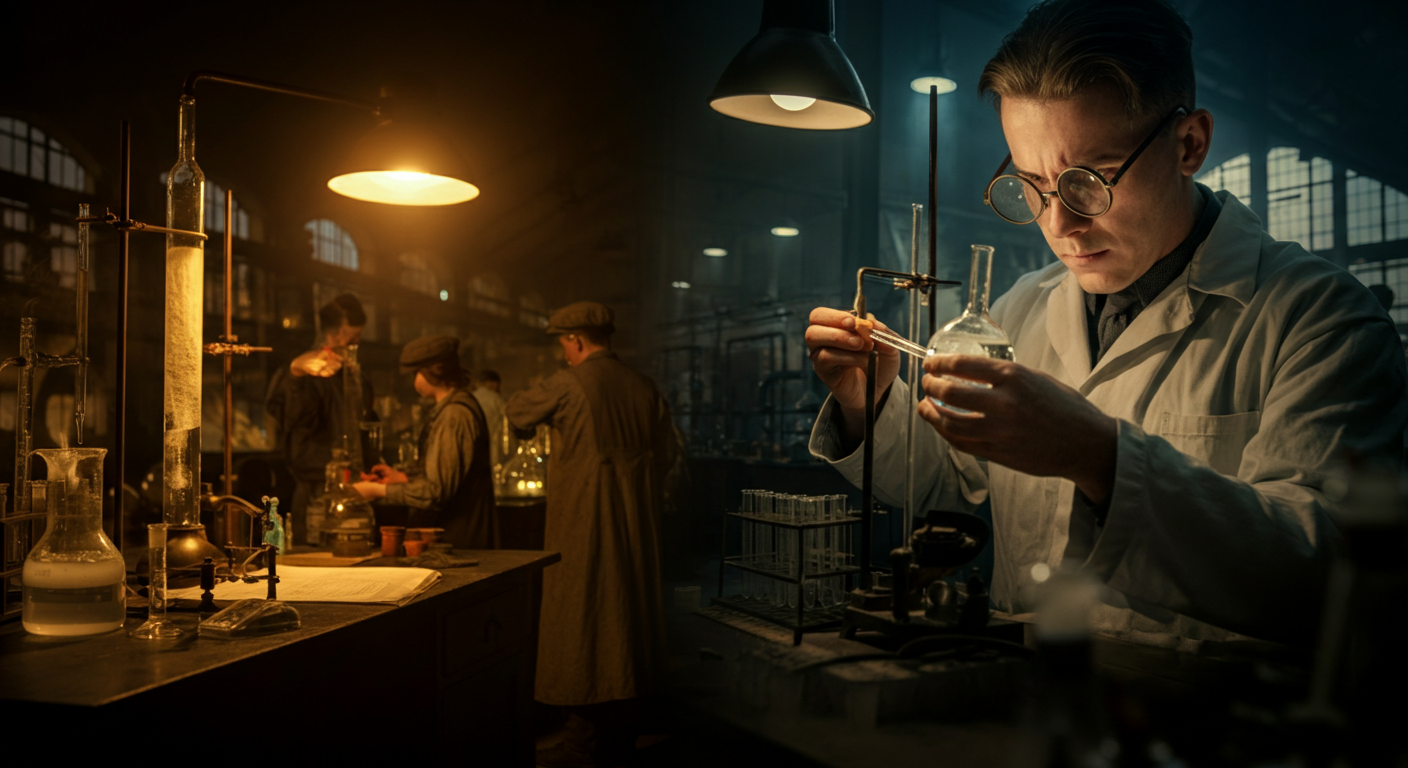
History loves a good accidental genius story. The narrative surrounding the birth of synthetic detergents is practically written in stone: in 1916, amidst severe wartime shortages of fats and oils, German chemists Fritz Günther and Fritz Hetzer desperately scrambled for an alternative to soap. Through sheer serendipity and frantic wartime ingenuity, they whipped up the world's first synthetic surfactant, saving the German home front and inadvertently birthing the modern cleaning empire.
It is a tidy, comforting tale. It is also completely wrong.
The idea that the multi-billion-dollar synthetic detergent industry was born out of a sudden, accidental wartime eureka moment is a historical fantasy. It treats corporate innovation like a cartoon lightning strike.
The truth is far colder, far more calculated, and rooted in a reality that today’s R&D departments desperately try to ignore. The invention of alkylnaphthalene sulfonate (Nekal)—the actual compound behind that 1916 breakthrough—was not a desperate accident. It was the predictable, aggressive execution of long-term coal-tar chemistry research that BASF and its peers had been hammering away at for decades.
Wartime resource scarcity did not spark the invention; it merely forced the commercialization of an existing, subpar industrial wetting agent that nobody wanted to use on human skin. By treating this history as a lucky accident, modern businesses continue to misunderstand how real technological disruption happens.
The Myth of the Accidental Savior
Pick up almost any standard history of consumer goods or chemical engineering. You will find the same lazy consensus: Germany ran out of fats for soap because of the British naval blockade, so chemists suddenly discovered how to make soap without fat.
Let us dismantle the chemistry first. Synthetic detergents are not "synthetic soap." Soap is a specific salt of a fatty acid, made through saponification. Synthetic detergents—surfactants—are entirely different beasts built on hydrocarbon chains that lower the surface tension of water.
Günther and Hetzer did not look into a beaker and accidentally discover a magical cleaning agent. They were working within a highly structured, well-funded corporate machine at BASF that had been systematically mapping out the reactions of naphthalene—a massive byproduct of the German coal-tar dye industry—for over thirty years. They knew exactly what adding a butyl group and a sulfonic acid group to naphthalene would do. They were trying to create an auxiliary agent for textile dyeing.
The war did not create the science. The war merely created a captive market for an inferior product.
Nekal was terrible at washing clothes in the way consumers understood it. It didn't foam well, it smelled faintly of industrial tar, and it was harsh. If you used it to wash your hands, it stripped away skin lipids ruthlessly. Under normal market conditions, a consumer goods company would have laughed it out of the boardroom. But when you are cut off from global trade and your population is suffering from scabies due to a lack of basic hygiene, "harsh and foul-smelling" becomes acceptable.
The Real Mechanism of Industrial Disruption
If you want to understand how a technology actually takes over an industry, you have to look at the transition from Nekal to alkylbenzene sulfonates (LAS) in the 1930s and 1940s.
I have watched modern chemical and tech firms waste tens of millions of dollars trying to replicate "accidental breakthroughs" by giving their engineers unstructured free time or setting up flashy "innovation labs." They are chasing a ghost.
True disruption requires three boring, unglamorous pillars:
- A Massive Industrial Byproduct Problem: Germany didn't just have a shortage of fat; they had an absolute mountain of coal tar from coking plants that they needed to monetize.
- Infrastructure Lock-in: The equipment used to sulfonated dyes was the exact same equipment needed to make synthetic surfactants. The capital expenditure was already amortized.
- The Pivot from Industrial to Consumer: The breakthrough wasn't the chemical synthesis in 1916; it was the formulation engineering in 1933 when Procter & Gamble figured out that adding "builders" (like sodium tripolyphosphate) to synthetic surfactants could actually make them clean better than traditional soap in hard water.
Consider the mechanics of how a surfactant molecule actually works. You have a hydrophilic (water-loving) head and a hydrophobic (water-fearing) tail. Traditional soap molecules bind with the calcium and magnesium ions in hard water, creating an insoluble scum that sticks to clothes and tubs.
Synthetic surfactants do not bind with those minerals. That is their true competitive edge.
But the 1916 German invention alone could not leverage this edge. Without the addition of complex phosphates to soften the water and suspend dirt, synthetic detergents were a niche industrial failure. The competitor narrative stops where the story actually gets interesting because explaining formulation chemistry doesn't make for a snappy, romantic headline.
Why the "Scarcity Breeds Innovation" Premise is Flawed
We are constantly bombarded with the idea that desperation breeds the best technology. "Necessity is the mother of invention."
It is an incredibly dangerous lie for a business leader to believe. Desperation breeds shortcuts.
Imagine a scenario where a modern manufacturer loses access to a critical semiconductor or raw material. They do not suddenly invent a superior quantum computing architecture out of thin air. They downgrade. They rewrite software to run on older, less efficient chips that are readily available. They patch the hole.
That is exactly what Germany did in 1916. Nekal was a patch. It was so ill-suited for universal consumer use that the moment World War I ended and global fat trade resumed, consumers instantly abandoned synthetic detergents and went right back to traditional fat-based soaps. The "revolution" died the second the pressure eased.
The actual shift to synthetic dominance took another two decades of meticulous, unromantic corporate development during peacetime. It required the rise of the petrochemical industry, which swapped out dirty coal-tar naphthalene for cheap, abundant petroleum-derived benzene.
The timeline of surfactant evolution reveals the slow, methodical reality:
| Era | Primary Raw Material | Primary Application | Market Adoption |
|---|---|---|---|
| Pre-1916 | Animal fats, vegetable oils | Consumer bathing, laundry | 100% market dominance |
| 1916–1920 | Coal-tar (Naphthalene) | Industrial textiles, wartime substitute | Restricted to Germany, abandoned post-war |
| 1930s | Petroleum (Kerosene/Benzene) | Industrial processing, early commercial powders | Niche, failed to clean heavily soiled clothes |
| 1940s–Present | Branched/Linear Alkylbenzenes | Universal consumer laundry, dishwashing | Complete displacement of traditional soap |
If you want to disrupt a market, do not pray for a crisis to force your hand. Look at your waste streams. Look at what your manufacturing plants are already built to produce, and find the consumer utility that your current infrastructure can scale without massive capital expenditure.
The Dark Side of Synthetic Dominance
To be fiercely honest, the contrarian approach of pushing synthetic surfactants over natural soaps has a massive, undeniable downside that the chemical industry spent forty years trying to cover up: environmental persistence.
When the industry shifted from coal tar to petroleum in the 1940s, they utilized branched-chain alkylbenzene sulfonates (tetrapropylene benzene sulfonate). These molecules were incredibly effective at cleaning. They were cheap. They scaled beautifully.
They were also completely immune to bacteria.
Because the hydrocarbon chains were heavily branched, the microorganisms in sewage treatment plants couldn't break them down. By the late 1950s, rivers across the United States and Europe were literally covered in mountain-sized walls of toxic white foam. Drinking water coming out of household taps in some regions would foam up like beer.
The industry was forced to re-engineer their entire supply chain in the 1960s to switch to linear alkylbenzene sulfonates (LAS), which are biodegradable. It was an expensive, agonizing pivot that could have been avoided if companies had spent less time celebrating their market dominance and more time analyzing the long-term system mechanics of their chemistry.
Stop Chasing the Epiphany
The lesson of 1916 isn't that shortages create miracles. The lesson is that long-term asset utilization wins.
BASF succeeded because they spent decades mastering the grueling, dangerous, incremental world of coal-tar derivatives. When the crisis hit, they simply reached into their catalog of existing chemical structures and found one that could be repurposed.
Stop waiting for a creative lightning bolt to strike your product pipeline. Stop structuring your business around the myth of the brilliant accident.
Map your existing technical capabilities. Master the core mechanics of your specific industrial footprint. Build a deep, systemic library of solutions before you think you need them. Disruption is not an accident; it is an inevitability engineered by those who are boring enough to prepare for it.