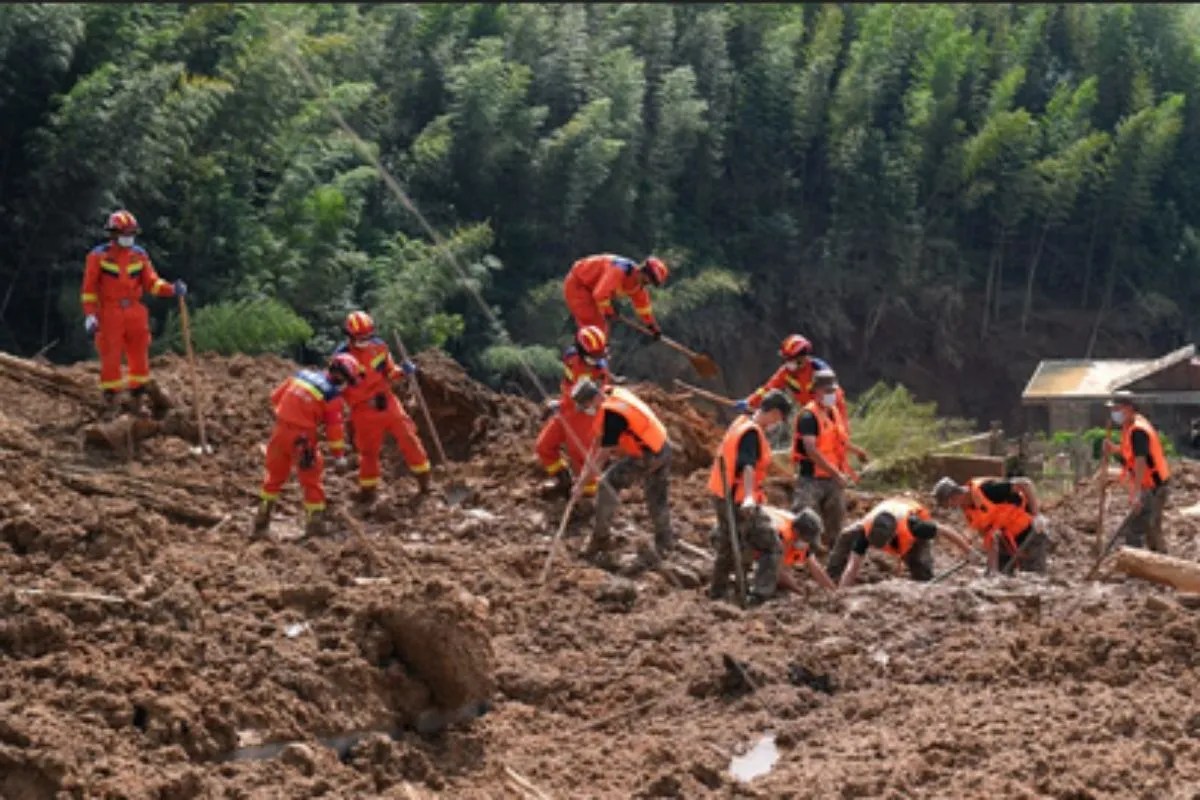
Severe slope failures in mountainous terrains represent complex hydrological hazards where excessive precipitation, compromised soil matrix suction, and steep gravitational gradients intersect. The recent catastrophic landslide in a rural Sichuan village, which resulted in twelve confirmed fatalities, exemplifies the devastating mechanical collapse of weathered regolith under intense pore-water pressure. Understanding this event requires moving beyond surface-level reporting to examine the underlying geotechnical mechanics, regional vulnerability factors, and structural limitations of rural disaster mitigation frameworks.
The Mechanical Failure Sequence
The mechanics governing rapid mass wasting events follow a distinct sequence of stress accumulation and shear strength reduction. In saturated mountain environments, precipitation infiltration alters the internal equilibrium of the soil slope through two primary physical processes.
First, the infiltration of rainwater increases the total unit weight of the soil mass, thereby increasing the driving gravitational forces downward along the potential slip surface. Second, and more critically, the wetting front moves downward, raising the groundwater table and generating positive pore-water pressure. This reduces the effective stress within the granular soil matrix according to Terzaghi's effective stress principle:
$$\sigma' = \sigma - u$$
When pore-water pressure ($u$) increases, the effective normal stress ($\sigma'$) decreases, which directly diminishes the shear strength ($\tau_f$) dictated by the Mohr-Coulomb failure criterion:
$$\tau_f = c' + (\sigma - u) \tan\phi'$$
In this equation, $c'$ represents effective cohesion and $\phi'$ represents the internal friction angle. When the driving shear stress surpasses this degraded shear strength, immediate slope destabilization occurs, transforming static earth into a destructive debris flow.
Vulnerability Factors in Mountainous Settlements
Rural settlements situated in narrow valleys face compound vulnerabilities due to geography, historical land-use patterns, and infrastructure limitations.
Geographic constriction forces communities to occupy alluvial fans, colluvial deposits, and the toes of steep slopes—areas inherently prone to mass movement. Over generations, terracing for agriculture and slope-cutting for road construction have destabilized the basal geometry of local hillsides, increasing the slope angle and removing structural toe support.
Infrastructure gaps further compound these risks. Unlike densely populated urban centers equipped with real-time geotechnical monitoring arrays, tiltmeters, and automated piezometers, remote rural villages rely heavily on passive observation and historical precedent. Early warning systems in these zones often depend on cumulative rainfall thresholds rather than site-specific pore-pressure monitoring. When extreme precipitation events exceed statistical models, the response window collapses, rendering evacuation protocols ineffective.
The Cost Function of Disaster Response
Evaluating the societal and economic impact of slope failures requires analyzing the operational friction inherent in search, rescue, and recovery phases in remote terrains.
The primary cost driver in mountain rescue operations is logistical impedance. Blocked access routes caused by secondary slides, disrupted telecommunications infrastructure, and rugged topography severely restrict the deployment of heavy excavation machinery. Consequently, initial rescue operations rely on manual labor and canine units, drastically reducing the golden rescue window during which survival rates for buried victims remain viable.
Furthermore, the economic burden extends far beyond immediate emergency response. The destruction of local infrastructure halts agricultural supply chains, isolates communities, and necessitates expensive post-disaster relocation programs. Traditional reactive spending—pouring capital into post-event reconstruction without addressing up-stream watershed management—creates a recurring fiscal drain.
Systemic Mitigation Strategies
Mitigating future mass wasting events in vulnerable rural sectors demands a shift from reactive disaster management to proactive geotechnical intervention.
Slope stabilization requires targeted engineering controls based on site-specific geological surveys. Standard structural interventions include the installation of drainage systems to intercept surface runoff and lower subsurface water tables, rock-bolt stabilization for fractured bedrock, and retaining structures at vulnerable slope toes.
For non-structural defense, implementing low-cost, community-managed monitoring networks bridges the technological gap between high-risk rural areas and municipal command centers. Deploying tipping-bucket rain gauges linked to automated SMS alert systems, combined with clearly demarcated evacuation routes mapped against historical slide paths, establishes a functional baseline of community resilience.
Resource allocation must prioritize high-risk settlement mapping, integrating satellite-based Interferometric Synthetic Aperture Radar (InSAR) data to detect subtle ground deformation before catastrophic failure occurs. Shifting administrative focus toward preemptive relocation for communities situated on active creeping slopes remains the singular policy measure capable of eliminating fatalities entirely.


