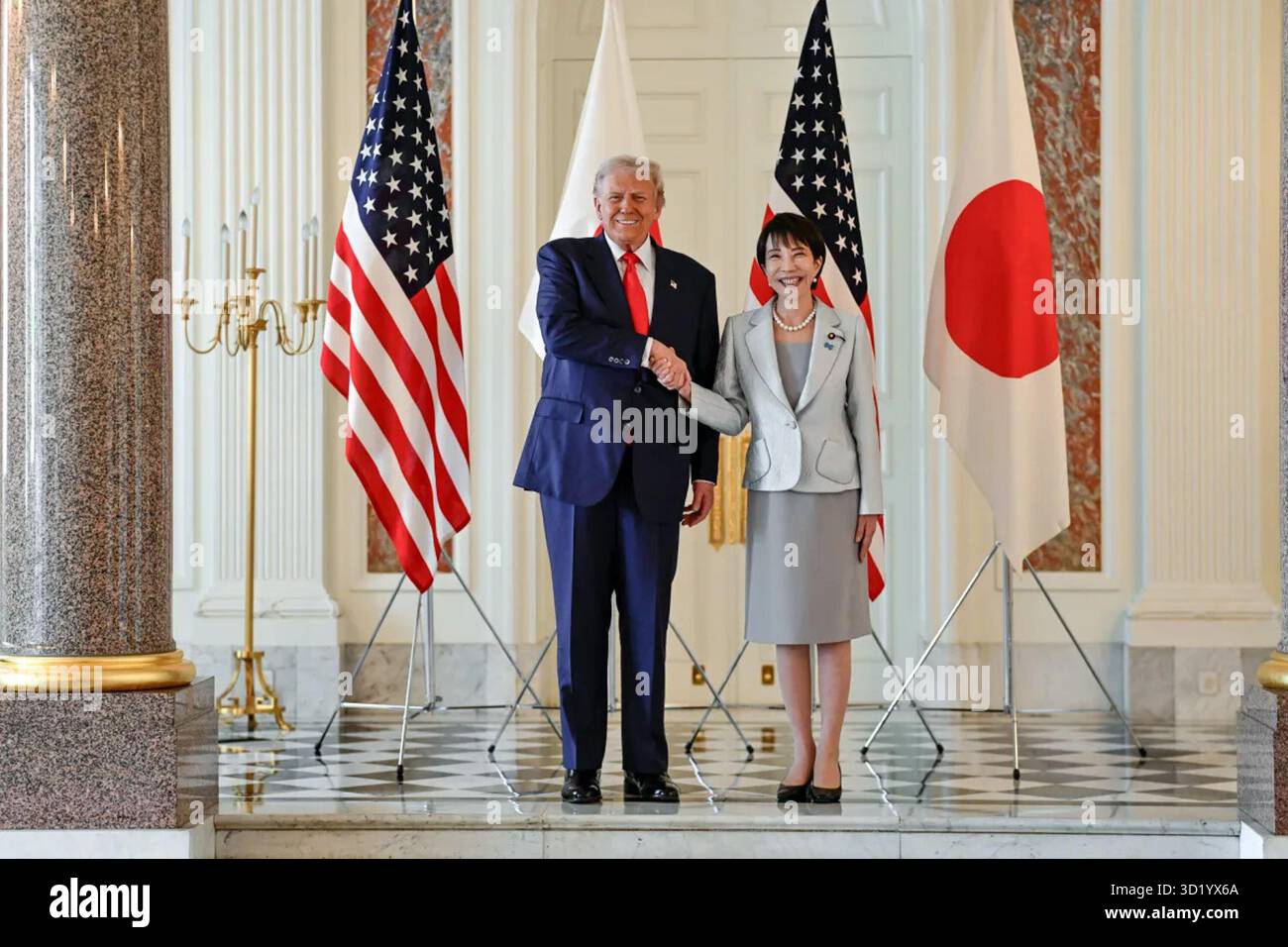
Sovereignty is an absolute asset class in Beijing, whereas individual liberty is a depreciating currency. This fundamental asymmetry explains why U.S. President Donald Trump’s recent bilateral talks with Chinese President Xi Jinping yielded a asymmetric split risk calculation: a conditional willingness to release detained underground church pastor Ezra Jin Mingri, contrasted against an absolute diplomatic roadblock regarding imprisoned Hong Kong media tycoon Jimmy Lai. When President Trump remarked aboard Air Force One that the response regarding the 78-year-old Lai "was not positive" and that Xi designated the file as a "tough one," he was not encountering a sudden diplomatic hitch. He was running directly into China's rigid framework for domestic security governance.
To understand why Jimmy Lai remains locked in a high-security cell while other detainees are treated as tradable geopolitical commodities, one must analyze the distinct legal, structural, and symbolic variables that govern Beijing's strategic calculus. The failure to secure even a rhetorical concession for Lai highlights the limits of transactional, leader-to-leader diplomacy when applied to core Chinese national security doctrines.
The Traded Asset vs. The Existential Precedent
The divergent outcomes of the Jin and Lai cases provide an empirical map of how Beijing categorizes state security threats. The state uses a two-tiered classification mechanism to separate low-risk internal non-conformists from systemic threats to the ruling party's authority.
The Domestic Compliance Tier (The Case of Pastor Jin Mingri)
Pastor Jin, founder of Beijing's unregistered Zion Church, was detained under a localized regulatory framework designed to enforce state control over religious networks. The primary objective of his detention is behavioral alignment and institutional containment. Because the Zion Church is an internal, non-state entity without an explicit geopolitical mandate, Jin represents a compliance issue rather than a structural threat.
His liberty is a liquid diplomatic asset. Beijing can trade him back to Washington in exchange for trade concessions, technology export relaxations, or a rhetorical de-escalation on human rights without undermining the authority of its domestic state apparatus.
The Systemic Subversion Tier (The Case of Jimmy Lai)
Jimmy Lai occupies an entirely different structural position within China's security architecture. Convicted under the 2020 National Security Law for conspiracy to collude with foreign forces and publishing seditious materials, Lai's corporate and media activities via the now-defunct Apple Daily are viewed by Beijing as the primary operational conduit for Western influence during the 2019 Hong Kong protests.
[Threat Tier Matrix]
Low Systemic Threat (Pastor Jin)   ---> Local Regulatory Breach ---> High Trade Liquidity
High Systemic Threat (Jimmy Lai)  ---> National Security Law   ---> Zero Trade Liquidity
For the Chinese Communist Party (CCP), releasing Lai would not be viewed as a gesture of international goodwill; it would be analyzed as a capitulation on the absolute principle of territorial sovereignty. It would signal to domestic and regional actors that the National Security Law has a price tag, functionally destroying its deterrent utility.
The Cost Function of Legal Retraction in Hong Kong
The institutional mechanics of Hong Kong’s post-2020 legal framework create a high cost function for any potential executive intervention by Beijing. Lai was sentenced to a 20-year prison term in February 2026. This sentence acts as the definitive anchor for the city's legal integration into the mainland's security architecture.
A unilateral pardon or an engineered medical parole for Lai would generate severe institutional frictions across three specific axes:
- The Judicial Integrity Paradox: Beijing has spent years asserting that Hong Kong’s judicial system operates with absolute independence and that international criticisms represent illegitimate external meddling. A sudden executive intervention to release a British citizen at the behest of a U.S. President would structurally falsify this narrative, exposing the explicit subordination of Hong Kong courts to centralized political mandates.
- The Deterrence Degradation: The 20-year sentence handed down to Lai was designed to establish a new legal benchmark for political dissent, purposefully eclipsing the 10-year sentences given to other prominent activists like Benny Tai. Reducing this sentence via external political intervention would instantly degrade the risk premium Beijing has established for political non-compliance in the region.
- The Sovereign Infallibility Principle: Under Xi Jinping's governance model, the centralization of state authority requires that major security initiatives—such as the complete political restructuring of Hong Kong—are irreversible. Retracting a flagship prosecution under international pressure would introduce institutional volatility by showing that Western economic or diplomatic leverage can alter internal Chinese legal outcomes.
The Operational Reality of Solitary Confinement
While political analysts track the diplomatic maneuvering, the physical reality of Lai's detention functions as an implicit variable in the negotiations. At 78 years old, managing severe diabetes while being held in prolonged solitary confinement under extreme ambient temperatures—surpassing 40°C in peak summer months—Lai faces a rapid biological depreciation curve.
This biological reality creates a severe structural bottleneck for Western negotiators. The time horizon for diplomatic leverage is structurally constrained by the detainee's life expectancy. Beijing understands this calculation perfectly. History shows that Chinese state security operations frequently favor the biological neutralisation of a security threat within the prison system over the political volatility of an external release.
The precedent set by Nobel laureate Liu Xiaobo, who died under state custody in 2017 despite intense international diplomatic pressure for medical transit abroad, serves as the definitive baseline model for how Beijing handles high-value ideological prisoners.
The Structural Limits of Leader-to-Leader Diplomacy
The modern U.S. foreign policy approach frequently relies on a personalized, transactional methodology. This strategy presumes that complex geopolitical disputes can be unbundled into discrete bilateral trades driven by personal rapport between heads of state. The failure to move the needle on the Lai file exposes the limits of this model when interacting with a highly institutionalized, committee-driven state like China.
When President Trump presented the argument that Lai is "an older man" who is "not feeling too well" and that a release "would be nice," he was utilizing an informal, relational negotiation framework. This framework fails because it does not interface with the quantitative risk-reward matrices used by the CCP's Central Policy Research Office.
For Beijing, the structural payoffs of keeping Lai incarcerated vastly outweigh the transactional incentives offered by Washington. The stability of the domestic security architecture, the absolute enforcement of the National Security Law, and the containment of Hong Kong’s financial ecosystem within a strictly controlled political framework are non-negotiable strategic priorities. No marginal adjustment in trade quotas, tariff schedules, or security commitments regarding Taiwan can offset the perceived systemic risk of displaying political weakness on a core sovereignty issue.
The Strategic Path Forward for Western Diplomacy
Because informal diplomatic appeals have failed to alter Beijing’s operational calculus, Western governments must abandon ad-hoc requests and implement a structured, multi-lateral leverage framework if they intend to alter the trajectory of Lai’s detention.
[Leverage Matrix Integration]
Bilateral Rhetoric (Current) ---> Low Sovereign Cost to China ---> Status Quo Maintained
Multilateral Cost Imposition ---> High Institutional Frictions ---> Operational Re-evaluation
First, the United States and the United Kingdom must unify their diplomatic positions, explicitly linking Hong Kong's preferential economic statuses and separate international judicial treatments to the verifiable observation of human rights baselines, using Lai’s health and legal status as a primary index.
Second, international negotiators must shift from moral arguments to hard institutional costs. This means imposing targeted, multilateral sanctions on the specific financial and administrative pipelines that manage Hong Kong's security apparatus.
Ultimately, Western states must accept that unless the external costs imposed on Beijing surpass the internal political costs of a legal retraction, Jimmy Lai will remain a permanent fixture within China's penal architecture.