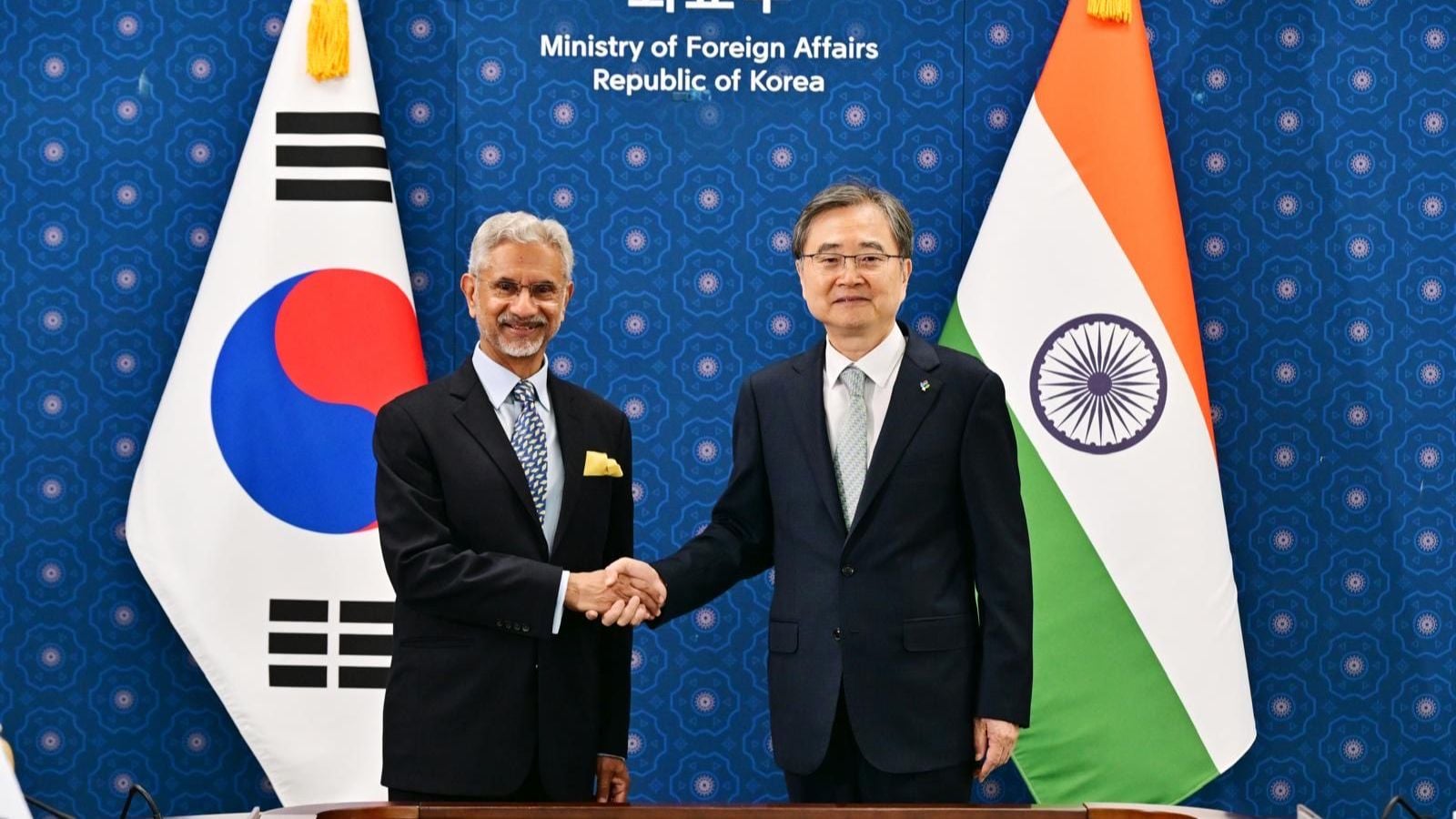
Indian External Affairs Minister S. Jaishankar’s meeting with his South Korean counterpart, Cho Tae-yul, goes far beyond the standard diplomatic pleasantries of deepening a strategic partnership. The real story is about supply chain survival and defense co-production in an increasingly volatile Indo-Pacific region. Both nations find themselves in a precarious position, wedged between a dominant China and an unpredictable West. To understand this sudden diplomatic urgency, one must look past the joint statements on trade figures and examine the harsh semiconductor realities and military hardware dependencies pulling New Delhi and Seoul together.
The Chips and Tanks Alliance
Diplomats love the phrase "Special Strategic Partnership," but the true drivers of this bilateral relationship are silicon and steel. India wants to build a domestic semiconductor industry from scratch. South Korea already owns one of the most advanced microchip ecosystems on earth.
This is not a matter of choice for New Delhi. India's reliance on imported electronics represents a massive economic vulnerability. By courting Seoul, India is attempting to secure a reliable source of technology transfer that does not carry the political baggage or high costs of American or European alternatives.
The defense sector tells a similar story of mutual need.
- The K9 Vajra Success: India’s procurement of the K9 Vajra self-propelled howitzer—a localized version of South Korea’s K9 Thunder—serves as the blueprint for future cooperation. Built by Larsen & Toubro in India, this program proved that South Korean military technology could be successfully absorbed into the Indian defense manufacturing ecosystem.
- Co-Production Realities: New Delhi is actively pushing for more agreements like the K9 project. The goal is to move away from the traditional buyer-seller dynamic and transition into joint development of advanced military hardware.
- The Russian Factor: For decades, India relied heavily on Moscow for military hardware. With Russia heavily distracted by the ongoing conflict in Ukraine and facing severe international sanctions, New Delhi desperately needs to diversify its defense supply chains. South Korea offers a highly capable, NATO-compatible alternative without the political friction associated with Western defense giants.
Weighing the Strategic Friction
The alignment looks perfect on paper, but significant friction points exist beneath the surface. The trade relationship remains deeply asymmetrical. India's trade deficit with South Korea is a persistent thorn in the side of policymakers in New Delhi.
Bilateral Trade Balance (Approximate Annual Figures)
+-------------------+---------------------+
| Indian Exports    | ~ $6.5 Billion      |
+-------------------+---------------------+
| S. Korean Exports | ~ $16.5 Billion     |
+-------------------+---------------------+
| India's Deficit   | ~ $10.0 Billion     |
+-------------------+---------------------+
India routinely complains that the Comprehensive Economic Partnership Agreement signed in 2009 favors South Korean conglomerates while blocking Indian pharmaceuticals and agricultural products through non-tariff barriers. Seoul, on its part, grows frustrated with India’s sudden regulatory shifts, complex tax structures, and protectionist tendencies under the "Make in India" initiative.
Then there is the China factor.
While both nations view Beijing's regional assertiveness with deep concern, their operational environments are entirely different. India shares a fiercely contested, heavily militarized land border with China. South Korea is geographically tethered to the Chinese economic engine while living under the constant shadow of a nuclear-armed North Korea.
Seoul cannot afford an adversarial relationship with Beijing. This reality limits how far South Korea can go in supporting India’s broader security architecture, particularly within frameworks like the Quad. Seoul prefers to keep its security engagements strictly bilateral or focused on non-traditional security threats like piracy and cybersecurity rather than joining explicit anti-China coalitions.
The Corporate Blueprint
To understand where this relationship is heading, ignore the defense ministries and watch the boardroom movements in Seoul and Mumbai. South Korean chaebols—the massive family-owned conglomerates that dominate their domestic economy—are quietly shifting their global strategies.
Hyundai is expanding its manufacturing footprint in India, treating the subcontinent not just as a consumer market, but as an export hub for the Middle East and Africa. Samsung has established one of its largest mobile phone manufacturing facilities in Noida. These are long-term capital investments that signal deep structural commitment.
Key South Korean Corporate Footprints in India:
1. Hyundai Motor Group: Extensive manufacturing hubs in Tamil Nadu; aggressive EV expansion.
2. Samsung Electronics: Massive manufacturing facilities and R&D centers across northern India.
3. LG Electronics: Widespread domestic appliance production and distribution networks.
4. Posco: Ongoing steel production investments despite local regulatory hurdles.
The next frontier is the semiconductor supply chain.
Building a fabrication plant requires immense capital, reliable water and power infrastructure, and a highly specialized workforce. India currently lacks all three in the quantities required. South Korea is hesitant to export its crown-jewel technology—advanced logic chip manufacturing—to an unproven ecosystem.
Instead, the immediate focus is shifting toward Assembly, Testing, Marking, and Packaging facilities. This allows India to enter the semiconductor value chain at a lower threshold while giving South Korean firms a cost-effective alternative to their current manufacturing bases in China.
The True Test of the Indo Pacific Strategy
The diplomatic tango between Jaishankar and Cho Tae-yul is an exercise in managing limitations while maximizing mutual vulnerabilities. India needs South Korea’s technology and manufacturing expertise to fuel its rise as an industrial superpower. South Korea needs India’s massive domestic market and geopolitical weight to hedge against its declining demographic profile and over-dependence on Chinese supply chains.
Success will not be measured by the warmth of diplomatic handshakes or the signing of minor memorandums of understanding. It will be measured by whether Seoul is willing to transfer high-end technology to Indian factories, and whether New Delhi can cut through its own bureaucratic red tape to create a hospitable environment for South Korean capital. Until those structural shifts occur, the partnership will remain a collection of missed opportunities hidden behind sophisticated diplomatic rhetoric.