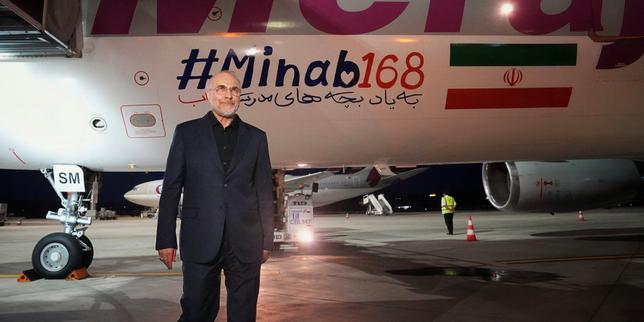
The proclamation by Iran's chief negotiator and parliamentary speaker, Mohammad Bagher Ghalibaf, that the Strait of Hormuz will never return to its pre-war conditions and will be administered directly by Tehran, signals a structural shift in maritime security frameworks. While generalist analysis frequently interprets such declarations as rhetorical posturing or an outright violation of international law, an operational assessment reveals a calculated transition from a shared transit paradigm to a high-leverage unilateral gatekeeping model.
The baseline reality of this shift rests on a hard security infrastructure finalized during recent bilateral negotiations in Switzerland. By extracting an interim mechanism that includes a 60-day open-transit protocol, the unfreezing of $12 billion in restricted assets, and a temporary suspension of U.S. sanctions on oil, petrochemicals, banking, and insurance, Tehran has effectively codified its administrative presence. The operational architecture of this new regime alters the equilibrium of global energy logistics and maritime deterrence.
The Three Pillars of the Post-War Shipping Regime
Iran's strategy to institutionalize its administrative oversight over the Strait of Hormuz relies on three distinct operational pillars designed to bypass traditional Western naval containment.
1. Codified Communication Lines
The establishmennt of a dedicated, direct technical communication channel between Washington and Tehran regarding ship movements is the central mechanism of the new administrative model. Rather than relying on traditional multi-lateral maritime tracking or intermediary states, this bilateral link forces the United States to recognize Iran as the primary traffic controller within the chokepoint. The operational utility for Tehran is dual-purpose: it legitimizes their surveillance capabilities and creates a formal protocol where maritime friction must be resolved through direct diplomatic or technical engagement with Iranian authorities.
2. Strategic Synchronization with Sovereign Littorals
Ghalibaf’s diplomatic itinerary immediately following the Switzerland talks included high-level briefings in Muscat with Oman’s Sultan Haitham bin Tariq. Because the United Nations Convention on the Law of the Sea (UNCLOS) governs the Strait via the right of transit passage through international straits, any unilateral Iranian alteration of shipping lanes requires either the complicity or structured neutrality of Oman, whose territorial waters cover the southern half of the navigable inbound/outbound shipping lanes. By positioning this new administrative framework as a joint regional arrangement, Iran attempts to insulation its actions from immediate legal challenges by non-littoral states.
3. Integrated Military-Diplomatic Feedback Loops
The Iranian negotiating team explicitly characterized their diplomatic concessions as an extension of tactical achievements on the battlefield. This integration establishes a clear feedback loop: military capabilities—specifically anti-ship ballistic missiles, drone swarms, and fast-attack craft—are used to disrupt maritime traffic to create a diplomatic negotiation floor. Once concessions are secured, the administrative framework is locked in via diplomatic protocols. If execution friction occurs, Tehran retains the capability to revert to kinetic disruption, treating negotiations not as an end state, but as a continuous method of managing geopolitical leverage.
The Cost Function of Transit Disruption
To evaluate the stability of Iran's administrative claim, the mechanics of maritime transit through the Strait must be analyzed through a quantitative cost function. The Strait of Hormuz is a hyper-dense maritime bottleneck measuring only 21 nautical miles wide at its narrowest point, with shipping lanes divided into two-mile-wide inbound and outbound corridors separated by a two-mile buffer zone.
The economic cost of disruption within this corridor is not linear; it accelerates based on compounding operational variables:
$$C_{\text{disruption}} = f(I_{\text{premium}}, L_{\text{demurrage}}, T_{\text{reroute}}, V_{\text{replacement}})$$
Where:
- $I_{\text{premium}}$ represents the war-risk insurance premium multipliers levied on hull and cargo assets.
- $L_{\text{demurrage}}$ reflects the daily liquidity losses incurred by commercial fleets held at anchor during closures.
- $T_{\text{reroute}}$ calculates the capital expenditure required to divert crude volumes around the Cape of Good Hope or via under-capacity pipelines like Saudi Arabia's East-West Pipeline.
- $V_{\text{replacement}}$ is the marginal volatility index added to global benchmark crudes (Brent and WTI) per day of restricted flow.
During the height of recent kinetic engagements, maritime traffic through the Strait plummeted by an estimated 90 percent within a single week. This data point highlights the vulnerability of global energy supply chains and explains why the temporary suspension of U.S. naval blockades and sanctions was deemed necessary by Western economies to stabilize global markets. By establishing an administrative regime, Iran seeks to transition from crude, binary closures—which invite catastrophic military retaliation—to a regulated, high-friction model where it can dial the variables of the cost function up or down depending on its immediate sanctions-relief requirements.
Structural Boundaries and Strategic Risks
The primary structural limitation of Iran's strategy is the explicit enforcement threshold set by the United States. Concurrently with the sanctions relaxation, Washington enacted twin executive orders reinforcing a policy of zero-tolerance regarding long-term international transit interference or nuclear weapons acquisition. This creates an unstable equilibrium.
The administrative model assumes that the United States and its allies will tolerate a high degree of low-level Iranian oversight in exchange for predictability in energy markets. However, this assumption breaks down under two distinct scenarios:
- The Symmetrical Enforcement Dilemma: If Iran interprets "administration" as the right to inspect, delay, or selectively bar commercial vessels flying the flags of Western nations or their allies, it triggers the automatic re-imposition of the U.S. naval blockade. This would instantly collapse the temporary sanctions waivers, cutting off the newly unfrozen $12 billion asset liquidity line.
- The Tactical De-escalation Deficit: The Iranian model relies on the threat of immediate kinetic escalation (the "missile option") to enforce its diplomatic position. If a localized maritime incident occurs—such as an unauthorized boarding or a misidentified vessel targeting—the direct communication lines established in Switzerland may prove insufficient to halt rapid escalation cycles. The friction between decentralized naval commanders in the Islamic Revolutionary Guard Corps Navy (IRGCN) and the centralized diplomatic apparatus in Tehran introduces a high margin of operational error.
The Near-Term Strategic Play
The immediate trajectory of the Persian Gulf maritime security architecture will be determined during the 60-day operational window created by the Swiss protocol. Iran will not attempt an immediate, aggressive overhaul of transit rules. Instead, Tehran's optimal play is to quietly establish an operational baseline for its administrative oversight by enforcing minor regulatory updates, mandatory reporting protocols for commercial ships entering the Iranian sector of the Traffic Separation Scheme, and formalizing the Oman-Iran bilateral maritime management working group.
For international shipping syndicates and energy markets, this means treating the Strait of Hormuz not as an open international waterway, but as an actively managed political zone. Sovereign risk premiums will remain embedded in maritime shipping costs despite the current ceasefire, as the underlying structural cause of the conflict—the balance of power between Washington, Tel Aviv, and Tehran—has not been resolved, but merely converted into a technical administrative framework.

/https://tf-cmsv2-smithsonianmag-media.s3.amazonaws.com/filer/c6/97/c697b065-e0bd-4970-81ea-819779296b91/u765404inp.jpg)
