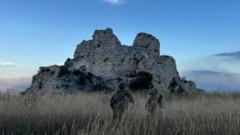
The capture of the medieval Beaufort Castle (Qalaat al-Shaqif) by the Israel Defense Forces (IDF) represents a profound shift in the structural parameters of the conflict in southern Lebanon. Media narratives framing this event purely around historical symbolism or tactical milestones obscure the underlying military calculus. By advancing five kilometers north of the Litani River near the city of Nabatiyeh, the IDF has executed its deepest ground incursion into Lebanon since the 2000 withdrawal. This maneuver fundamentally alters the defensive geometry of the region, replacing a highly contested border war with a high-stakes forward-buffer strategy designed to dictate terms to Hezbollah and its state sponsor, Iran.
To evaluate the strategic weight of this offensive, the deployment must be broken down into its core drivers: topographical dominance, spatial escalation frameworks, and the exploitation of a diplomatic vacuum.
The Mechanics of Topographical Dominance
The military utility of the Beaufort Ridge is dictated entirely by its geography. Perched at an elevation overlooking both the Litani River corridor and the western Bekaa Valley, the ridge functions as a natural force multiplier.
From an operational standpoint, control over this high ground provides three distinct advantages:
- Line-of-Sight Kinematics: The summit allows for direct visual and electronic surveillance over critical transit lanes and assembly points used by Hezbollah. This observation capability shortens the kill chain, reducing the latency between target acquisition and precision engagement via artillery or close air support.
- Counter-UAV Geometries: Throughout the current phase of hostilities, Hezbollah has leveraged low-altitude, fiber-optic-guided drones and low-radar-cross-section loitering munitions to bypass Israel's air defense grid, inflicting significant casualties on forward-deployed IDF units. Holding the Beaufort Ridge denies the group the low-altitude defilade launch points required to mask these drones during their initial acceleration phase, compressing Hezbollah’s operational depth.
- Interdiction of Tactical Fires: The ridge acts as a physical barrier. By establishing a fixed military presence on the heights, the IDF restricts Hezbollah's ability to position short-range rocket systems within direct trajectory lines of northern Israeli border towns like Metula and the broader Galilee Panhandle.
The Three Pillars of Spatial Escalation
The seizure of Beaufort Castle is not an isolated tactical raid; it serves as the linchpin of an expanded territorial strategy. This expansion operates across three structural pillars designed to systematically dismantle Hezbollah's presence between the Litani and Zahrani rivers.
       [ Pillar 1: Buffer Expansion ]
                     │
                     ▼
       [ Pillar 2: Kinetic Encirclement ] ──► Target: Nabatiyeh Hub
                     │
                     ▼
       [ Pillar 3: Forced Population Displacement ]
1. Buffer Expansion and Border Decoupling
The initial operational design of the IDF ground campaign relied on securing a narrow strip along the Blue Line. Crossing the Litani River breaks this self-imposed constraint. By redefining the combat zone up to the Zahrani River, forty kilometers north of the border, the Israeli command is shifting from a policy of defensive denial to one of offensive insulation. The objective is to construct a deep kinetic buffer zone where any movement is classified as hostile, thereby pushing the threat vector entirely out of physical range of Israeli civilian centers.
2. Kinetic Encirclement of Nabatiyeh
Positioned roughly five kilometers from the newly established IDF lines, Nabatiyeh operates as the economic, administrative, and logistical center of gravity for southern Lebanon. Rather than committing heavy armor to direct urban warfare—a choice that historically yields high attrition rates—the capture of the surrounding heights suggests a strategy of kinetic encirclement. By controlling the dominant terrain, the IDF can interdict supply lines and isolate the city, forcing Hezbollah units to either withdraw or engage in exposed, asymmetric counter-attacks against fortified high positions.
3. Forced Population Displacement as an Operational Shield
The issuance of sweeping evacuation orders covering all territory south of the Zahrani River serves a dual function. Structurally, it strips Hezbollah of the civilian architecture it uses for concealment and logistics. Pragmatically, it creates an empty battlespace, allowing the IDF to employ unrestricted combined arms fire, including engineering units tasked with the systemic demolition of subterranean infrastructure and weapons caches. This creates what Lebanese officials call a scorched-earth reality, raising the long-term economic and political cost of governance for the Lebanese state.
The Diplomatic Vacuum and the Cost Function of Delay
The timing of this deep ground push reveals an intentional convergence between military maneuvering and diplomatic stagnation. Direct negotiations scheduled at the U.S. State Department serve as a ticking clock for both combatants. The current offensive highlights a distinct cost-benefit calculation that explains why nominal ceasefires fail to hold on the ground.
For the Israeli political leadership, the failure of the April 17 ceasefire to halt low-signature drone attacks created an unsustainable status quo. The strategic play is to maximize territorial gains and infrastructure destruction before a U.S.- or internationally brokered framework imposes strict operational boundaries. By holding the Beaufort Ridge prior to entering direct talks, Israel shifts the baseline of the negotiations. The presence of the Golani Brigade flag over the fortress transforms a tactical position into an explicit bargaining chip: Israel can offer a future withdrawal from positions north of the Litani in exchange for hard, verifiable enforcement mechanisms that guarantee Hezbollah cannot re-enter the border zone.
Conversely, this creates a punishing cost function for Hezbollah and its primary patron, Iran. Following U.S.-Israeli strikes on Iranian leadership and assets, Hezbollah finds itself operating under reduced strategic air cover. Every square kilometer surrendered north of the Litani degrades the group's leverage at the negotiating table, forcing them to burn through dwindling stockpiles of precision missiles and loitering munitions in an attempt to inflict enough IDF casualties to make the occupation of the ridge politically unviable inside Israel.
Systemic Risks and Operational Limitations
While the capture of Beaufort Ridge provides a clear tactical advantage, history outlines the profound structural risks associated with holding this specific terrain. The site is a historical trap; the IDF occupied this exact fortress from 1982 until its unilateral withdrawal in 2000. During that period, the static nature of the outpost turned it into a primary target for Hezbollah's war of attrition, contributing heavily to the domestic political pressure that eventually forced the Israeli retreat.
The primary limitation of a forward-buffer strategy is the friction of extended supply lines. As the IDF pushes further north toward Nabatiyeh, its logistical corridors must traverse rugged, asymmetric terrain that is highly vulnerable to ambushes, improvised explosive devices (IEDs), and anti-tank guided missile (ATGM) teams operating from bypassed pockets of resistance. A single drone strike west of the Beaufort area recently claimed the life of an Israeli soldier, demonstrating that topographical dominance does not equal total operational immunity.
Furthermore, a strategy predicated on total population displacement carries a steep diplomatic depreciation schedule. While it provides short-term military freedom of action, the compounding humanitarian crisis accelerates international pressure and complicates bilateral relations with Western partners. This makes the upcoming diplomatic sessions a critical pivot point.
The ultimate success of the Beaufort operation will not be measured by the symbolic placement of a flag on a medieval wall, but by whether the IDF can convert this temporary topographical dominance into a permanent structural reality before the diplomatic window closes. If used to force a demilitarized architecture overseen by robust international verification, the operation achieves its goal. If negotiations stall indefinitely, the ridge risks transitioning once again from a dominant forward operating base into a costly, static target in a prolonged war of attrition.