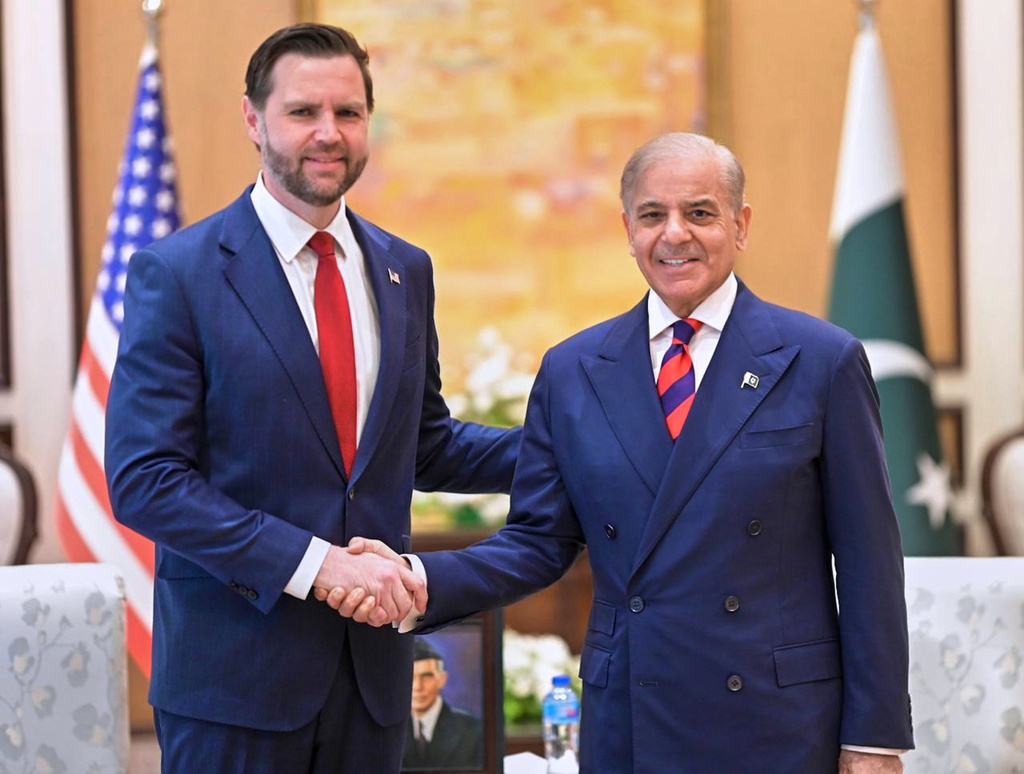
The selection of Pakistan as the physical venue for high-level US-Iran dialogue signals a transition from erratic back-channel signaling to a structured, mediated engagement model designed to isolate regional friction from global energy markets. This diplomatic shift operates on the principle of triangulated de-escalation, where Islamabad functions not merely as a host, but as a strategic buffer capable of absorbing the political fallout for both Washington and Tehran. The initiation of these talks suggests that the cost-benefit analysis for both powers has shifted; the risk of uncontrolled escalation now outweighs the domestic political capital gained from continued hostility.
The Tripartite Strategic Calculus
The decision to convene in Pakistan is governed by three distinct operational pressures that have rendered previous mediation channels, such as those in Muscat or Doha, insufficient for the current requirements. For another perspective, consider: this related article.
1. The Proximity-Security Paradox
Pakistan shares a 900-kilometer border with Iran and maintains a long-standing, albeit complex, security partnership with the United States. This dual-access gives Islamabad a unique "enforcement" credibility. For the US, Pakistan provides a footprint that is geographically relevant to the Iranian Revolutionary Guard Corps (IRGC) operations in the east. For Iran, Islamabad represents a non-Arab intermediary, bypassing the sectarian and regional rivalries inherent in Gulf-led mediation.
2. The Internal Economic Burden
The Iranian economy operates under a sustained Sanctions Elasticity Constraint. Tehran has reached a threshold where the marginal cost of circumventing sanctions is beginning to exceed the revenue generated from "gray market" energy exports. The dialogue in Pakistan is fundamentally an attempt to negotiate a "sanctions-for-stability" swap. Specifically, Iran seeks technical waivers on frozen assets in exchange for a verifiable reduction in enrichment levels and a cessation of specific proxy activities. Related reporting on this trend has been provided by NPR.
3. The US Pivot to Resource Conservation
Washington’s participation is driven by a necessity to reallocate military and intelligence resources toward the Indo-Pacific. Every unit of diplomatic energy spent on containing Iran is a unit diverted from theater-level competition with peer adversaries. By formalizing a dialogue in Pakistan, the US aims to establish a "managed rivalry"—a state of predictable friction that does not require the constant deployment of Carrier Strike Groups to the Persian Gulf.
Mechanics of the Pakistani Mediation Model
Islamabad’s role is defined by Discrete Neutrality. Unlike previous mediators who often sought to bridge ideological gaps, Pakistan’s objective is functional: the creation of a communication corridor that survives localized kinetic exchanges.
The mediation framework relies on a Double-Blind Verification Process. Pakistan acts as the courier for sensitive technical data regarding Iran’s nuclear program and the US’s sanctions-relief timelines. This reduces the "face-saving" costs for both administrations, as they are not seen as negotiating directly with an "enemy" but are instead "consulting with a regional partner."
- Phase I: The De-risking Protocol. Establishment of direct hotlines between military commands to prevent accidental escalation in the Strait of Hormuz.
- Phase II: The Asset Repatriation Schedule. Mapping the release of Iranian funds held in South Korean and Japanese banks against specific, time-bound milestones in Iranian nuclear de-enrichment.
- Phase III: The Proxy Boundary Agreement. Defining "Red Zones" where Iranian-backed regional actors must cease operations to avoid triggering a direct US response.
Structural Bottlenecks and Friction Points
The success of these talks is not guaranteed. Several structural variables create a high probability of "negotiation stall."
The Principal-Agent Problem
The Iranian negotiating team represents the executive branch, yet the ultimate veto power resides with the Supreme Leader and the IRGC. If the IRGC perceives that de-escalation threatens their internal economic monopolies—often built on the necessity of a "resistance economy"—they possess the kinetic tools to sabotage the talks through localized border skirmishes or maritime harassment.
The Congressional Constraint
In Washington, any movement toward a formal agreement faces the Legislative Override Risk. The US executive branch is negotiating under the shadow of the Iran Nuclear Agreement Review Act (INARA), which provides Congress the mechanism to reject any deal that resembles a return to the 2015 JCPOA. Consequently, the talks in Pakistan are likely to produce a "Non-Paper" agreement—a series of unwritten, reciprocal understandings that do not require formal ratification but remain highly fragile.
The Israeli Variable
Israel views any US-Iran thaw through the lens of an existential threat. A successful Pakistani dialogue could trigger an Israeli "Strategic Breakout," where Jerusalem initiates unilateral operations against Iranian nuclear infrastructure to force the US back into a confrontational posture.
Quantifying the Regional Security Impact
If the Pakistan talks stabilize into a recurring forum, the regional power dynamic will undergo a fundamental recalibration.
The first shift will be the Depreciation of the Conflict Premium in global oil prices. Market volatility is currently indexed to the "Strait of Hormuz Risk." A formal de-escalation channel in Islamabad provides a psychological floor for energy markets, potentially reducing Brent Crude volatility by 15-20% over a fiscal quarter.
The second shift concerns the Balochistan Security Architecture. Both Iran and Pakistan face insurgencies in the border region. A byproduct of these talks is a coordinated counter-terrorism framework. If the US provides tacit approval or intelligence sharing, the border between Iran and Pakistan could transform from a zone of mutual suspicion into a managed security corridor, effectively neutralizing third-party militant groups that benefit from the current vacuum.
The Cost Function of Failure
The collapse of the Islamabad channel would result in a Hardened Containment Cycle. Without this outlet, the US will be forced to increase its "Over-the-Horizon" capabilities in the region, leading to a permanent increase in CENTCOM’s operational budget. For Iran, failure signifies a total pivot to the "East," deepening dependency on Chinese credit lines and Russian military technology, which effectively removes Tehran from the Western diplomatic orbit for a generation.
The "Pakistan Track" represents the final viable alternative to a binary choice between a nuclear-armed Iran or a full-scale regional war. The primary metric for success in the coming months will not be a signed treaty, but the absence of "irregular" kinetic events in the Persian Gulf and the stabilization of the rial against the dollar.
Strategic Forecast and Mandatory Adjustments
For the dialogue to move beyond a preliminary exchange, the US must shift its stance from "Total Denuclearization" to "Containment of Intent." Attempting to strip Iran of all nuclear knowledge is a technical impossibility. The strategy should focus on extending the "Breakout Time" through the Pakistani channel while offering Iran a path to regional economic integration that makes the cost of a nuclear weapon prohibitively high.
Regional stakeholders, particularly the GCC, must be integrated into the "Pakistani Framework" via a secondary consultative loop. Excluding Riyadh or Abu Dhabi from the results of the Islamabad talks will ensure their eventual collapse through regional lobbying in Washington. The objective is the creation of a Regional Stability Equilibrium where the US-Iran relationship is no longer the primary driver of Middle Eastern insecurity, but a managed variable within a broader South Asian and Gulf security architecture.
The immediate tactical play for the US is to secure a "Standstill Agreement"—a 90-day freeze on both sanctions expansion and enrichment activities—to provide the Islamabad forum the breathing room required to draft a technical memorandum. Failure to secure this freeze within the first two rounds of talks will likely result in the channel being dismissed as a stalling tactic by hardliners on both sides.