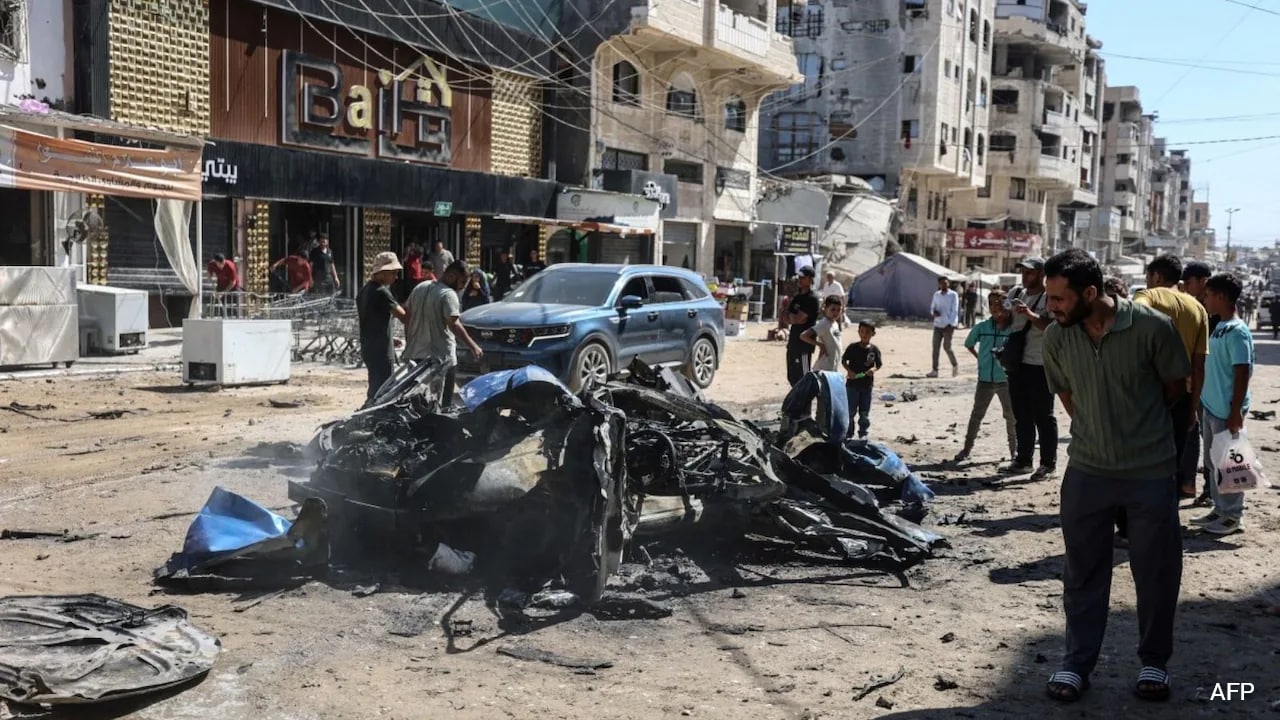
Five bodies arrived at Al-Shifa Hospital in Gaza City before noon. Two were pulled from the rubble of a residential entrance near a municipal park where families sought temporary refuge; three others were charred inside a civilian vehicle reduced to a warped metal shell in the Tel al-Hawa neighborhood. Standard news wire updates logged the toll with grim administrative efficiency, noting that the military targeted operatives while medical rescuers counted the dead. This pattern reduces catastrophic urban warfare to a recurring statistical blip. Headlines repeat an unchanging formula of routine airstrikes and low-digit casualties, obscuring the systemic mechanics that normalize civilian death on an industrial scale.
Look past the immediate shock of a single collapsed roof or a bombed-out car, and a calculated operational logic emerges. Modern munitions dropped in dense residential envelopes do not discriminate by accident; they do so by design, governed by automated targeting systems and relaxed collateral thresholds. When a drone strikes a car in Tel al-Hawa or a bomb hits a park perimeter, military briefers point to a generalized designation of hostile presence. Yet, the frequency of these low-casualty events reveals an underlying truth about how contemporary armed conflict treats non-combatant life. Each isolated incident represents a routine calculation where the perceived military utility vastly outweighs the anticipated civilian cost.
The Arithmetic of Acceptable Collateral
Military commands operating advanced aerial surveillance rely on mathematical matrices to greenlight strikes in crowded zones. Algorithms process telemetry, communication intercepts, and movement patterns to assign threat probabilities to individuals. When a strike is authorized on a moving vehicle or a multi-story apartment building, the command structure has already run a risk assessment factoring in civilian proximity.
The threshold for acceptable civilian fatalities is rarely a static number. It shifts upward depending on the perceived rank of the target or the urgency of the operational window. In urban environments saturated with displaced populations, avoiding civilian casualties entirely is treated as an operational impossibility rather than a legal imperative. The resulting calculus treats human beings living in designated combat zones as permanent variables of acceptable loss.
Intelligence databases leak figures indicating that civilian mortality rates in contemporary urban campaigns heavily outpace historical norms. Investigative findings from internal military assessments consistently show that non-combatants comprise the vast majority of casualties in high-density bombardments. Despite these internal metrics, public communications maintain a rigid separation between targeted military assets and collateral damage. This disconnect allows military institutions to frame systemic structural devastation as a series of unfortunate, isolated exceptions to an otherwise precise campaign.
The Infrastructure of Erasure
Destruction in Gaza follows an architectural blueprint designed to dismantle the basic prerequisites of human survival. Water treatment plants, electrical grids, municipal archives, and residential blocks do not crumble by miscalculation. They are targeted because prolonged conflict strategies rely on the systematic erosion of civil society infrastructure. When a neighborhood like Tel al-Hawa or a municipal park becomes a recurring theater of kinetic strikes, the physical space itself is rendered uninhabitable.
Civil defense workers operating with bare hands and rudimentary tools sift through pulverized concrete not because equipment is scarce by chance, but because blockades restrict heavy machinery from entering the strip. International bodies document the methodical strangulation of logistical support, yet diplomatic channels respond with procedural statements that treat humanitarian crises as intractable natural disasters rather than human-made catastrophes. The destruction is totalizing, affecting not only those killed instantly by shrapnel and concussive force, but also those left vulnerable to systemic disease, starvation, and exposure.
Accountability mechanisms remain largely toothless against this backdrop of institutionalized violence. Domestic military investigations into civilian deaths routinely conclude with internal exonerations, citing battlefield fog, erroneous intelligence, or the presence of secondary explosions indicating hidden militant stores. This self-policing loop ensures that no structural changes are ever introduced to curb high civilian death tolls.
The five dead in Gaza City will fade from the media cycle within hours, replaced by the next sequence of coordinates and casualty counts. The machinery of war grinds forward, sustained by automated targeting protocols and political indifference. Every strike reinforces a brutal precedent, proving that human life in densely populated enclaves can be spent cheaply and without consequence.