Black.
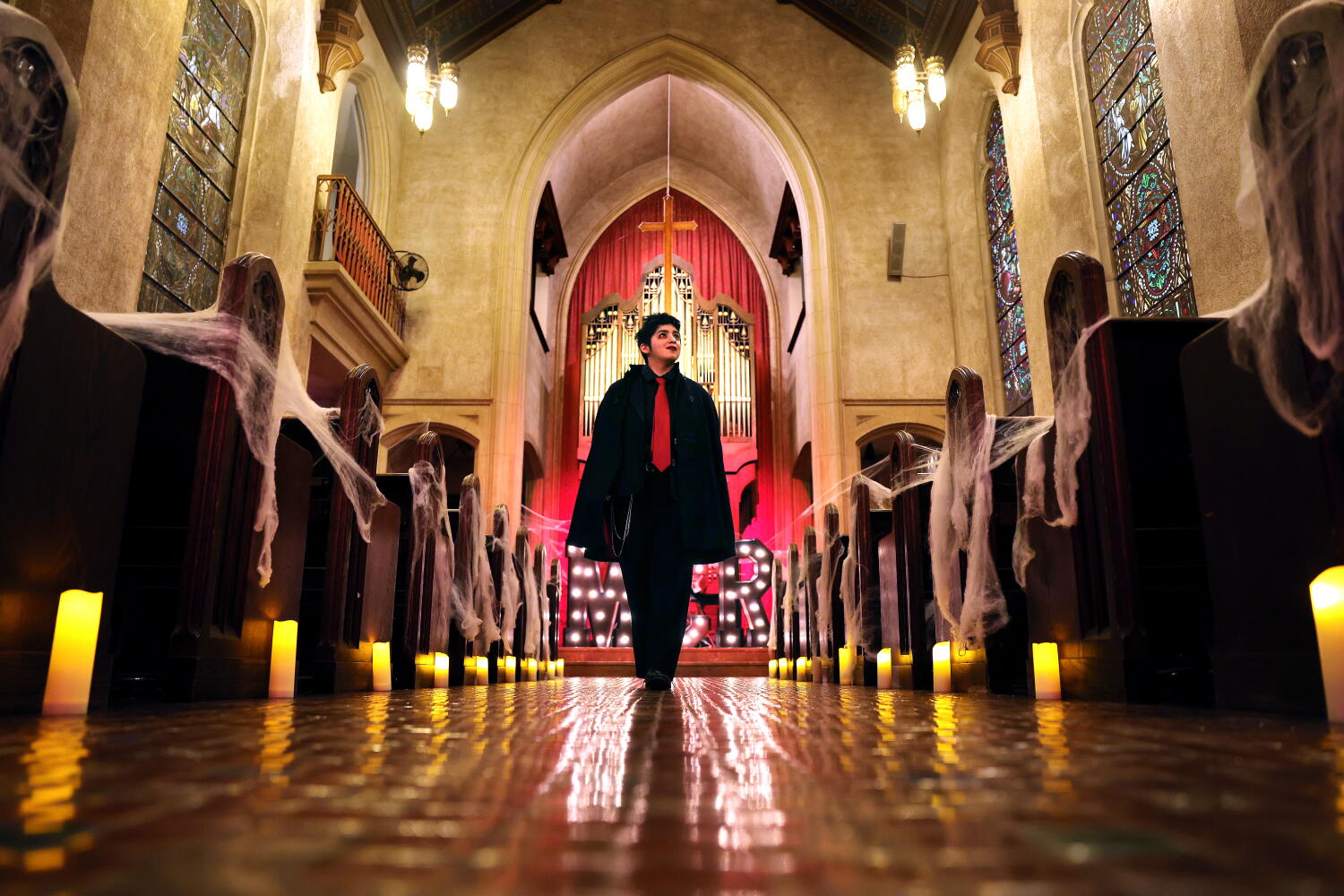
That is the first thing you notice when you step off the blisteringly bright concrete of Los Angeles and cross the threshold into the cool, cavernous gloom of the sanctuary.Outside, palm trees sway against a cloudless California sky, indifferent to the calendar, indifferent to the weight of nostalgia. Inside, the air smells faintly of beeswax, old wood, and cheap drugstore eyeliner.
At the front of the nave, resting squarely where a bride might stand or a congregation might kneel for communion, sits an open casket.
Nobody has died. At least, not in the literal, biological sense that brings paramedics and probate lawyers knocking at the door. Yet the grief in the room is thick enough to choke on, braided tightly with a strange, defiant euphoria. Dozens of twenty- and thirty-somethings—accountants, baristas, graphic designers, and tired parents who traded their band hoodies for corporate lanyards a decade ago—are filing past the velvet-lined box. They are dressed in tailored black suits, smeared red eyeshadow, and frayed marching band jackets. They are laying down white carnations. They are weeping. And over the church’s sound system, the opening, isolated piano notes of "Welcome to the Black Parade" echo off the vaulted ceiling, reverberating straight through the floorboards and into the soles of their boots.
To an outsider glancing at a local news blurb, this looks like peak millennial absurdity. A quirky subculture meetup. A theatrical cosplay stunt staged by die-hard fans of the New Jersey rock band My Chemical Romance.
Look closer, though, and the irony evaporates. What is happening inside this Los Angeles church is not a joke, and it is certainly not a mere concert pre-game. It is a secular liturgy for a generation that spent its adolescence being told its pain was a phase, only to discover in adulthood that the world had grown infinitely darker than the songs they used to scream into their bedroom pillows.
The Architecture of a Shared Ghost
To understand why grown adults would rent out a sacred space and stage a mock funeral in the middle of Los Angeles, you have to understand what March 22, 2013, felt like to millions of teenagers.
That was the Friday My Chemical Romance posted a brief, unceremonious statement on their website announcing their breakup. There was no farewell tour. There was no final bow. After twelve years of turning suicidal ideation, Catholic guilt, queer angst, and suburban alienation into operatic, blood-splattered rock anthems, Gerard Way and his bandmates simply walked off the stage and closed the door.
Consider a hypothetical fan—let’s call her Elena, though she could easily be any of the three hundred people packed into these wooden pews tonight. In 2006, when The Black Parade was released, Elena was fifteen. She lived in a sprawling, sun-bleached suburb forty miles east of downtown L.A., where feeling deeply was treated like a social defect. She kept a spiral notebook hidden beneath her mattress, filled with lyrics copied out in black gel pen. When the panic attacks hit at two in the morning, she didn't have a therapist, and she didn't have the vocabulary to explain why she felt like an alien in her own skin. She had a pair of tangled white earbuds and four guys from Newark, New Jersey, screaming at the top of their lungs that it was okay to be broken, as long as you kept marching.
When the band broke up seven years later, Elena was in college. She told herself she had outgrown it. She packed the studded belts into a plastic bin in her parents’ garage, learned how to write cover letters, and mastered the art of smiling politely during performance reviews.
Then came the twenty-twenties. A global pandemic. Economic whiplash. A relentless, algorithmic news cycle feeding anxiety directly into the palm of her hand every waking second. Suddenly, the theatrical gloom of her teenage years didn't look melodramatic anymore. It looked prophetic.
When My Chemical Romance finally reunited and announced a massive, multi-night residency at the Kia Forum in Inglewood—a return delayed by two years of lockdowns and uncertainty—the anticipation didn't just build; it fermented. Fans didn't just want to buy a $200 ticket, drink an overpriced beer, and watch a legacy act play the hits. They needed a ritual. They needed a physical space to bury the version of themselves that had barely survived the last decade, and to resurrect the part that still knew how to feel alive.
Anatomy of an Emo Liturgy
The organizers of the Los Angeles fan tribute understood something that major record labels and corporate festival promoters routinely miss: fandom, at its highest voltage, functions identically to organized religion.
Think of a traditional funeral. Why do human beings gather around a box to stare at a body that no longer holds the person they loved? Psychologists and anthropologists have spent centuries studying this, and the answer is remarkably simple. Grief is an abstract, shapeless fog. Without a physical focal point—a casket, a headstone, a designated hour to wail—the human brain struggles to process an ending. A funeral gives sorrow a container. It tells the mourner, Here is the edge of your pain. You may put it down right here.
Inside the L.A. sanctuary, the organizers built that exact container out of sheer DIY devotion.
The staging was meticulous, walking a razor-thin line between high camp and genuine reverence. The casket at the altar wasn't a cheap cardboard Halloween prop; it was heavy, polished, and flanked by towering floral arrangements that mirrored the iconic artwork of the band’s 2004 masterpiece, Three Cheers for Sweet Revenge. Alongside the roses sat framed photographs of the band, flickering pillar candles, and handwritten letters left by attendees.
As the evening unfolded, the barrier between spectator and participant dissolved entirely. There were no VIP velvet ropes. Nobody was checking credentials at the pulpit. One by one, fans stepped up to the microphone to deliver eulogies—not for the musicians, who were very much alive and preparing to take the stage across town, but for the seasons of their own lives that the music had carried them through.
A young man in a sharp black tie spoke with a trembling voice about surviving a brutal bout of depression in his early twenties, crediting the song "Famous Last Words" with giving him a mantra when his own mind felt uninhabitable. A woman in towering platform boots talked about finding her chosen family in the comment sections of old live concert videos after coming out to an unsupportive household.
Listen to the cadence of the room during those speeches. There were no ironic snickers. There were no phones held aloft to mock the vulnerability on display. Instead, you heard the soft, rhythmic rustle of tissues being passed down the pews and the occasional, involuntary gasp of recognition when a stranger articulated a secret everyone else had been carrying alone.
Why Society Still Laughs at the Black Parade
I will admit something that used to embarrass me when I was younger: for years, I hid my own history with this music behind a shield of cynical humor.
If someone brought up mid-2000s emo or pop-punk at a dinner party, I would laugh along with the clichés. I would make the easy jokes about swoopy hair, dramatic eyeliner, and teenage melodrama. It is a defense mechanism almost every former "emo kid" learns before they turn twenty-five. We preemptively mock the things that saved us so that nobody else gets the chance to mock them first.
Mainstream culture has always struggled to take the emotional lives of young people—and the adults they become—seriously, particularly when that emotion is wrapped in theatricality. When a fifty-year-old man weeps at a Bruce Springsteen concert over songs about dying factories and lost youth, critics call it working-class poetry. When a twenty-eight-year-old woman weeps in a Los Angeles church over a band dressed like zombie marching band conductors, pundits call it arrested development.
That double standard exposes a profound cultural blind spot.
The theatricality of My Chemical Romance was never about vanity; it was armor. Gerard Way has spoken openly over the years about how the costumes, the face paint, and the grandiose concepts of The Black Parade allowed a shy, anxious kid from New Jersey to step onto a stage in front of fifty thousand people and tell the absolute truth about his terror of death and insignificance. The makeup wasn't a mask to hide behind. It was a magnifying glass.
When fans gathered in that L.A. church, putting on their own smudges of red shadow and black lace, they were claiming that exact same permission. In a culture that demands constant, curated positivity—where you are expected to optimize your morning routine, monetize your hobbies, and keep your existential dread neatly tucked away—walking into a church to mourn at a fake funeral is a radical act of honesty. It is a collective refusal to pretend that everything is fine.
The Invisible Stakes of Showing Up
It is easy to dismiss a fan-organized tribute as a niche curiosity, a harmless footnote to a sold-out arena tour. Doing so, however, misses the urgent crisis quietly hollowing out modern adult life.
We are living through an epidemic of isolation that no app has managed to cure. Third places—those vital, non-commercial community hubs like neighborhood bars, bowling leagues, community centers, and traditional congregations—have been systematically priced out of existence or replaced by digital feeds. You can have ten thousand followers and still realize, on a Tuesday night when your chest feels tight with panic, that there is nowhere in your city you can simply walk into and be known.
Building a physical gathering from scratch in a city as sprawling, expensive, and fragmented as Los Angeles is nothing short of a logistical miracle. It requires permits, insurance, venue negotiations, sound equipment, and months of unpaid labor by fans who have full-time jobs and rent due on the first of the month. They didn't do it for a profit margin. There were no corporate sponsors slapping logos onto the casket.
They did it because the stakes were personal.
Watch what happens when people are given a real, physical room to congregate around a shared love. Within twenty minutes of the doors opening, strangers who had only ever interacted as avatars on social media were trading handmade bracelets, fixing each other’s smeared makeup in the restroom mirrors, and pooling cash to make sure a fan whose flight had been delayed could get a ride to the venue.
This is the hidden engine of subculture that outsiders rarely see. Beneath the dark aesthetic and the morbid humor lies an almost aggressive tenderness. These are people who learned early on that nobody was coming to rescue them from their own heads, so they built a network to rescue each other instead.
The Resurrection
By the time the final chords of the evening faded out, the mood inside the sanctuary had shifted entirely. The heavy, suffocating grief that hung over the pews at seven o'clock had burned off, replaced by an electric, hum-in-your-teeth momentum.
People weren't shuffling out with their heads down. They were spilling onto the Los Angeles sidewalk in loud, laughing clusters, arms slung over each other’s shoulders, trading phone numbers and making plans to meet up outside the Forum the following night. The casket had served its purpose. Whatever heavy, nameless dread they had carried through the church doors had been laid neatly inside the velvet lining, given a proper eulogy, and left behind in the dark.
Outside, the California night air was warm, smelling of exhaust and blooming jasmine. A group of four friends stood beneath a flickering streetlight near the church steps, one of them holding a slightly crushed white carnation against the lapel of a thrifted black blazer.
Down the block, a car rolled past with its windows down, blasting the frantic, joyful guitar riff of "I'm Not Okay (I Promise)" into the Los Angeles traffic, and without a word, all four of them threw their heads back and sang every single syllable at the top of their lungs.