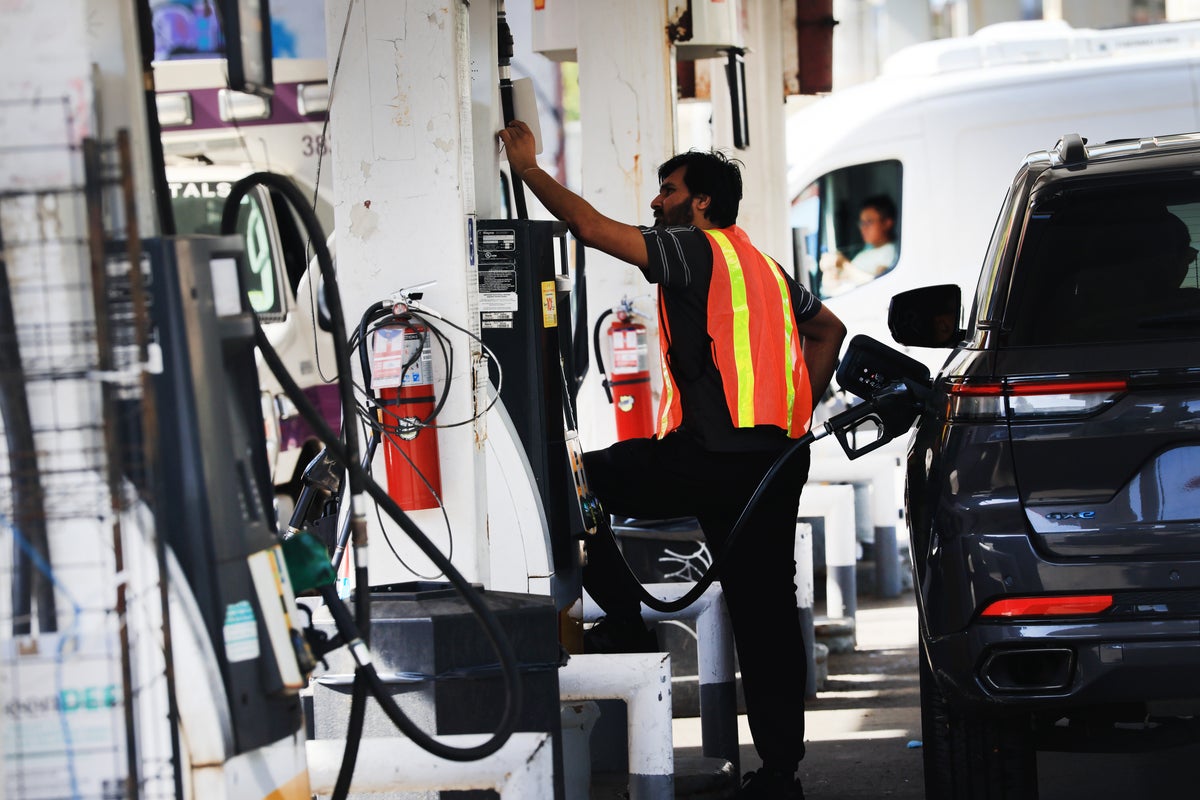
Voter behavior during midterm elections is frequently reduced to broad national mood indicators, yet macroeconomic sentiment is fundamentally anchored to microeconomic friction points. Among these, the retail cost of gasoline functions as a high-frequency economic indicator that directly dictates consumer confidence and political attribution. When fuel expenditures surge, households experience an immediate compression of discretionary income that cannot be absorbed by wages over short time horizons. This dynamic transforms the neighborhood filling station into an involuntary polling place where voters interface daily with inflation.
The Microeconomics of Pump Price Sensitivity
The political impact of fuel price spikes stems from the unique structural characteristics of gasoline demand and consumption frequency. Unlike major capital expenditures such as housing or automobiles, or even periodic utility bills, fuel purchases are recurring, highly visible, and difficult to defer in the short term.
[Price Shock at Pump] -> [Immediate Discretionary Squeeze] -> [Salient Economic Attribution] -> [Electoral Retribution]
Inelastic Short-Term Demand
Automotive fuel possesses near-zero short-term price elasticity for the vast majority of the workforce. Commuting requirements, supply chain logistics, and spatial dispersion in suburban and rural districts mean that consumers cannot simply opt out of purchasing gasoline when prices rise. When a gallon of regular unleaded climbs by one dollar, a household driving fifteen thousand miles annually at twenty-five miles per gallon absorbs an immediate six-hundred-dollar annualized tax on mobility.
High Salience and Frequency
Price visibility is absolute. Digital marquee pricing towers stand on every major commercial thoroughfare, broadcasting minute-by-minute market adjustments to drivers multiple times daily. This contrasts sharply with inflation in services or medical care, which is obscured by complex billing structures and infrequent transactions. Because the cost per gallon is front-of-mind, it serves as a cognitive heuristic for the health of the entire national economy. Consumers generalize from the pump to the macroeconomy, treating fuel inflation as proof of systemic fiscal mismanagement.
Asymmetric Psychological Impact
Behavioral economics demonstrates that losses loom larger than gains. Drivers notice price increases immediately—often within hours of a wholesale market shift—while price retreats are met with skepticism and slower adjustments at the retail level. This asymmetry ensures that rising fuel prices generate sustained cognitive friction, reinforcing a continuous loop of economic anxiety during critical campaign windows.
The Political Transmission Mechanism
Electoral accountability relies on attribution. When voters experience economic distress, they assign responsibility to the incumbent party controlling the executive branch and legislative majorities, regardless of global commodity drivers, geopolitical supply shocks, or domestic refining capacity constraints.
The political transmission mechanism operates through three distinct vectors:
- The Disposable Income Compression: As fuel takes a larger share of non-negotiable household overhead, discretionary spending contracts. Small and medium-sized businesses catering to local retail and leisure sectors experience localized recessions, compounding the sense of economic malaise.
- The Media Amplification Loop: Local and national news outlets naturally gravitate toward daily fuel price trackers, vacation travel cost indices, and commuter pain points. This relentless media coverage synchronizes individual economic anxiety into a collective narrative of decline.
- The Incumbency Cost Function: Ruling parties suffer because voters operate on a retrospective evaluation model. The question asked in the voting booth is not whether global OPEC quotas or international shipping bottlenecks caused the shock, but whether financial stability improved under the current administration.
Structural Vulnerabilities in the Supply Chain
To understand why fuel price spikes remain potent political weapons, one must examine the structural rigidities of the liquid fuels market. Crude oil extraction, transportation, refining, and retail distribution form a complex matrix with severe capacity constraints.
+--------------------+      +--------------------+      +--------------------+      +--------------------+
| Crude Extraction   | ---> | Refining Capacity  | ---> | Logistics & Storage| ---> | Retail Distribution|
| (Global Markets)   |      | (Bottleneck Asset) |      | (Pipelines/Trucks) |      | (Local Margin)     |
+--------------------+      +--------------------+      +--------------------+      +--------------------+
Refining capacity operates near maximum utilization rates during peak demand seasons. When maintenance outages, extreme weather events, or geopolitical conflicts disrupt output, the marginal barrel of refined product commands an exponential price premium. Because capital investment in new refining infrastructure requires multi-year regulatory horizons and significant upfront capital expenditure, supply cannot rapidly pivot to meet sudden demand surges or output shortfalls.
Consequently, retail prices overshoot equilibrium during periods of market stress. This structural lag ensures that high prices persist long enough to dominate the electoral calendar, rendering short-term legislative releases of strategic reserves largely symbolic against the weight of global market mechanics.
Strategic Forecasting and Electoral Outcomes
Midterm elections are structurally defined by enthusiasm gaps, turnout differentials, and marginal district volatility. When fuel prices remain elevated, suburban swing voters—who frequently drive longer cumulative distances for commuting and domestic logistics—exhibit heightened sensitivity to cost-of-living pressures.
Parties failing to account for this microeconomic friction find their macro messaging rejected at the ballot box. Campaigns that attempt to pivot away from immediate pocketbook metrics toward abstract achievements face a severe engagement deficit. The political imperative for incumbents is therefore stark: mitigating localized cost pressures or framing coherent operational interventions before retail pain hardens into permanent electoral realignment. The margin of victory in closely contested districts rests not on grand ideological debates, but on the arithmetic of the gas tank.