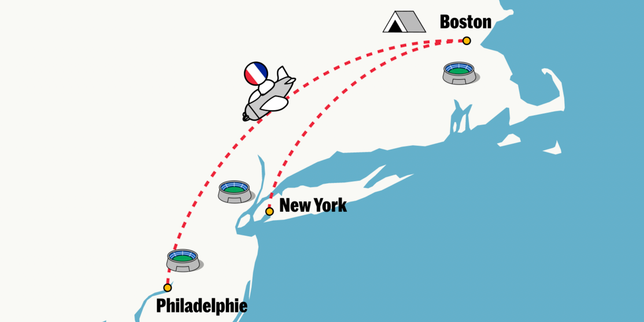
When FIFA announced a 48-team World Cup spread across three massive countries, football purists panicked about the geography. Visions of players stepping off eleven-hour flights with swollen ankles and jet lag dominated the headlines. For some teams, that nightmare came true. But for Didier Deschamps and Les Bleus, the flight schedule looks more like a casual weekend tour of the American East Coast.
If you think every team faces grueling transcontinental treks this summer, you're mistaken. France hit the absolute jackpot. While certain nations are crisscrossing North America, the French squad will spend minimal time at 35,000 feet during the group stage. Discover more on a similar subject: this related article.
The Easy Ride in Group I
Let's look at the actual numbers because they paint a striking picture. From their base camp in Boston, Massachusetts, France will barely break a sweat traveling to their opening matches. Group I is concentrated entirely within the dense Northeast corridor of the United States, meaning Les Bleus avoid the brutal cross-country flights plaguing Group B or Group G.
During the initial group phase, France will cover a mere 566 kilometers (around 352 miles) between their match cities. They open their campaign against Senegal at MetLife Stadium in New Jersey, before facing Iraq and Norway with fixtures split between Lincoln Financial Field in Philadelphia and Gillette Stadium right in their backyard in Boston. Additional journalism by Bleacher Report delves into similar perspectives on the subject.
To put that into perspective, look at what some of their competitors are dealing with. Curacao is projected to fly over 6,000 miles from their Florida base to games in Houston and Kansas City. Even traditional heavyweights face tough logistical puzzles. England and Germany have schedules that require bouncing between drastically different climate zones and time zones. France, meanwhile, stays locked into the Eastern Time Zone. No jet lag, no circadian rhythm disruption, and no three-hour time shifts.
Why Base Camp Selection Dictated the Journey
The secret behind this breezy travel schedule comes down to clever planning and a bit of luck during the FIFA base camp selection process. By securing Boston as their tournament home, the French Football Federation (FFF) eliminated the need for long domestic flights.
Most fans don't realize how much travel fatigue ruins a team's tournament chances. Moving an entire delegation of players, coaches, physiotherapists, and tons of training gear is an operational headache. When a team has to fly four hours after a grueling match, recovery windows shrink. Flying from Boston to New York or Philadelphia takes about an hour. It's practically a commute.
This short-haul reality gives French staff an enormous advantage in sports science. Players can get back into recovery pools and compression gear hours ahead of their rivals. They don't have to deal with the dehydration that comes with prolonged cabin pressure.
The Long Road to the Final
Of course, the easy ride doesn't last forever. If France tops Group I as expected, the knockout rounds will eventually force them out of their comfortable Northeast bubble.
The projected route for the top seed in Group I involves a steady progression down the bracket, eventually leading toward the later stages in the South.
- Round of 32 to Quarter-finals: Matches remain heavily contained within the Northeast hub (New York, Philadelphia, Boston), keeping total travel under 1,400 kilometers for the early knockouts.
- Semi-finals: A mandatory trek to Dallas, Texas, introduces the first major climate and distance shift.
- The Final: A return flight to New Jersey for the trophy match at MetLife Stadium.
Even when you factor in the entire journey all the way to the final, France is projected to fly a total of roughly 6,137 kilometers. It sounds like a lot, but in a tournament that spans from Vancouver to Mexico City, that number is incredibly low. Mexico and South Korea will clear 5,000 kilometers just trying to get out of their groups.
What This Means for Your Bracket
Don't underestimate the impact of this lopsided travel map when predicting who lifts the trophy. The tournament format is harsher than ever before, requiring seven matches just to reach the final. Physical preservation is the real name of the game here.
If you're looking at the betting favorites, keep a close eye on how much fuel they're burning in the air. Teams like Argentina and France have drawn highly localized schedules that protect their star players from travel exhaustion. Teams dealing with three-zone travel shifts will likely hit a wall by the quarter-finals.
For Deschamps, the logistical victory is already won. The next step is turning that physical freshness into points on the pitch. Keep an eye on how fresh the squad looks in the second half of their group games; those short flights might just be the quiet edge France needs to make another deep run.