Long before federal protections redrew the maps of the Florissant Valley, a seventy-five-year-old copper tycoon named John D. Coplen hauled an old railway station across the Colorado dirt to build a tourist haven.
Travelers seeking an authentic Colorado resort experience often look toward modern luxury compounds or sprawling ski hubs, missing the stranger, older history hidden in plain sight. In the spring of 1923, Coplen opened a 160-acre destination centered squarely around an abandoned train depot. This property sat directly beside massive petrified redwood stumps and ancient fossil shale beds. Four decades later, those exact acres were absorbed into the Florissant Fossil Beds National Monument. Understanding how a private railway-station hotel transformed into a protected federal park reveals a fascinating shift in how the American West commercialized and eventually preserved its prehistoric past.
The Copper King and the Fossil Ranch
Coplen was no ordinary hospitality entrepreneur. Born in Indiana in 1844, he spent decades carving out a formidable fortune through Western mining and business operations. By the time he turned his attention entirely to his Florissant property, he had mastered low-grade copper extraction methods that fueled the massive Inspiration Copper Mine in Arizona.
Yet his personal connection to the valley ran deeper than corporate balance sheets. His sister, Charlotte Hill, along with her husband, had established the Petrified Stump Ranch in 1874. That initial claim sat dead center in one of the most densely packed fossil deposits on the continent. Massive ancient sequoias, turned completely to stone, rested in the high-altitude dirt alongside delicately preserved insect and plant fossils compressed into shale.
For years, the site faced steady degradation. Unregulated souvenir hunters chipped away at the petrified wood, hauling off multi-ton fragments with sledgehammers and teams of draft horses. Early conservation efforts by the short-lived Colorado Museum Association collapsed by 1903, leaving the property vulnerable. Coplen bought out the remaining investors, consolidated the land, and waited until he retired from active mining leadership to execute his next move.
Engineering a Geological Theme Park
Coplen did not view preservation as a mandate for total exclusion. Instead, he believed the public should experience the prehistoric wonders firsthand, packaged within an accessible tourist environment.
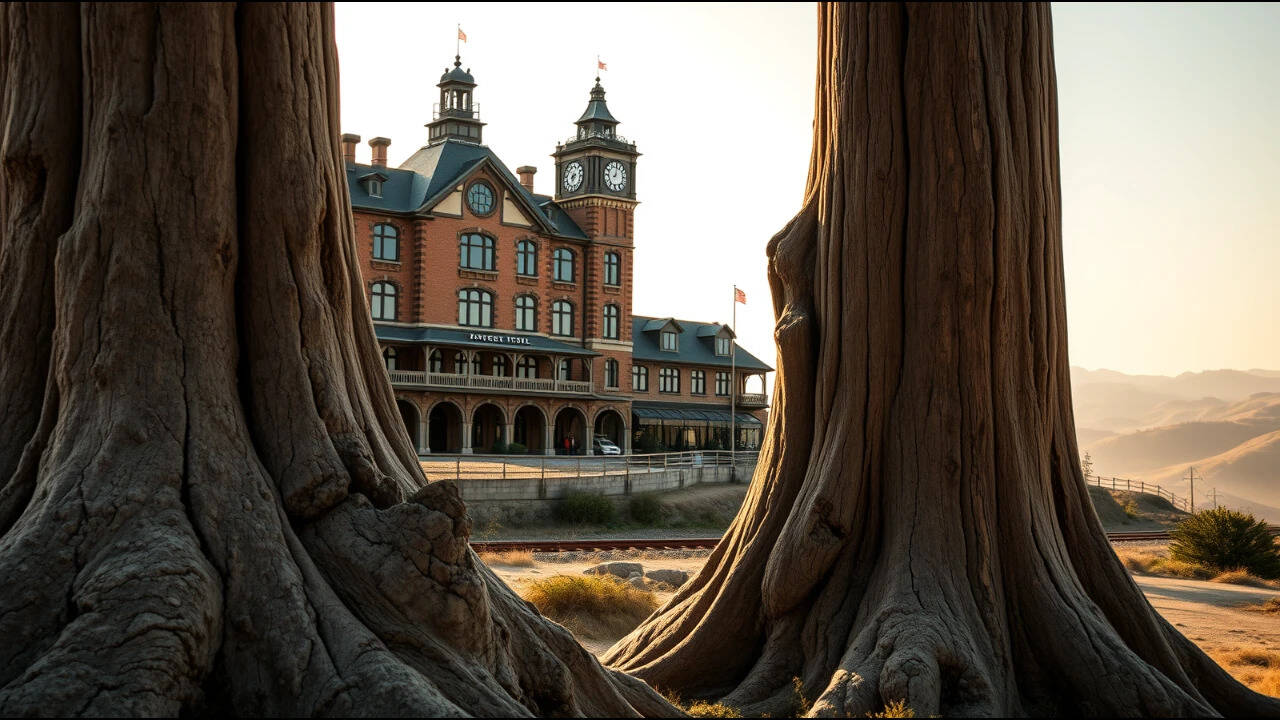
To achieve this, he engineered a logistical feat. The old Florissant railway station, rendered obsolete by shifting rail economics, was physically hoisted, moved onto the ranch property, and gutted into a functional rustic lodge. He laid out a dedicated access road to handle incoming passenger traffic. When the Coplen Petrified Forest Hotel and Resort opened its doors in the spring of 1923, it functioned as an early prototype of a geological theme park.
Visitors arrived to find a blend of industrial salvage and prehistoric grandeur. The repurposed rail station served as the central hub where guests gathered before embarking on tours led personally by Coplen and his wife. More than 2,900 people paid admission during that inaugural summer. They walked among petrified redwood stumps that had stood undisturbed for thirty-four million years, now framed by the infrastructure of early-twentieth-century auto tourism.
From Private Attraction to Federal Monument
The commercial phase of the property was relatively brief. Coplen sold the 160-acre resort in 1927, just a year before his death. Subsequent owners continued to operate the site as a private tourist attraction, keeping the gates open to road-tripping families and amateur geologists for decades.
By the mid-twentieth century, however, public policy regarding natural resources had shifted dramatically. The post-war surge in American outdoor recreation placed immense strain on fragile scientific sites. Local scientists, paleontologists, and conservation groups began lobbying aggressively to rescue the entire Florissant basin from piecemeal commercial development.
The political battle took years. Developers eyed parts of the valley for subdivision housing, while researchers warned that irreplaceable fossil beds were still vulnerable to theft and erosion. Congress finally established the Florissant Fossil Beds National Monument in 1969, creating a federally managed boundary designed to protect both the shale layers and the giant petrified trees. The National Park Service subsequently acquired the historic Coplen resort property in 1973.
Visiting the Remnants Today
Modern travelers visiting the national monument rarely realize the extent to which early tourism shaped the physical landscape. Today, more than 80,000 people pass through the gates annually. They hike trails that wind past the exact petrified redwood stumps Coplen spent decades guarding and commercializing.
The park service maintains the area primarily for scientific interpretation and ecological preservation, a stark contrast to Coplen's vision of an active resort hotel. Yet the architectural footprint of that era remains embedded in local history. The transformation of a humble railway station into a resort lodge, and its subsequent absorption into the federal park system, illustrates the winding path of Western land use. What began as a private mining fortune backing a tourist attraction ultimately laid the groundwork for permanent federal stewardship.