Dust remembers what maps forget.
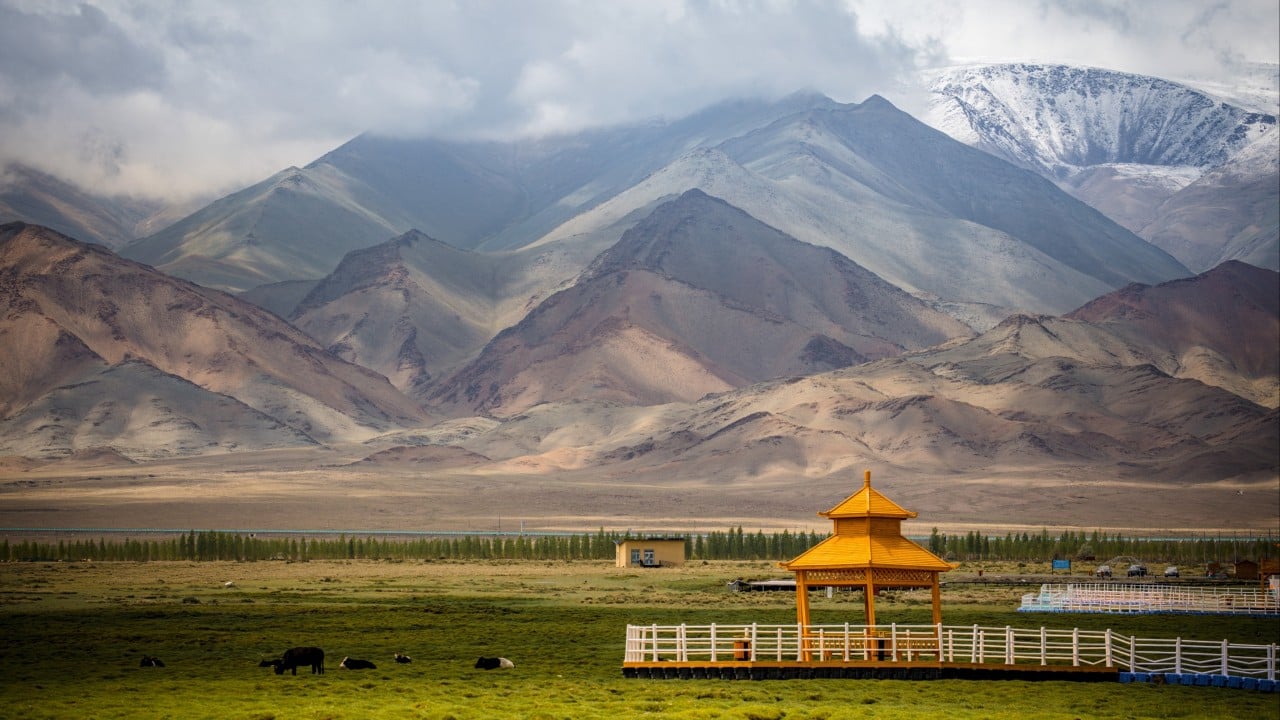
For thousands of years, the wind has carved through the Tarim Basin, sweeping fine, yellow silt across the edges of the Taklamakan Desert—a place whose very name translates to you go in, but you do not come out. It is a landscape of existential thirst, where towering dunes swallow old paths and the ghosts of forgotten caravans lie buried beneath dry earth. Yet, sometimes, the wind gives back.
Deep inside the ancient tombs of Xinjiang, tucked away in the arid cradle of northwestern China, bodies have rested for millennia. They are remarkably preserved by the dry salt and alkaline soil, their skin leathered, their hair still catching the dim light of modern flashlights. For generations, these graves have whispered secrets to archaeologists. They wore woven wool caps, colorful twill tunics, and leather boots. They were buried with cheeses, grains, and ephemera of lives lived at the crossroads of the world.
For a long time, historians argued over who these people were. Were they western wanderers who drifted across the steppe? Were they indigenous hunter-gatherers who simply stayed put? The bones held the answer. They were waiting in the quiet dark, locked inside double helixes of genetic code.
When modern geneticists finally extracted DNA from these ancient remains, the results fundamentally altered how we understand the dawn of civilization in Central Asia. Scientists tracing the maternal and paternal lines discovered a startling truth. Roughly half of the genetic ancestry in Xinjiang's oldest tombs traces directly back to the ancient farmers of the Yellow River valley.
Distance in the ancient world was measured in blood and blistered feet, not miles. To understand how Yellow River ancestry wound up thousands of miles away in the windswept basins of Xinjiang requires imagining a migration not of armies, but of farmers seeking fertile ground.
Picture a family living along the middle reaches of the Yellow River four thousand years ago. Their world is defined by the heavy, silt-laden water that feeds their millet crops. Life is a precarious negotiation with the earth. Floods come without warning, washing away months of labor. Drought bakes the soil until it cracks like broken pottery.
Eventually, some choose to pack up. They do not leave because they are conquerors. They leave because they are survivors. They carry bags of domesticated millet seeds, bronze-casting knowledge, and generations of agrarian wisdom. They walk westward, following the green ribbons of mountain runoff, hugging the northern slopes of the Kunlun and Tian Shan mountains.
As they move, they do not march through empty lands. They encounter local hunter-gatherer groups who already know every nuance of the desert edge—where to find bitter roots, how to track wild gazelle, which waterholes turn bitter in the summer heat.
What happens next is not a replacement, but an entanglement.
Genetic data does not show a clean sweep where one group erases another. Instead, it shows a slow, profound blending. The Yellow River farmers brought their crops, their steady heartbeat of cultivation, and their genes. The indigenous populations brought their deep, localized survival strategies. Over centuries, these two distinct streams of humanity converged in the oases of Xinjiang, creating a hybrid culture long before the official opening of the Silk Road.
We often think of globalization as a modern invention, born of container ships and fiber-optic cables. We imagine that our ancestors stayed put in isolated pockets, interacting only when trade routes forced them together.
The tombs prove otherwise.
Long before silk and spices became currency, human beings were already crossing vast expanses, falling in love across cultural divides, and sharing the heavy burden of survival. The genetic footprint in Xinjiang's oldest graves is a monument to human mobility. It tells us that our roots have always been tangled.
Standing in a modern laboratory, looking at a computer screen displaying nucleotide sequences, it is easy to forget the human cost of these historical migrations. We see percentages and charts. But every data point represents a heartbeat. It represents a grandmother who taught her grandchildren words from a distant eastern river valley while they sat beneath the shadow of western mountains. It represents a blending of worlds so thorough that thousands of years later, scientists can read the epic poem of human movement written directly into our cells.
The desert eventually reclaims everything. Foundations crumble. Names fade from stone. But the body keeps score.
When the wind howls across the Tarim Basin today, it carries the same dust it carried when those ancient farmers planted their first rows of millet in foreign soil. They came looking for a place to live, to plant, and to endure. In doing so, they wrote a chapter of our shared story that could never be erased by time or sand. They left their DNA like breadcrumbs along an ancient trail, reminding us that we are all, ultimately, children of many rivers.