The wind does not care about geopolitics. It sweeps off the cold, slate-gray Atlantic, battering the jagged cliffs of Saint Pierre and Miquelon with an ancient, bone-chilling fury. This archipelago is a strange fragment of Europe dropped onto the doorstep of North America—a sliver of France lost in the Canadian fog, where the air smells of salt, cod scales, and woodsmoke.
For centuries, this salt-scoured rock has been a haven for fishermen, rum-runners, and exiles. Today, it became something else entirely.
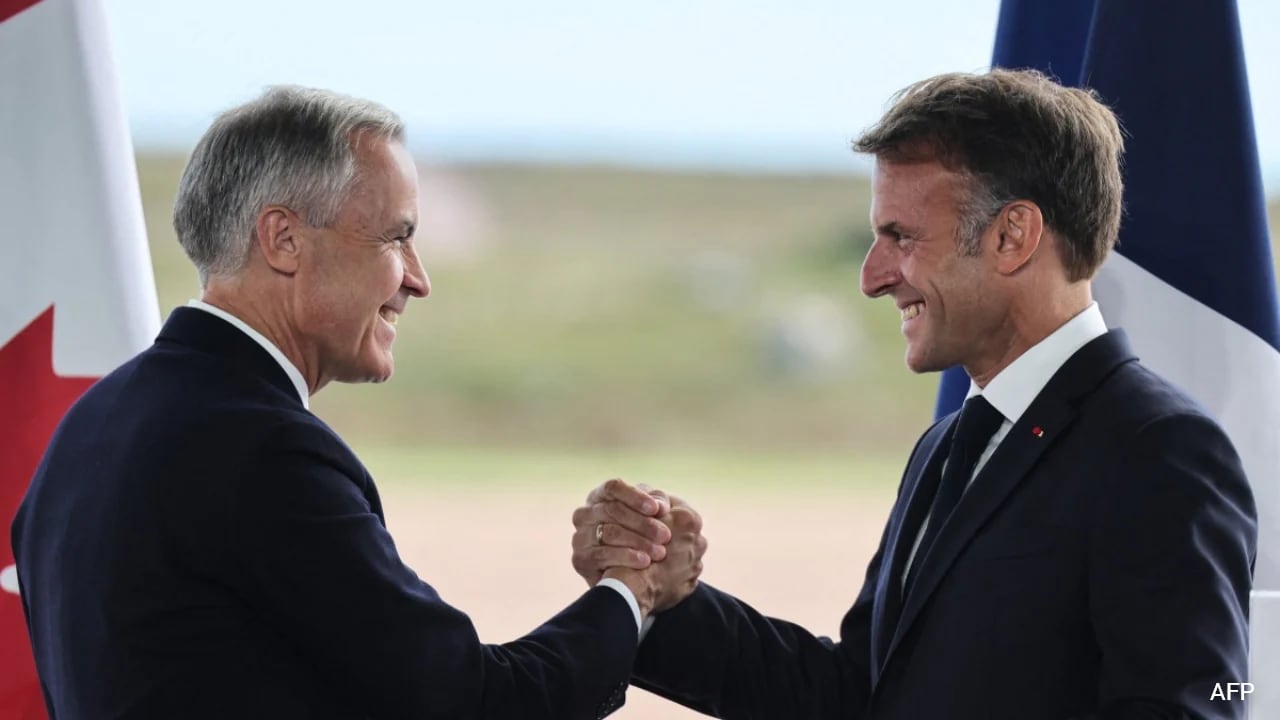
Mark Carney and Emmanuel Macron stood on these windswept shores, looking out at an ocean that has both divided and united empires for five hundred years. On paper, it was a summit about partnership, trade routes, and strategic security in a warming, unstable Arctic. But paperwork does not capture the sound of a foghorn cutting through the mist at dawn. Paperwork does not explain why two men, carrying the immense weight of modern economic and political anxiety, walked these narrow streets where the street signs are in French and the currency is the Euro, yet the horizon is fiercely, indelibly North American.
Consider the geography of isolation. Saint Pierre and Miquelon sits just twenty-five kilometers off the south coast of Newfoundland. When the winter gales roll in, isolation is not a metaphor; it is a locked door. Groceries arrive by boat. Energy is imported. Every connection to the mainland—whether physical or digital—is a fragile thread spanning thousands of miles of unpredictable water.
When leaders like Carney and Macron gather in such a place, the meeting is rarely just about the immediate economic ledger. It is about a deeper, more fragile geometry of survival.
We live in an era obsessed with the frictionless. We want our data instantaneous, our supply chains invisible, our borders erased by algorithms. Yet reality keeps intruding with a stubborn, heavy foot. The pandemic broke our supply chains. Geopolitical friction froze our energy markets. The Arctic ice is melting, opening up maritime highways that every major power eyes with predatory ambition. In this chaotic scramble, small outposts matter. Islands become ears listening to the static of the north. They become anchors in an ocean of uncertainty.
Imagine standing on the dock of Saint Pierre as a local fisherman mends his nets, hands calloused and scarred by decades of wrestling saltwater and freezing lines. To him, the grand communiqués signed in Paris or Ottawa sound like distant thunder. He cares about the price of fuel. He cares about whether the quota will allow him to feed his family next season. He cares about the invisible line in the water that separates French jurisdiction from Canadian waters—a line that fish refuse to respect.
When Macron and Carney talked partnership, they were trying to bridge the gap between the fisherman's horizon and the statesman's map.
The partnership discussed on this dot of French soil is rooted in a sober realization: no nation, no matter how powerful or resource-rich, can weather the coming decades alone. Canada has the vast, unforgiving expanse of the North, the minerals, the timber, the raw geological potential. France has the historical reach, the diplomatic weight in Europe, and the stubborn insistence on maintaining a cultural foothold in the Western Hemisphere. Together, their dialogue acknowledges that the old alliances are fraying under the weight of populism and shifting global poles.
To understand why this meeting matters, you have to look past the tailored suits and the carefully choreographed handshakes. You have to look at the map of the North Atlantic.
As the polar ice retreats, the Northwest Passage transforms from a frozen graveyard of explorers into a contested commercial shipping lane. Nations that have no business being in the Arctic are suddenly staking claims, building icebreakers, and mapping the seabed. Canada's sovereignty in the North has long relied on two things: ice and allies. As the ice vanishes, the alliance must step up to take its place.
France, through Saint Pierre and Miquelon, is an Arctic neighbor by proxy. It holds a seat at the table of northern geography, even if Paris is thousands of miles away. By aligning closely with Canada on security, ecological preservation, and sustainable resource management, France secures a voice in the shaping of the twenty-first-century North.
And Carney? Carney brings a unique lens to this equation. Economist, central banker, climate envoy—he understands the brutal mathematics of risk. He looks at the Arctic not just as a geopolitical chessboard, but as a balance sheet of existential threats. The melting permafrost, the shifting fish stocks, the skyrocketing cost of maintaining infrastructure in remote sub-zero environments—these are not distant theoretical problems. They are immediate crises demanding capital, coordination, and an unprecedented level of international trust.
The danger of modern diplomacy is its sterility. We consume news of summits as if watching a weather report—distant, observational, ultimately forgettable. We hear words like bilateral cooperation, framework agreement, and strategic alignment, and our minds glaze over.
We forget the human cost of disconnection.
When supply chains fail, shelves go bare in Saint Pierre. When diplomatic ties sour, research stations go dark, and cooperative fisheries collapse. The abstract abstraction of international relations becomes the concrete reality of a winter meal missed or a coast guard cutter arriving too late.
Walking through the brightly painted wooden houses of Saint Pierre, past bakeries smelling of fresh baguettes and cafes serving warm pastries against the Atlantic chill, you feel the profound duality of the place. It is deeply European in its rhythms, yet shaped entirely by the brutal, beautiful geography of the North American coast. It is a reminder that culture is resilient, but it requires oxygen to breathe. It requires open sea lanes, stable trade, and predictable neighbors.
The talks between Carney and Macron were framed around the future. But the future is built out of the materials of the past.
For centuries, this archipelago was a prize fought over by empires. British and French cannons traded thunder across these waters. Blood soaked the deck planks of wooden schooners. The names of the bays carry the memory of old griefs and desperate hopes. To stand here now and watch modern leaders negotiate partnership rather than partition is a quiet, radical shift in human history.
Yet, peace and cooperation are fragile things. They require constant tending, like a fire kept burning in a stone hearth against a howling gale.
If you ask the people who live here what they think of high-level geopolitics, they will likely shrug and offer you a cup of coffee. They have seen politicians come and go like the seasonal storms. They know that grand declarations do not heat a home or mend a torn net. What matters to them is whether the promises made in the quiet rooms translate into a predictable, stable life when the November winds start to scream off the water.
This is the invisible stake of every modern summit. It is not just about trade balances or defense pacts. It is about whether the systems we build can protect the vulnerable corners of our world from the shocks of a turbulent century.
The fog is rolling back in now, swallowing the cliffs, the harbor, and the distant outline of the fishing boats. From the shore, the horizon disappears into a seamless, monochromatic gray where sky and ocean become one.
In that sudden, blinding white-out, everything feels uncertain. You cannot see the next island. You cannot see the European coast, and you cannot see the Canadian mainland. You are suspended in a moment of absolute stillness, listening only to the rhythmic pounding of the surf against the stone.
That is where we live now. Between the known past and an unwritten future, enveloped in a fog of our own making.
Carney and Macron have left the island. The handshakes have been photographed, the statements issued, the planes flown back into the gray sky. But the wind remains. The salt still cakes the windows of the pastel houses. And out on the dark, restless water, the fish continue to swim across invisible borders, indifferent to the maps we draw, waiting to see what kind of world we will build before the next storm breaks.