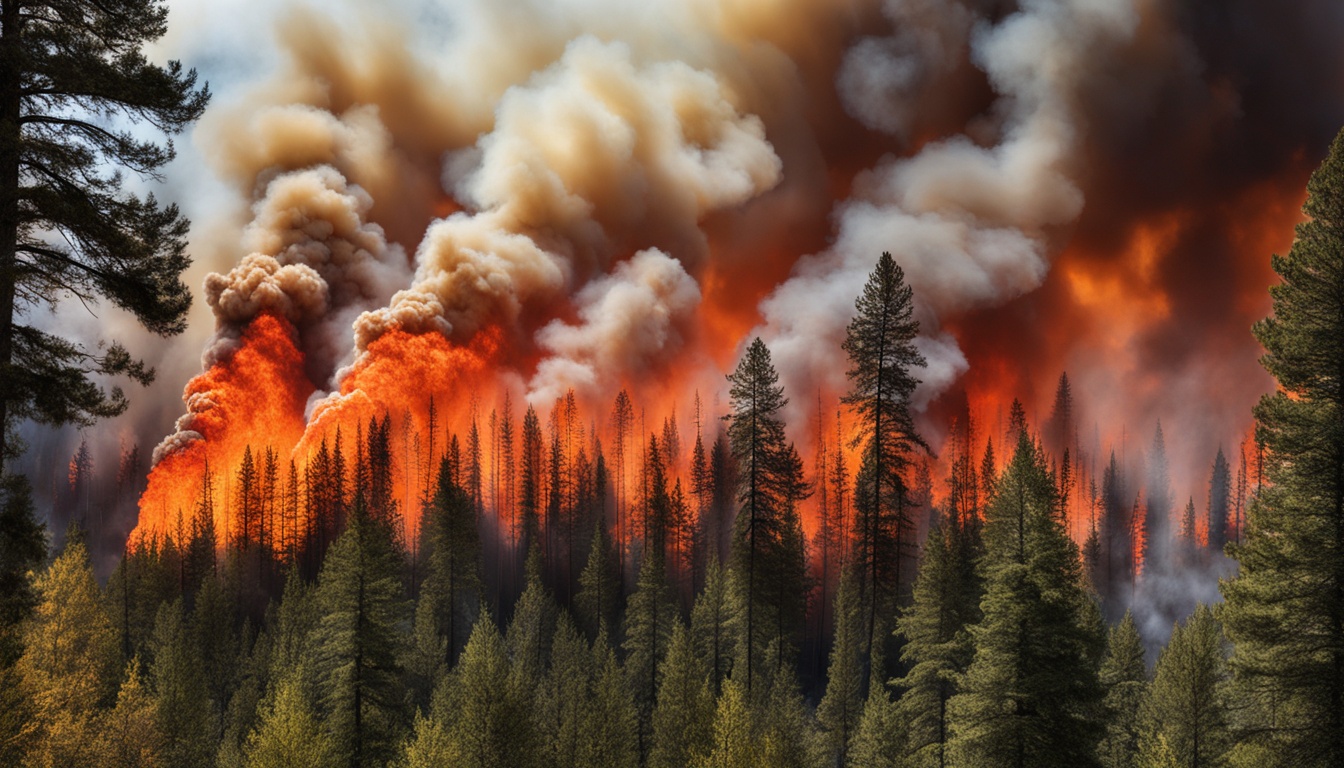
Toronto is choking under a toxic orange shroud, its skyline erased by a dense corridor of particulate matter drifting south from northwestern Ontario. This is not a simple natural disaster, but the direct consequence of decades of aggressive fire suppression, chronic underfunding of forest management, and a rapidly warming northern atmosphere. As the city's Air Quality Health Index spikes into hazardous territory, residents are forced to confront a brutal truth. The policies meant to protect our forests have instead primed them to burn, leaving millions in urban centers to breathe the consequences.
The immediate culprit is a familiar pattern of high-pressure systems steering smoke from hundreds of active blazes directly into the Great Lakes basin. Yet focusing solely on the wind patterns misses the systemic failure unfolding in the boreal forest. For another view, check out: this related article.
The Chemistry of the Orange Glow
To understand the crisis, one must first look at the light filtering through the haze. The eerie amber hue draping the CN Tower is the result of Rayleigh scattering. Wildfire smoke is thick with fine particulate matter, specifically particles less than 2.5 micrometers in diameter, commonly known as PM2.5. These microscopic particles are highly effective at scattering shorter wavelengths of light, such as blue and violet, while allowing longer wavelengths, like red and orange, to pass through.
But the orange sky is more than a visual spectacle. It is a sign of a trapped air mass. Related analysis on this matter has been provided by Reuters.
Recent atmospheric research reveals that dense smoke plumes trigger a phenomenon known as global dimming. Organic carbon particles in the smoke scatter incoming solar radiation back into space, cooling the ground level beneath the plume by several degrees Celsius. This cooling might sound beneficial, but it creates a dangerous local microclimate.
By cooling the surface while the air above remains warm, the smoke creates a strong temperature inversion. This inversion acts as a lid, halting the vertical mixing of air and trapping toxic PM2.5, vehicle emissions, and industrial pollutants close to the ground. Instead of dispersing, the poison accumulates precisely where people breathe.
Decades of Systematic Suppression Have Backfired
For over a century, Canadian forestry management operated on a straightforward, flawed doctrine: put out every fire as quickly as possible.
This aggressive suppression strategy has fundamentally altered the ecology of the boreal forest. In a natural cycle, regular low-intensity fires clear out underbrush, dead wood, and organic litter, allowing new growth to take root. By extinguishing these fires immediately, authorities have allowed a massive accumulation of dry fuel across millions of hectares.
Our forests are now dense, overcrowded powder kegs.
When a fire does break out under these conditions—often sparked by lightning strikes that are projected to double by the end of the century—it is no longer a manageable ground fire. It quickly escalates into a catastrophic crown fire, burning hot enough to consume entire forest canopies and generate its own weather systems, including pyrocumulonimbus clouds that spit out more lightning.
Furthermore, the suppression of traditional Indigenous cultural burns has stripped the land of its most effective defense. For millennia, controlled, low-intensity burns were used to manage fuel loads and create natural firebreaks. Forbidding these practices in the name of modern timber protection has ultimately left the commercial forests more vulnerable than ever.
The True Toll on Human Health
While the visual impact of an orange skyline dominates social media, the physiological damage occurs deep inside the human body.
PM2.5 particles are small enough to bypass the natural filtration systems of the human respiratory tract. They penetrate deep into the lungs, entering the alveoli where oxygen exchange occurs, and can even cross directly into the bloodstream.
The biological defense mechanism against these foreign invaders is quickly overwhelmed. Research into the impact of Canadian wildfire smoke has shown that exposure to these specific carbon-rich particles reduces the viability of lung macrophages—the critical immune cells tasked with clearing pathogens—by roughly 20 percent.
The systemic effects are immediate and measurable:
- Cardiovascular strain: The inflammatory response triggered by PM2.5 in the bloodstream can cause acute arterial stiffening, increasing the risk of heart attacks and strokes.
- Respiratory emergency: During major smoke events, emergency department visits for asthma and reactive airway diseases routinely spike by up to 80 percent.
- Long-term cellular damage: The smoke contains polycyclic aromatic hydrocarbons (PAHs) and heavy metals from burned soil, which are known carcinogens.
Average Daily PM2.5 Levels vs. World Health Organization Guidelines
──────────────────────────────────────────────────────────────────
WHO Safe Limit:     15 µg/m³
Toronto Peak Event: 120+ µg/m³ (8x higher than recommended)
──────────────────────────────────────────────────────────────────
The economic burden of these health outcomes is staggering. Public health economists estimate that a single week of severe wildfire smoke in Ontario can cost upwards of $1.2 billion in premature deaths, lost productivity, and emergency healthcare strains.
The Underfunded Frontlines of Wildland Firefighting
The physical reality of managing these fires is dictated by chronic budget shortages and labor crises.
Provincial wildland firefighting agencies have struggled for years with recruitment and retention. Seasonal firefighters are often paid barely above minimum wage for grueling, hazardous work, with little to no long-term health benefits or mental health support for post-traumatic stress. As a result, highly experienced crew leaders are leaving the sector, leaving behind a younger, less experienced workforce to handle increasingly complex, unpredictable fires.
When provincial resources are stretched thin, governments rely on a patchwork of international aid, flying in crews from South Africa, Australia, and Costa Rica. While international solidarity is valuable, it is an expensive, reactive sticking plaster for a structural wound.
The reliance on reactive suppression rather than proactive mitigation means money is poured into expensive water bombers and emergency evacuations, while pennies are spent on fuel reduction, community FireSmart programs, and prescribed burning.
Why the Haze Will Keep Returning
The atmosphere of northern Ontario is warming at more than twice the global average rate. Winter snowpacks are melting earlier, leaving forest floors dry and highly flammable by early spring. The jet stream, weakened by warming arctic temperatures, frequently stalls, creating prolonged blocks of hot, dry weather that bake the boreal region for weeks at a time.
Under these conditions, hoping for a summer without smoke is a fantasy.
Without a fundamental shift away from total fire suppression and toward active, preventative forest management, urban centers like Toronto will continue to experience these periods of toxic air. Installing domestic air purifiers and wearing high-quality masks are necessary personal defenses, but they do nothing to address the root of the crisis.
Canada must prepare its infrastructure, its healthcare systems, and its forestry budgets for a future where the boreal forest is no longer a passive carbon sink, but an active source of atmospheric instability. Until we treat the health of the northern forests as inseparable from the health of our southern cities, we will continue to watch our skies turn orange, breathing in the ashes of our own policy failures.