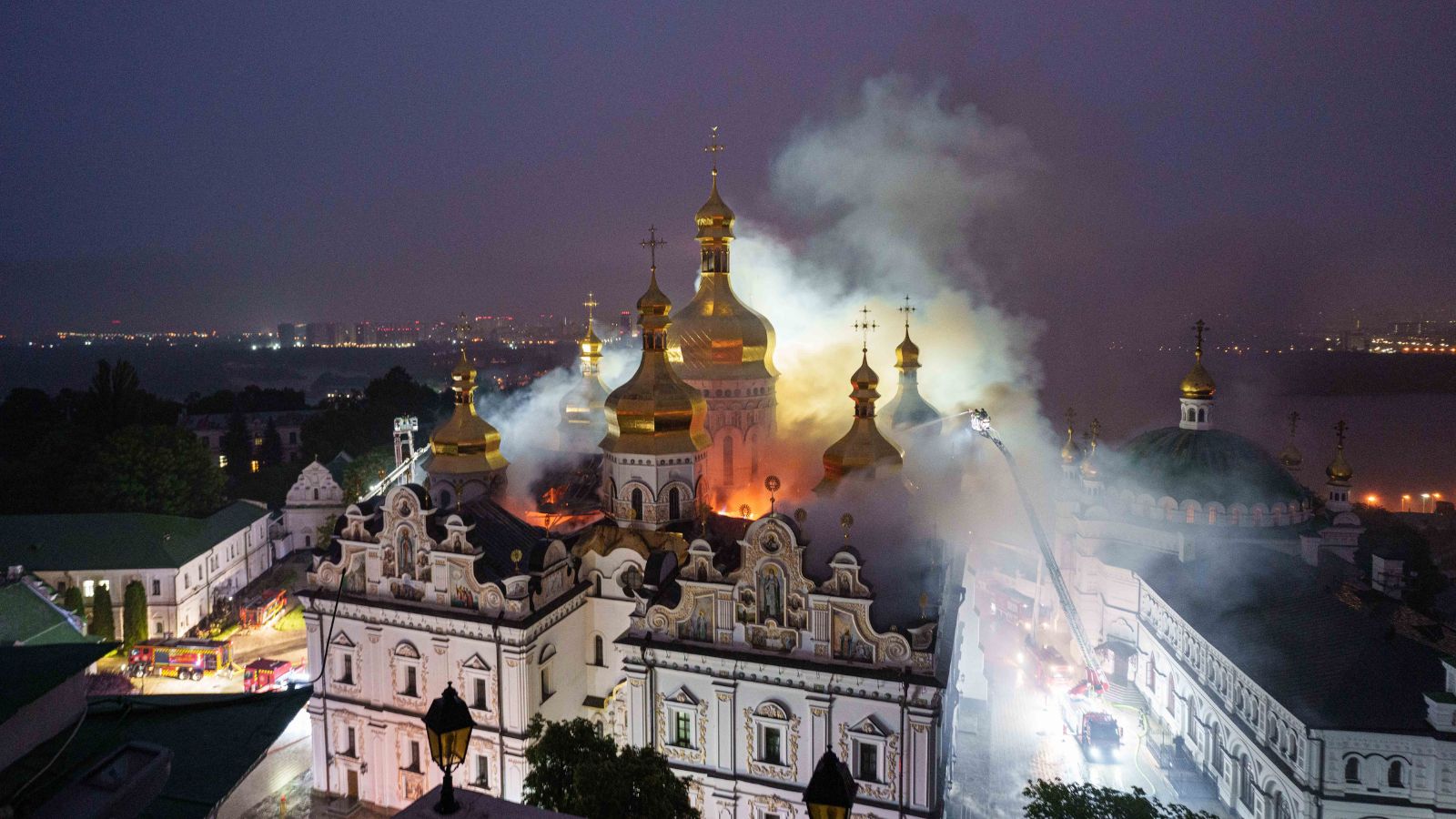
The fires eating through the copper and timber roofing of Kyiv’s Dormition Cathedral were still smoldering when the diplomatic recycling began. On June 15, 2026, a massive Russian barrage involving 70 missiles and over 600 long-range drones slammed into Ukraine, killing at least 11 people nationwide and leaving 140,000 households in the capital without power. The most symbolic casualty was the Kyiv Pechersk Lavra, a 950-year-old cradle of Eastern Orthodoxy and a UNESCO World Heritage site.
This devastating escalation occurred less than 24 hours after Ukrainian President Volodymyr Zelensky and Russian President Vladimir Putin held separate, highly publicized phone conversations with US President Donald Trump. While Western observers scrambled to parse the sudden violence as a breakdown in back-channel communications, the grim reality on the ground suggests a far more calculated strategy. Moscow is not rejecting diplomacy. It is using high-altitude arson to dictate its terms before the talking even begins.
The Choreography of Escalation
For days leading up to the raid, Ukrainian intelligence observed Russian forces stockpiling Kh-101 cruise missiles and Iskander-M ballistics. The sudden pause in daily raids looked deceptive. Zelensky noted that Putin appeared to deliberately hold the strike until immediately after the diplomatic phone logs cleared and regional birthday pleasantries subsided. The moment the American administration hung up the phone, the order was given.
The sheer volume of the assault tells the real story.
- Total Projectiles Launched: 681 (70 missiles, 611 drones)
- Kyiv Interceptions: The vast majority were downed, but debris from two Geran-2 drones tore through the historical core.
- Collateral Toll: 16 distinct locations struck in the capital alone, including the historic Mystetskyi Arsenal museum complex and a major postal sorting facility.
By the time dawn broke over the Dnipro River, monastery volunteers and state security officers were sorting through twisted, gilded debris. The Russian Defense Ministry quickly issued a boilerplate denial, claiming the ancient cathedral was actually damaged by a stray missile fired from a US-made Patriot air defense battery.
It is a familiar rhetorical deflection. Yet the physical evidence left on the ancient stone courtyard told a different story. Ukrainian security service photos quickly identified the jagged, distinctive internal components of Iranian-designed loitering munitions.
The Battle for the Orthodox Soul
To treat the Pechersk Lavra as merely a tragic line item on a list of damaged architecture misses the entire point of the target selection. The monastery complex is not just a collection of old churches and burial catacombs. It is the spiritual epicenter of the historic rivalry between Kyiv and Moscow.
Kyiv Pechersk Lavra: A Timeline of Contested Sovereignty

[1051]
Founded by Monks Anthony and Theodosius; establishes Kyiv as the heart of Slavic Christianity centuries before Moscow's rise.

[1688]
The Ecumenical Patriarchate is pressured to place the monastery under the administrative control of the Moscow Patriarchate.

[1990]
Inscribed as a UNESCO World Heritage site during the final months of the Soviet Union.

[2023]
Kyiv terminates the lease of the Russian-aligned Ukrainian Orthodox Church (UOC-MP), transferring control back to the independent Orthodox Church of Ukraine.
When Ukraine evicted the Russian-affiliated monks from the property following the full-scale invasion, Moscow framed the eviction as an act of religious persecution. By striking the complex now, the Kremlin sends a chilling message to the independent Orthodox Church of Ukraine. If Moscow cannot control the historical cradle of its faith, it is fully prepared to reduce it to ash.
French Foreign Minister Jean-Noël Barrot compared the structural loss to a deliberate strike on Notre Dame. It was an apt comparison, but it understated the geopolitical spite involved. Notre Dame was an accident. The burning of the Dormition Cathedral was an explicit statement of ownership through destruction.
Air Defense Exhaustion as a Diplomatic Leverage Point
Beyond the cultural warfare, the timing of the raid exposes a glaring, structural vulnerability in Ukraine’s defensive calculus. The attack occurred on the eve of a G7 summit in France, where Western leaders gathered to negotiate the next phase of continental security.
Russia’s current production capacity sits at roughly 60 to 70 ballistic missiles and 50 cruise missiles every month. By combining these high-end munitions with hundreds of cheap, locally assembled drones, Moscow forces Ukrainian air defense teams to make impossible choices. Do they protect critical electrical substations, or do they protect historic cultural sanctuaries?
Every interception costs a rare, expensive Western-supplied missile. The Kremlin knows the math. By launching 600 drones in a single evening, they successfully depleted Ukraine’s defensive magazines just as international leaders sat down to discuss a potential framework for a ceasefire.
The strategy is clear. Russia is aggressively burning through Ukraine's air defenses to ensure that when formal negotiations occur, Kyiv will be forced to talk under an open, undefended sky.
The Illusion of the Reset
The political fallout from the June 15 strikes exposes the inherent danger of trusting immediate diplomatic breakthroughs. For months, the promise of a swift, negotiated settlement has circulated through Western capitals. The back-to-back phone calls over the weekend were supposed to signal the beginning of a cooling-off period.
Instead, they produced the heaviest bombardment Kyiv has seen in weeks.
This behavior fits a long-standing historical pattern of Russian statecraft. Heavy kinetic leverage is applied precisely when negotiations appear imminent. It is a tactical maneuver designed to maximize leverage, project absolute indifference to international condemnation, and test the resolve of a shifting American administration.
As the bells of the burning monastery rang out the Ukrainian national anthem over the smoke on Monday morning, the true cost of this diplomatic transition became undeniable. The path to any future peace settlement will not be paved with amicable phone calls. It is being written in real-time by the fires lighting up the Kyiv skyline.