The Pacific Ocean at dusk does not look like a battlefield. It looks like an infinity of slate-grey glass, vast and indifferent, swallowing the horizon until sky and water bleed into a single, darkening void. For thousands of miles off the coast of South America, there are no roads, no landmarks, and no witnesses. There is only the rhythmic, hypnotic slap of the swell against hull steel.
Then comes the roar of a twin-propeller aircraft cutting through the silence.
High above the clouds, a U.S. Navy maritime patrol plane tracks a tiny speck on the radar. On the water below, a low-profile vessel—what law enforcement calls a "narco-submarine" or a "ghost boat"—slices through the waves. It sits so low in the water that it is nearly invisible to the naked eye, a fiberglass needle customized for a single, desperate purpose: to carry millions of dollars of illicit cargo from the jungles of Colombia to the streets of North America.
We often read about the drug war in statistics. We see numbers of kilograms seized, street values calculated in abstract millions, and policy debates broadcast from well-lit studios. But on this specific night, the abstraction evaporated. The cold calculus of international interdiction collided with raw human choices.
The chase ended in a blinding flash of orange fire. Two people died.
To understand how a routine maritime interception turns into a fatal explosion in the middle of nowhere, you have to look past the official press releases. You have to look at the invisible stakes playing out in the dark.
The Architecture of a Ghost Boat
A low-profile vessel is not built for comfort, safety, or longevity. It is built to disappear.
Typically constructed in makeshift shipyards hidden deep within mangrove swamps, these boats are engineering marvels born of criminal desperation. They are often painted ocean-blue or sea-foam green to match the water. Driven by powerful outboard motors, they carry thousands of gallons of fuel alongside their suffocating cargo.
Imagine sitting inside a coffin-shaped fiberglass shell for two weeks.
The air inside is a toxic stew of diesel fumes, fiberglass dust, and human sweat. The noise of the engine is deafening, standard safety equipment is non-existent, and the hull sits just inches above the waterline. The men who crew these vessels are rarely cartel kingpins. They are usually impoverished fishermen or desperate locals recruited with the promise of a life-changing payday, risking everything on a gamble against the vastness of the sea and the reach of the U.S. Coast Guard.
On the night of the interception, a U.S. Navy ship operating under the jurisdiction of the military's Joint Interagency Task Force South detected the vessel. The protocol in these moments is a tense, highly choreographed dance. U.S. forces deploy fast-boat crews and helicopters to close the distance, using spotlights and loudspeakers to command the vessel to stop.
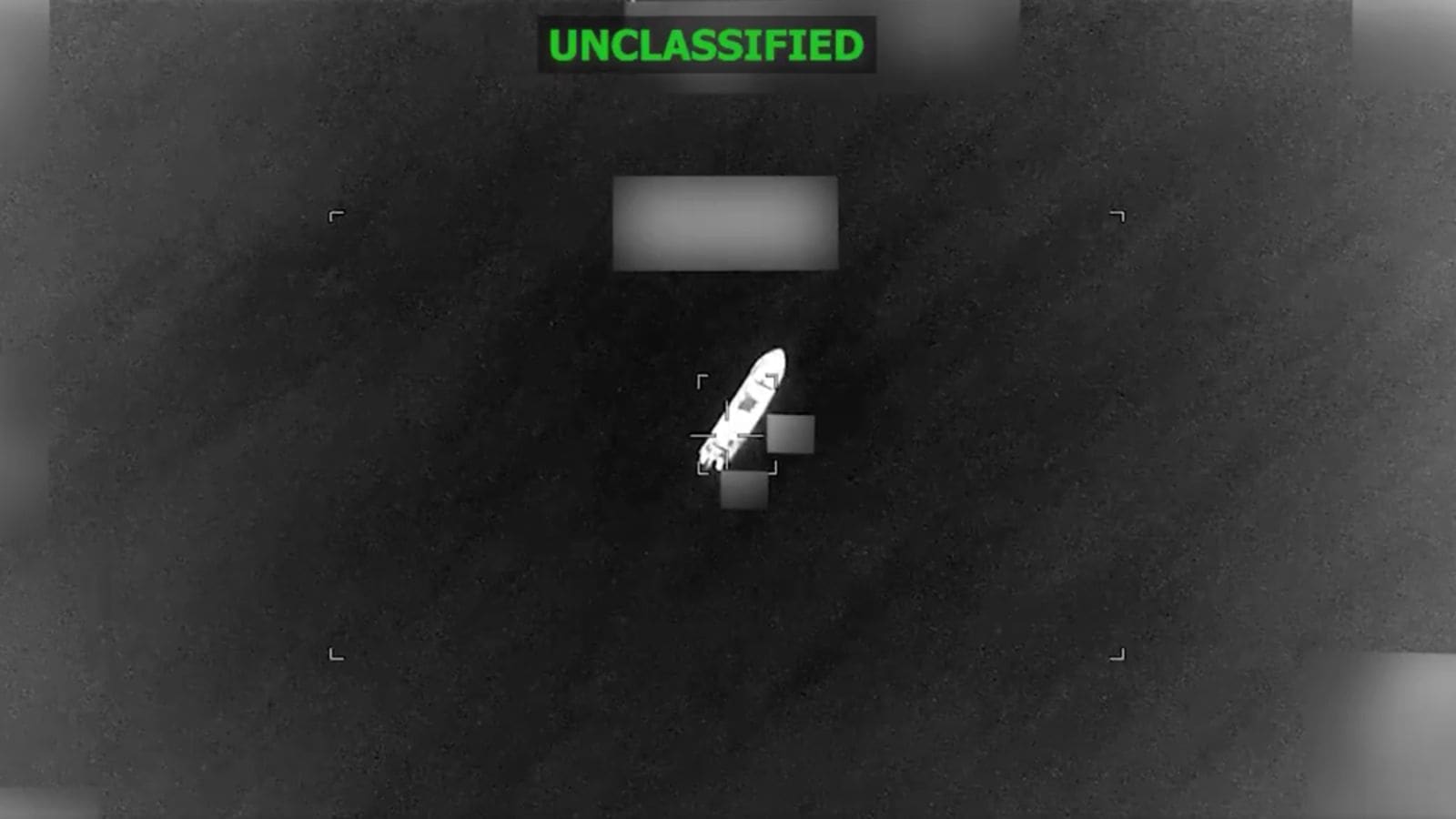
What happened next is captured in a grainy, infrared video released by the military—a sequence of events that lasted only seconds but carries a lifetime of weight.
The Moment of Impact
As the American interceptor boats closed in, the ghost boat did not slow down.
In the infrared footage, the vessel appears as a glowing white silhouette against the dark, cold water. Suddenly, a brilliant eruption of light obliterates the screen. The explosion is violent, instantaneous, and total. A shockwave ripples across the water, sending a plume of smoke and debris hundreds of feet into the air.
When the smoke cleared, there was nothing left but scattered fragments of fiberglass and a burning slick on the ocean surface.
U.S. personnel rushed to the scene to launch a search-and-rescue operation. Out of the crew on board, two survivors were pulled from the burning water, severely injured but alive. Two others vanished into the deep. They were later pronounced dead, their bodies claimed by the Pacific.
The immediate question that echoes after the smoke clears is simple: Why did it blow up?
Military officials point to a recurring, dangerous tactic used by smuggling crews when they realize escape is impossible. To destroy the evidence and prevent the cargo from being used in court, crews will sometimes scuttle the vessel by opening valves to flood it, or, in extreme cases, ignite the fuel supply. When a boat is carrying thousands of gallons of gasoline in makeshift bladders right next to a hot engine, the margin for error is zero. A single spark transforms a transport vessel into a floating bomb.
Whether the explosion was a deliberate act of sabotage gone wrong or the tragic result of a panicked crew trying to maneuver a highly unstable craft under pressure remains a haunting uncertainty.
The Human Cost of the Invisible Line
It is easy to compartmentalize this event as a tactical victory or a routine hazard of the trade. But doing so ignores the true weight of what transpired on that lonely stretch of ocean.
Every year, tons of narcotics flow across these maritime corridors, driving a cycle of violence that destabilizes communities across the Americas. The operations to stop them are perilous, requiring young sailors and coast guardsmen to board hostile, unstable vessels in total darkness, thousands of miles from medical aid.
The explosion in the eastern Pacific underscores a brutal reality: the frontlines of this conflict are fluid, volatile, and unforgiving. The line between a successful law enforcement operation and a fatal catastrophe is as thin as a fiberglass hull.
The two survivors were taken aboard a U.S. vessel to receive medical treatment and face the legal consequences of their voyage. For them, the journey ended in handcuffs and bandages. For the two who perished, their names will likely never appear in the headlines, their fates serving only as a quiet warning buried in a military briefing.
The ocean has returned to its slate-grey calm. The waves have washed away the burn residue, the debris has sunk to the seafloor, and the infinite expanse of the Pacific looks exactly as it did before the sky tore open. But somewhere, a family is waiting for a phone call from a fisherman who promised he would return home after one last trip, unaware that his final seconds were captured in the cold, green tint of a military night-vision lens.