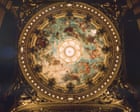
The cultural gatekeepers are at it again. Paris is losing its collective mind over a painted piece of canvas, treating a century-old administrative squabble like a sacred crusade. The recent legal noise surrounding the ceiling of the Paris Opera House—specifically the obsessive hand-wringing over Marc Chagall versus Jules Lenepveu—misses the entire point of what architecture and public art are supposed to do.
Everyone is arguing about purity, historical preservation, and artistic sacrilege. They are wrong.
Let us look at the actual reality of the Palais Garnier. The building is not a static museum piece frozen in amber for tourists to worship. It is a working machine. It is a massive, breathing incubator of performance art that has evolved through decades of structural adjustments, stylistic collisions, and administrative revisions. When Chagall climbed up on scaffolding in 1964 to paste his vibrant, dreamlike canopy over the existing 19th-century work by Lenepveu, he did not commit an act of vandalism. He did something far more disruptive. He made the room relevant.
The lazy consensus in arts journalism is that historical layers must remain separate, pristine, and strictly cataloged. Critics love to wring their hands over the juxtaposition of Belle Époque academic painting and modernist whimsy. They claim that slapping Chagall’s Fauvist dreamscape of Mozart, Wagner, and Berlioz over Lenepveu’s classical allegories creates visual confusion.
That confusion is precisely the point.
Art should not politely match the drapes. Great cultural spaces survive because they reject stagnation. The Paris Opera House was never meant to be a mausoleum. Charles Garnier designed a monument to excess, theatricality, and bold choices. If Garnier were alive today, he would laugh at the lawyers trying to litigate paint layers. He built a house of illusion. Adding another layer of illusion a century later is not a constitutional crisis. It is an honest continuation of the building's identity.
Let us dismantle the core legal argument floating around the current dispute. The debate hinges on moral rights, heritage laws, and the sacredness of the original architect's vision. This is pure romantic fiction. Governments and cultural ministries love invoking heritage laws because it gives bureaucrats something to do. It transforms maintenance into high drama.
When you dig into the mechanics of historic preservation, you find a dirty little secret. Most of these strict rules are arbitrary lines drawn by committees terrified of making a mistake. They treat buildings like holy relics while ignoring how those same buildings were funded, built, and altered in real-time. The Palais Garnier was modernized during construction. Materials were swapped, budgets blew up, and compromises were made. The idea that there was ever a single, pure, unblemished moment of original intent is a fairy tale invented by modern preservationists who have never run a major capital project in their lives.
Consider the alternative. What if the courts actually ruled in favor of stripping away the Chagall? What if some misguided preservationist panel decided to roll back the clock to 1875 and expose Lenepveu in all his academic, forgotten glory?
You would end up with an expensive tourist trap that looks correct on paper and feels completely dead in practice. Millions of people look up at Chagall’s ceiling every year not because they care about mid-century modernism versus academic classicism, but because it pulses with color, chaos, and life. It stops you in your tracks. Lenepveu’s original work, by contrast, is textbook academic wallpaper—competent, safe, and entirely forgettable. There is a reason nobody was fighting street battles to keep it uncovered before the mid-twentieth century.
The legal challenge isn't about protecting art. It is about control. It is about a specific faction of traditionalists trying to lock down public spaces and dictate what current and future generations are allowed to experience. They want to sanitize culture so it fits neatly into an art history textbook.
Stop treating historical buildings like glass cages. Great spaces absorb history. They layer it, clash with it, and grow through it. If you want a sterile museum where nothing ever changes, go to a warehouse in the suburbs. If you want living architecture, accept that art fights with itself, overrides its predecessors, and refuses to apologize for being alive.
The next time someone tries to drag you into a debate about the purity of a historic monument, ask them what they are really trying to preserve. Usually, it is just their own nostalgia.
Tear down the mental scaffolding. Let the building breathe.


