Five in the morning smells like wet wool, stale coffee, and sharp, metallic cold.
If you have ever stood inside a minor-league Canadian rink before sunrise, you know the sound before you even push open the heavy steel doors. It is the rhythmic shhh-thwack of steel blades biting into fresh ice, followed by the hollow thunder of a vulcanized rubber puck slamming against composite boards. For decades, that sound has been the heartbeat of small-town survival across the northern half of this continent. Parents sit huddled in fleece blankets with thermoses pressed between their knees, watching their kids chase a frozen dream.
We tend to measure hockey in brutal, tangible metrics. Goals. Assists. Penalty minutes. Plus-minus ratings. When a fifteen-year-old kid steps onto the ice in mid-November, the scouting reports look at his edge work, his release velocity, and whether he flinches when a two-hundred-pound defenseman pinches down the wall.
Nobody keeps a stat sheet for how much weight a teenager can carry when the arena lights go dark and the hospital fluorescent bulbs flicker on.
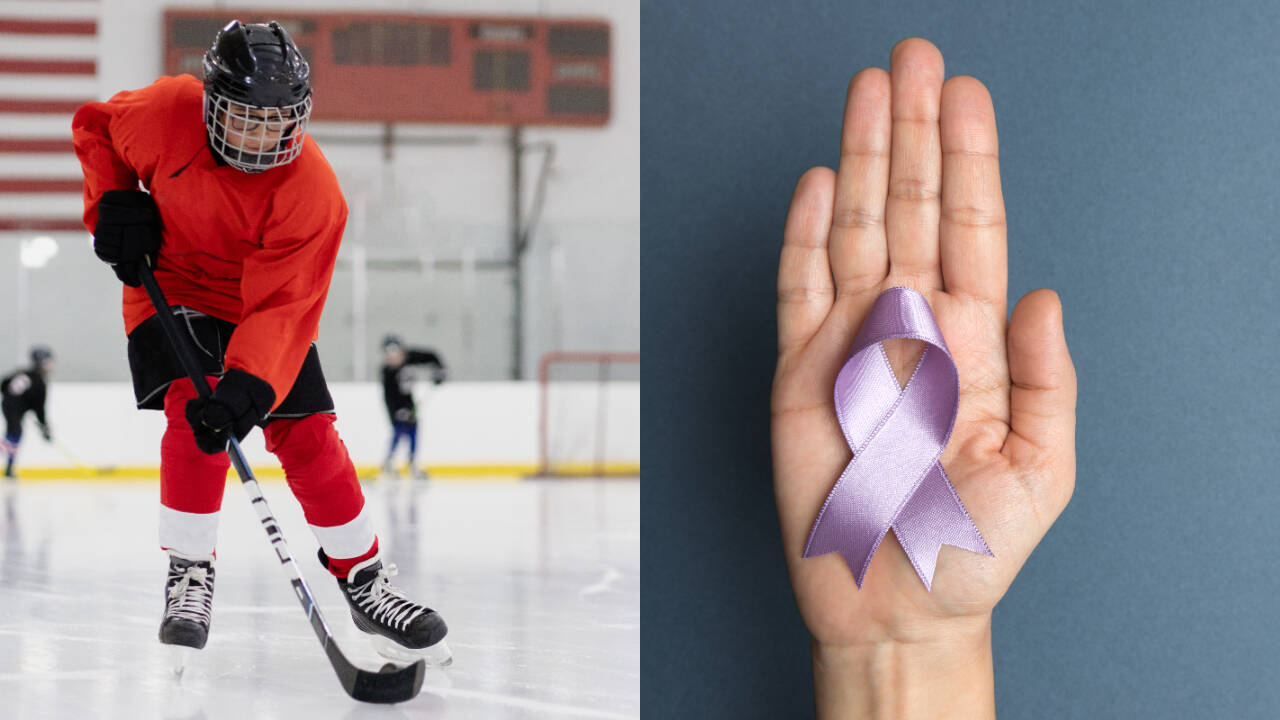
Recently, a wire-service headline floated across sports feeds with the sterile efficiency of a box score: 15-year-old Canadian hockey player reaches $50,000 cancer treatment fundraising goal. Read it once, nod approvingly at the wholesome Canadian cliché, and scroll down to the trade rumors. That is what the algorithm expects you to do.
But stop. Look at that number again. Fifty thousand dollars.
At fifteen, most kids are trying to figure out how to pay for gas in a beat-up Honda Civic or scraping together enough cash for new tape and a pair of mid-tier skates. Raising fifty grand is not a bake sale. It is not standing outside a grocery store with a coffee can on a Saturday afternoon. It is an astronomical, bone-grinding financial mountain—and the fact that a kid in shoulder pads had to climb it tells us something profound about the invisible mechanics of community, the terrifying arithmetic of modern illness, and what happens when a sport built on toughness discovers what strength actually looks like.
The Arithmetic of a Sudden Diagnosis
To understand why fifty thousand dollars matters, you have to understand what happens to a family's bank account the exact second an oncologist walks into an examination room.
Let us step into a hypothetical scenario—a composite of thousands of real families across North America who have heard the words aggressive, protocol, and out-of-network in the same breath. Picture a kitchen table in a quiet Ontario or Alberta town. On Tuesday, the biggest line item on the monthly budget is rep hockey fees, tournament hotel rooms, and sixty-dollar sticks that snap in half during a routine slap shot. On Wednesday, after a persistent ache in a leg or a swollen lymph node refuses to go down, the budget evaporates.
People often assume that in a country with universal healthcare like Canada, a cancer diagnosis comes with a zero-dollar price tag. That is a comforting myth, and like most comforting myths, it falls apart the moment you read the fine print.
Public healthcare covers the hospital bed, the standard chemotherapy infusion, and the surgeon’s scalpel. It does not pay the mortgage when one parent has to quit their job to drive four hours each way to a pediatric oncology center in Toronto, Vancouver, or Calgary. It does not cover specialized clinical trials across the border, experimental immunotherapies still awaiting provincial formulary approval, or the staggering cost of anti-nausea medications, specialized nutrition, and hotel stays near metropolitan hospitals. According to data from the Canadian Cancer Society, the average cancer patient faces thousands of dollars in out-of-pocket costs every single month—a phenomenon researchers clinically refer to as "financial toxicity."
Financial toxicity. Think about that phrase. It means the cure itself is poisoning your family’s future.
When a fifteen-year-old watches their parent stare at a stack of envelopes at two in the morning, trying to calculate how many shifts they can miss before the bank calls, something shifts inside that kid. Adolescence is supposed to be selfish. It is supposed to be loud music, bad haircuts, and worrying about whether you made the top power-play unit. A medical crisis steals that selfishness overnight.
Why Hockey Players Know How to Bleed for Inches
There is a reason this story happened on ice rather than in a debate club or a chess tournament, and it has nothing to do with clichés about Canadian politeness.
Hockey is an inherently absurd game. You strap knives to your feet, balance on an eighth of an inch of hollow-ground steel, and hurl yourself across a frictionless surface while people legally try to knock you off your balance. You learn very early on that individual brilliance is a fragile thing. Connor McDavid can skate faster than anyone on earth, yet even he gets shut down if four teammates refuse to backcheck.
I spent twelve years in those cold rinks—first as a mediocre winger who couldn't stop on his left edge, and later as an assistant coach trying to teach fourteen-year-olds why blocking a shot with their shin pads mattered more than scoring a highlight-reel goal. You learn a specific language in those locker rooms. It smells like sweat-soaked leather and cheap body wash, and the core rule is simple: when someone on your bench goes down, the rest of the bench shortens the shift and works twice as hard.
When a fifteen-year-old decides to raise fifty thousand dollars for cancer treatment—whether for a teammate, a parent, a sibling, or a local kid fighting for another season—they do not approach it like a corporate marketing executive. They approach it like a third-period penalty kill.
Consider how an effort like this actually unfolds. It starts small, usually with an awkward post on a local community board or a shaky smartphone video recorded in a basement next to a laundry machine. The goal looks absurd at first. Five thousand dollars feels like a fortune. Ten thousand feels like fantasy.
Then the locker room network activates.
In Canada, hockey is not merely a pastime; it is an informal telecommunications grid that connects every small town from Newfoundland to British Columbia. A bantam team in one town challenges a rival squad thirty miles down the highway. Suddenly, kids who were cross-checking each other into the boards on Saturday night are pooling their allowance money on Sunday morning. Local auto shops sponsor a dollar for every save a goalie makes. Grandmothers knit tuques in team colors and sell them out of the trunks of sedans in rink parking lots during freezing rainstorms.
By the time the tally crosses thirty thousand, the momentum stops being a fundraiser and starts becoming a referendum on human decency.
The Hidden Mechanics of Teenage Grit
We love to romanticize young athletes, usually right up until the moment they make a mistake on a big stage. Watch any World Junior Championship broadcast and you will see adults on social media screaming at eighteen-year-old kids for missing a pass. We demand professional composure from children while treating them like commodities.
Yet when we strip away the television cameras and the draft projections, something remarkable emerges about fifteen-year-olds. They sit in a rare psychological sweet spot. They are old enough to comprehend the permanence of death and the crushing weight of adult financial ruin, yet they are still young enough to reject cynicism.
Tell a forty-five-year-old accountant that a local family needs fifty thousand dollars for cancer treatment, and the accountant will immediately run a mental risk assessment. They will think about overhead costs, donor fatigue, tax receipts, and the statistical probability of falling short.
Tell a fifteen-year-old hockey player the same thing, and they will ask how many pucks they need to shoot, how many kilometers they need to skate, or how many doors they need to knock on before dinner.
In behavioral psychology, researchers talk about self-efficacy—the belief that your specific actions can alter an outcome that seems fixed in stone. Most adults lose their self-efficacy slowly, eroded by bureaucracy, insurance claim denials, and endless automated phone menus. Kids who live in competitive sports still possess it in raw, unfiltered form. They believe, down to their marrow, that if you keep moving your feet when your lungs are burning, the puck will eventually bounce your way.
That naive, stubborn refusal to accept defeat is the secret engine behind every grassroots miracle.
Think about what it actually takes to push a campaign from forty-two thousand dollars to fifty thousand. The easy money is already gone by then. Family members have donated. Close friends have chipped in. The local newspaper ran a brief column two weeks ago, and the initial surge of clicks has dried up. The final eight thousand dollars is the hardest stretch of ice on the rink. It requires asking strangers when your voice is tired. It requires showing up to early morning practices exhausted, answering messages between algebra class and dryland training, and carrying the quiet terror that if you fall short, someone you care about might go without the care they need.
What Fifty Thousand Dollars Actually Buys
Let us strip away the romance for a second and look at the cold, hard utility of that money.
In the brutal economy of oncology, fifty thousand dollars is not a magic wand. It cannot rewrite cellular DNA, and it cannot guarantee a clean PET scan. Anyone who has sat beside a chemo chair knows that money buys time, comfort, and options—and when you are staring down a malignant tumor, options are indistinguishable from hope.
Fifty thousand dollars means a parent does not have to choose between paying the heating bill in January and buying a specialized anti-emetic drug that keeps their child from vomiting for seventy-two straight hours after an infusion.
It means paying for a private-duty nurse or specialized physiotherapy when muscles atrophy from weeks spent staring at a ceiling tile.
It means covering airfare and temporary housing near a research hospital where a phase-two clinical trial offers a three-percent better survival curve than standard care—because when you love someone, three percent looks like the entire universe.
And perhaps most importantly, it buys psychological oxygen. Stress is not merely an emotion; it is a physiological cascade of cortisol and adrenaline that impairs immune function and disrupts sleep. When a family realizes their community—led by a teenager in scuffed shin guards—has built a fifty-thousand-dollar firewall around them, the panic in the room drops by half. For the first time in months, they can focus entirely on fighting the disease rather than fighting the bills.
The Mirror Held Up to the Rest of Us
There is an uncomfortable truth buried beneath the applause for a story like this, and we owe it to ourselves to look at it squarely.
Why does a fifteen-year-old kid have to become a full-time fundraiser so someone can afford cancer treatment?
We celebrate the triumph—and we should, loudly and without reservation—because the courage required to pull it off is extraordinary. Yet beneath the celebration lies a quiet indictment of the gaps in our safety nets. Across North America, crowdfunding platforms have quietly morphed into one of the largest healthcare financiers on the continent. Millions of people every year type their worst nightmares into a text box, attach a photo from a hospital bed, and pray that strangers find their tragedy compelling enough to open a digital wallet.
It is a system that rewards charisma, community connections, and media hooks while leaving quiet, isolated families to drown in silence.
Which makes what this young hockey player accomplished even more staggering. He stepped into a broken space—a gap between what medical systems provide and what human beings actually require to survive—and bridged it with sheer willpower. He refused to wait for an institution, a policy change, or a wealthy benefactor to rescue the situation. He took the only tools he had: a stick, a pair of skates, a tight-knit locker room, and an unwillingness to quit before the final buzzer.
The Sound After the Buzzer
Imagine the exact moment the counter ticked over from $49,980 to $50,000.
There was no stadium horn blaring. No confetti falling from the rafters. No trophy presented at center ice by a commissioner in a tailored suit. Chances are, it happened on a cracked smartphone screen in a bedroom cluttered with laundry and hockey tape, or in the passenger seat of a car idling outside a rink while snow ticked softly against the windshield.
One quiet number flipping over to a slightly larger number.
For a kid who spends his winters chasing rubber across frozen water, that silent screen represents a shift no coach can ever diagram on a whiteboard. He has learned, decades ahead of schedule, that toughness has nothing to do with dropping your gloves or absorbing a cross-check in the corner. Toughness is looking at something terrifying, refusing to flinch, and convincing hundreds of other people to step onto the ice beside you.
Tomorrow morning at five o'clock, the heavy steel doors of that rink will swing open again. The air will still smell like wet wool and stale coffee. The ice will be fresh, unmarked, and indifferent to everything that happened the night before. A fifteen-year-old kid will lace up his skates, pull his jersey over his shoulders, and step over the boards—carrying fifty thousand dollars' worth of proof that when the clock winds down, nobody has to skate alone.