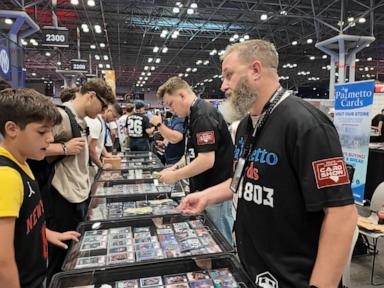
The mainstream sports media wants you to believe the trading card industry is experiencing a democratization of wealth. They point to high-profile spectacles like Fanatics Fest, pan across a room of hyper-caffeinated influencers holding pieces of cardboard worth more than a Honda Civic, and declare that the hobby has evolved into a legitimate, permanent asset class.
They are lying to you. Or worse, they are bought into the hype machine.
What happened at Fanatics Fest was not the celebration of a booming, organic market. It was a masterclass in artificial liquidity, engineered scarcity, and a highly coordinated attempt to turn a nostalgic hobby into a casino where the house always wins. If you are buying sports cards today thinking you are investing in a stable alternative asset, you are not an investor. You are the exit liquidity.
The Illusion of the Skyrocketing Market
The prevailing narrative surrounding the sports card boom is built on a fundamental misunderstanding of market mechanics. The headline-grabbing six- and seven-figure sales plastered across social media feeds are treated as proof of industry health. In reality, these astronomical valuations are anomalies, frequently manipulated by shill bidding, fractional ownership platforms desperate to justify their valuations, and high-net-worth individuals trading assets within insular networks to pump the perceived value of their portfolios.
I have spent over fifteen years tracking sports memorabilia markets, and the current cycle looks identical to every classic financial bubble in history.
When a single card sells for $5 million, the average collector assumes their $500 rookie card is on a proportional trajectory. It is not. The modern card market is sharply bifurcated. The ultra-high-end tier is a playground for billionaires and venture capitalists playing a game of hot potato. The remaining 95% of the market is flooded with overproduced, overgraded cardboard that is actively depreciating.
Consider the baseline structural flaws:
- The Overproduction Crisis (Junk Wax 2.0): Manufacturers claim numbered parallels (e.g., 1-of-1s, /5, /10) create scarcity. They do not. When a single player has fifty different "1-of-1" cards across dozens of product lines in a single year, the concept of scarcity is fundamentally broken.
- Grading Asymmetry: The entire value proposition of modern cards relies on third-party grading companies (PSA, BGS, SGC). A minute, microscopic centering flaw can mean the difference between a $10,000 "Gem Mint 10" and a $400 "Mint 9." This is not investing; it is a lottery based on the subjective whims of an underpaid grader looking through a loupe.
- The Liquidity Trap: Unlike equities or cryptocurrencies, you cannot liquidate a $50,000 sports card at the click of a button without taking a massive haircut. Selling through major auction houses incurs hefty consignment fees, takes months to settle, and depends entirely on finding a specific, willing buyer at that exact moment in time.
Fanatics and the Monopolization of Nostalgia
To understand why the current ecosystem is unsustainable, look directly at the entity driving the narrative. Fanatics has systematically acquired the exclusive licensing rights for the NFL, NBA, and MLB. They bought Topps. They secured the future rights to Panini’s basketball and football lines.
This is not a diversification of the market. It is a monopoly.
When a single corporation controls the manufacturing, the distribution, the primary marketplace, the breaking platforms, and potentially the grading or data verification services, the concept of a free market ceases to exist. They control the supply. They influence the demand. They set the price floors.
The Monopsony Reality: In a healthy asset market, independent forces dictate value. When one entity owns the entire vertical stack, they have every incentive to manufacture artificial hype to sustain their corporate valuation, irrespective of the long-term financial health of the end consumer.
Imagine a scenario where a traditional stock exchange also issued the shares, ran the brokerages, paid the analysts to recommend the stocks, and hosted the promotional conventions. The SEC would dismantle it by morning. In the unregulated wild west of sports memorabilia, it is hailed as a corporate triumph.
Dismantling the Common Myths
The public consensus around sports cards is riddled with flawed premises. Let's dismantle the questions people frequently ask when trying to justify entering this market.
Is it safer to invest in sports cards than the stock market?
This premise is inherently absurd. The S&P 500 represents fractional ownership in companies with tangible revenues, physical assets, intellectual property, and fiduciary duties to shareholders. A sports card represents a piece of cardboard dependent entirely on the speculative whim of the next buyer. Sports cards do not pay dividends. They do not generate cash flow. They have no intrinsic utility. If public interest shifts—as it did dramatically after the late 1990s sports card crash—the value can hit zero overnight.
Do rookie cards always go up if a player performs well?
This is the biggest trap for novice buyers. The assumption is that if a player wins an MVP or a championship, their cards will skyrocket. The reality is that the market routinely "buys the rumor and sells the news."
The price of a young player's card already prices in an Hall-of-Fame trajectory. When Patrick Mahomes wins another Super Bowl, his card prices often stay flat or even decline because the speculators who bought in early use the peak media moment to dump their inventory. If the player gets injured, underperforms, or suffers a PR scandal, the value plummets instantly. You are taking on all the downside risk of a professional athlete's career with almost none of the predictable upside.
Can card breaking be a profitable venture?
"Box breaking"—where individuals buy spots in a live stream to claim cards from a specific team—is marketed as a community-driven way to access high-end products. In execution, it is unregulated gambling disguised as entertainment. The cost of a spot in a high-end break is heavily mathematically weighted against the consumer. The breaker makes a guaranteed margin on the markup of the box; the participants lose their entire stake a vast majority of the time.
The Dangerous Allure of the "Influencer Asset"
The sudden influx of capital into the hobby during the early 2020s was not driven by a sudden, deep appreciation for sports history. It was driven by cheap capital, pandemic stimulus, and social media influencers who realized that sports cards were the perfect vehicle for content creation.
A flashy card looks great on an Instagram thumbnail. A dramatic reaction to pulling a rare card generates millions of views on TikTok. This created a feedback loop:
Influencer buys hyped card -> Posts video claiming it's an investment -> Clueless followers buy similar cards -> Prices temporarily rise -> Influencer quietly sells their inventory -> The market corrects -> Followers are left holding depreciated assets.
This cycle relies on a constant influx of uneducated buyers to sustain the prices of mid-tier modern cards. Events like Fanatics Fest serve primarily to inject a fresh wave of retail buyers into the top of the funnel just as the smart money is trying to rotate out.
How to Exist in the Market Without Getting Ruined
If you are going to participate in the sports card ecosystem, you must strip away the delusion that you are a sophisticated investor. You are a consumer engaging in a highly speculative, illiquid hobby.
To survive the inevitable correction, you must adopt an unconventional framework:
- Write Off Every Dollar Immediately: Treat a sports card purchase the same way you treat a ticket to a football game or a meal at a restaurant. The money is gone the moment it leaves your account. If the card appreciates, it is a pleasant surprise. If it goes to zero, your financial life remains undisturbed.
- Ignore Modern Ultra-Modern Shiny Objects: The shiny chromium cards featuring current rookies are the most volatile, overproduced assets on earth. If you must buy, focus on true vintage assets—pre-1970 cards of established, deceased Hall of Famers (e.g., Mickey Mantle, Hank Aaron). The supply of these cards is genuinely fixed; there are no factory reprints or additional parallels coming to dilute the market.
- Refuse to Buy the Hype Cycles: When an event like Fanatics Fest dominates the headlines, that is your signal to stop buying. That is the absolute peak of the local hype cycle. The time to buy cards is when the convention halls are empty, the influencers have moved on to a different asset class, and manufacturers are cutting production runs because retail shelves are dusty.
The sports card industry is not skyrocketing because it discovered a new fundamental truth about value. It is skyrocketing because a highly centralized corporate machine has perfected the art of turning nostalgia into FOMO. The music will eventually stop, the lights will turn on, and the people who thought they were building a revolutionary portfolio will realize they are just standing in a room full of expensive paper.