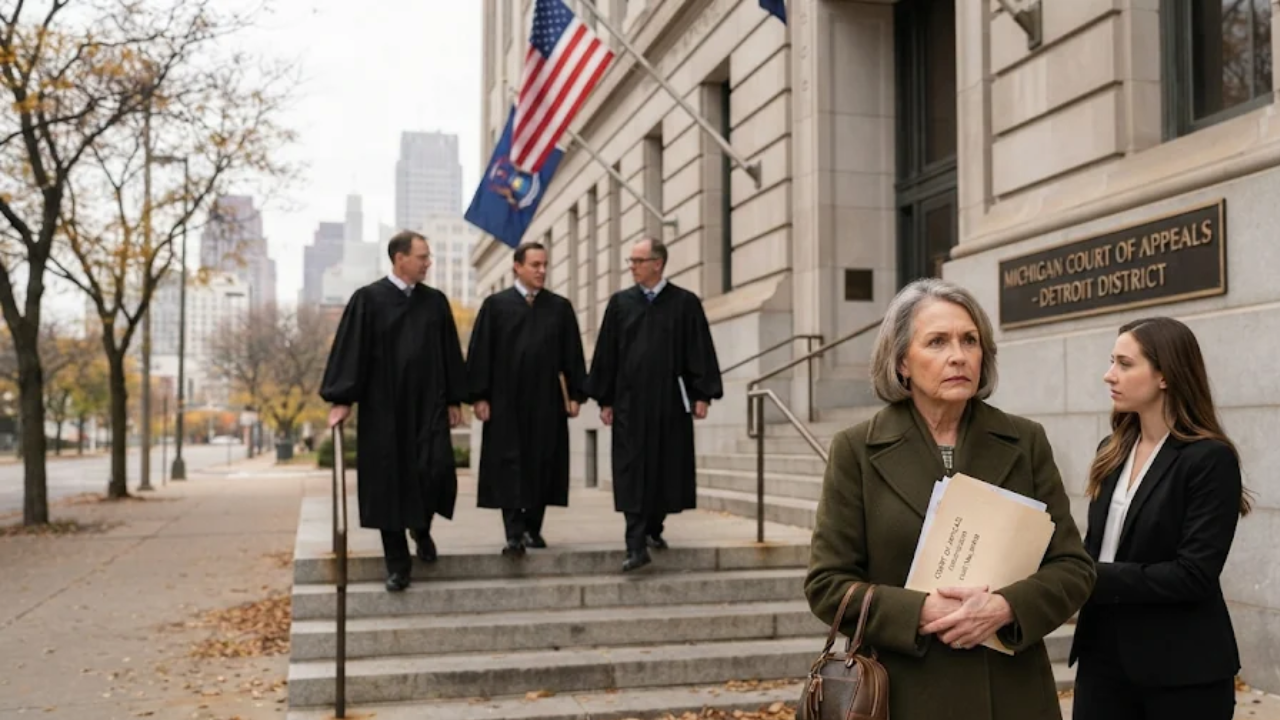
Federal Reserve Governor Lisa Cook’s refusal to attend a hearing convened by Donald Trump represents a structural stress test of statutory central bank independence under the Federal Reserve Act of 1913. Standard political coverage reduces such refusals to partisan friction, missing the underlying institutional mechanics: when a sitting president attempts to compel testimony or stage an executive hearing outside established legislative channels, the central bank official must choose between validating an irregular oversight venue or defending the legal firewall separating monetary policy from executive control.
This confrontation is governed by three distinct mechanisms: statutory tenure protections under Section 10 of the Federal Reserve Act, the constitutional separation of oversight powers between Article I and Article II, and the market signaling function of Federal Open Market Committee (FOMC) governance. Understanding how these mechanisms interact explains why attendance at an executive-convened hearing carries asymmetrical institutional risk for a sitting governor, regardless of the specific policy dispute or political actor involved.
The Architecture of Federal Reserve Governance
The Federal Reserve System was engineered to prevent short-term electoral cycles from dictating money supply and interest rate decisions. Congress achieved this by structuring the Board of Governors as an independent agency insulated from direct presidential command. Under 12 U.S.C. § 242, members of the Board of Governors serve staggered 14-year terms and can only be removed by the president "for cause."
In administrative law, "for cause" removal protection is the primary legal barrier distinguishing independent regulatory commissions from executive branch departments. While Cabinet secretaries serve at the pleasure of the president and must appear at executive summons, Federal Reserve governors answer statutorily to Congress.
The reporting lines are explicit:
- Legislative Accountability: Under the Humphrey-Hawkins Full Employment Act, the Chair of the Federal Reserve testifies semi-annually before the House Financial Services Committee and the Senate Banking Committee. Governors routinely appear before congressional subcommittees to answer questions regarding monetary policy, bank supervision, and financial stability.
- Executive Consultation: Interactions between the White House and the Board of Governors occur through informal bilateral channels—traditionally weekly breakfasts between the Treasury Secretary and the Fed Chair—rather than formal adversarial hearings convened by the executive branch.
- Operational Autonomy: The FOMC sets the federal funds rate without requiring presidential approval, and the Board manages its own budget outside the congressional appropriations process, funding operations through interest earned on its securities portfolio.
When an executive branch leader convenes a formal hearing and summons a sitting governor, that action bypasses the statutory reporting line to Article I (Congress) and attempts to construct a novel oversight mechanism under Article II (the Executive).
Institutional Risk Asymmetry in Executive Hearings
From a governance and risk-management perspective, a Federal Reserve governor facing an executive summons confronts an asymmetrical payoff matrix. Attending the hearing creates immediate institutional precedents that cannot be easily reversed, while declining imposes primarily short-term political costs.
The Precedent Cost of Attendance
If a governor participates in a formal hearing convened by a president, the act of appearance implicitly legitimizes the executive branch's authority to summon central bank officials for public interrogation. In institutional design, informal norms harden into binding expectations through repetition. Once a single governor submits to an executive-convened hearing, future administrations gain a precedent to demand appearances from FOMC members whenever interest rate decisions diverge from White House economic preferences.
This creates a direct transmission mechanism for political pressure into monetary policy deliberations. During periods of high inflation or pre-election economic slowdowns, the threat of a televised executive hearing functions as a coercive tool. Even if the governor refuses to alter their policy vote, the spectacle of executive interrogation signals to capital markets that the central bank's operational insulation is eroding.
The Legal Boundaries of Compulsion
A critical distinction exists between a congressional subpoena and an executive invitation. Congressional committees possess inherent constitutional authority, reinforced by statute, to issue subpoenas compelling testimony from agency officials in furtherance of legislative oversight. Refusing a valid congressional subpoena carries the risk of contempt proceedings.
By contrast, an executive-convened hearing lacks statutory subpoena power over members of an independent board. Because Federal Reserve governors are not subordinate executive officers in the chain of command—unlike officials within the Department of Justice or the Department of the Treasury—the president cannot issue a binding administrative order compelling a governor to sit for a public hearing. A refusal to attend is therefore not a violation of administrative law, but an assertion of statutory boundary lines.
Evaluating the Competing Arguments
Public debate surrounding Cook’s refusal divides along two competing theories of executive authority and democratic accountability. Both positions rely on established legal and economic doctrines, yet they reach opposite conclusions regarding the legitimacy of the refusal.
The Unitary Executive and Democratic Accountability Critique
Proponents of stronger presidential oversight argue from the unitary executive theory, which holds that Article II vests all executive power in the president, who must be able to supervise and control all officials exercising executive functions. From this viewpoint:
- Democratic Deficit: Unelected central bankers wield immense power over employment, borrowing costs, and asset prices without direct accountability to voters. When monetary policy causes economic contraction, elected leaders bear the political cost while central bankers remain insulated.
- Regulatory Reach: Beyond setting interest rates, the Federal Reserve exercises vast supervisory authority over the banking system, capital requirements, and financial stability rules. Critics contend that these functions are inherently executive in nature and should not be entirely shielded from presidential inquiry.
- Transparency: Supporters of the hearing argue that requiring a governor to answer questions in a public forum enhances transparency and forces officials to justify their analytical frameworks directly to the head of the executive branch.
Under this framework, declining to attend appears as institutional defiance and an unwillingness to submit public power to democratic scrutiny.
The Central Bank Independence and Credibility Defense
Defenders of Cook’s refusal ground their argument in decades of empirical monetary economics and administrative law. From this perspective:
- Time-Inconsistency Problem: As formalized by economists Finn Kydland and Edward Prescott, politicians face a structural incentive to pursue expansionary monetary policy before elections to boost short-term employment, accepting higher inflation after the election. Central bank independence solves this time-inconsistency problem by delegating monetary control to officials insulated from electoral horizons.
- Statutory Design: Congress deliberately placed the Federal Reserve outside the executive hierarchy. Participating in a hearing convened by a president undermines the statutory architecture that Congress created and that the Supreme Court upheld in Humphrey’s Executor v. United States regarding independent multi-member boards.
- Market Expectations: Global bond markets price U.S. Treasury securities based on the expectation that the Federal Reserve will defend price stability regardless of political pressure. If market participants observe governors submitting to executive branch hearings, inflation expectations can become unanchored, driving up long-term interest rates and increasing federal borrowing costs.
Under this framework, declining the summons is not a personal or partisan gesture, but a mandatory fiduciary defense of the institution's statutory mandate.
The Market Signaling Mechanism
Financial markets treat central bank governance disputes as leading indicators of future monetary policy regimes. When institutional friction emerges between the White House and the Federal Reserve, fixed-income and currency traders evaluate three specific risk vectors:
- Term Premium Expansion: Long-term Treasury yields consist of expected future short-term rates plus a term premium compensating investors for inflation and policy uncertainty. Perceived erosion of Fed independence typically causes the term premium on 10-year and 30-year Treasuries to widen, raising mortgage and corporate borrowing rates even if the FOMC leaves the overnight rate unchanged.
- Inflation Breakeven Shifts: The spread between nominal Treasuries and Treasury Inflation-Protected Securities (TIPS) measures market-implied inflation expectations. Historical episodes of executive interference in monetary policy—such as the Nixon administration's pressure on Fed Chair Arthur Burns in the early 1970s—demonstrate that compromised central bank autonomy leads to rising inflation breakevens as markets anticipate delayed rate hikes.
- Reserve Currency Credibility: Foreign central banks hold U.S. dollar reserves largely because the Federal Reserve operates under predictable, rule-based governance. Institutional instability at the Board of Governors introduces sovereign governance risk into what global markets treat as the benchmark risk-free asset.
By refusing to participate in an irregular executive hearing, a governor minimizes the market signal that the FOMC is vulnerable to direct political coercion. The refusal maintains the boundary between political commentary—which presidents have engaged in for decades—and formal institutional subordination.
Tactical Limitations of Institutional Refusal
While declining an executive-convened hearing preserves legal boundaries, the strategy carries clear operational limitations. It is a defensive posture rather than a comprehensive solution to political friction.
First, refusal does not insulate the central bank from legislative modification. Because the Federal Reserve is a creature of statute, a unified Congress and presidency can amend the Federal Reserve Act at any time, altering the Board's mandate, changing governance structures, or subjecting the Fed's budget to annual appropriations. Relying solely on statutory independence without maintaining broad bipartisan credibility in Congress leaves the institution vulnerable to legislative restructuring.
Second, a refusal creates a communications vacuum. When an executive figure stages a public forum and the central bank official declines to appear, the executive controls the narrative framing in the immediate news cycle. Without proactive, clear communication through established congressional and public channels, the central bank risks appearing detached from public economic concerns.
Third, legal doctrines surrounding independent agencies are subject to ongoing judicial review. Recent Supreme Court jurisprudence has narrowed removal protections for single-director independent agencies, signaling a stricter scrutiny of administrative insulation. While multi-member boards like the Federal Reserve remain distinct under current precedent, relying purely on historical legal assumptions without reinforcing institutional transparency carries long-term judicial risk.
Strategic Execution for Institutional Governance
For central bank leadership navigating executive pressure, maintaining statutory independence requires disciplined adherence to established channels rather than reactive engagement. The optimal operational protocol consists of three actions:
- Channel Discipline: Route all formal oversight interactions exclusively through the House Financial Services Committee and the Senate Banking Committee. Maintain strict refusal of ad-hoc executive hearings while simultaneously increasing the clarity and frequency of public reporting to Congress to preempt accusations of unaccountability.
- Unified Board Posture: Ensure that individual governors do not negotiate separate appearances or accommodations with the executive branch. Institutional credibility depends on the Board of Governors acting as a cohesive statutory body where the rules of engagement apply uniformly to all seven members.
- Data-Anchored Communication: Keep all public statements focused strictly on the dual mandate of maximum employment and price stability, backed by published econometric models and FOMC minutes. Refusing to engage in rhetorical disputes over executive authority keeps market focus on macroeconomic fundamentals rather than political conflict.