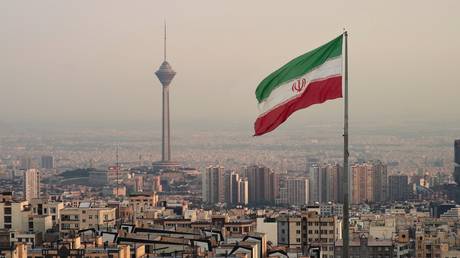
Mainstream foreign policy coverage treats every threat from Tehran like a countdown clock to global armageddon.
When headlines blare that Iran’s leadership has warned of a "geographically unrestricted" response to US and Israeli strikes, the lazy consensus in Western media immediately translates those words into a single, terrifying image. Analysts pull up maps of the Middle East, draw concentric circles around ballistic missile ranges, and warn of imminent, wide-scale conventional warfare across the Persian Gulf. In other updates, take a look at: Why Canada Is Chasing a Deeper Alliance With Europe Right Now.
That reading misses the entire strategic architecture of the Islamic Republic.
By taking "geographically unrestricted" at face value as a promise of massive, immediate kinetic escalation, conventional commentary falls straight into a psychological trap. According to reporting from outlets like Arab News, Tehran’s rhetoric is designed to project absolute resolve following direct military strikes. Yet, if you look at decades of Iranian military doctrine, historical precedent, and hard economic realities, "geographically unrestricted" does not mean "unlimited conventional war." It means the exact opposite. It is an admission of conventional asymmetry paired with a blueprint for low-cost, high-friction disruption far away from Iran's borders. Reuters has also covered this important subject in great detail.
To understand what actually happens next, we have to dismantle the standard playbook of geopolitical punditry and examine how asymmetric deterrence truly operates.
The Myth of the Imminent Regional Firestorm
Every time tensions spike between Washington, Tel Aviv, and Tehran, cable news panels predict an immediate, all-out regional war. They point to missile stockpiles, naval assets in the Strait of Hormuz, and proxy networks across the Levant. The assumption is linear: Strike A leads to Counter-Strike B, which inevitably spirals into Total War C.
In the real world of statecraft and military planning, escalation is rarely linear.
Iranian military planners—specifically within the Islamic Revolutionary Guard Corps (IRGC)—are acutely aware of the conventional military gap between their forces and a combined US-Israeli coalition. A direct, symmetric exchange of heavy firepower favors the side with stealth aviation, multi-layered missile defense networks, and superior intelligence, surveillance, and reconnaissance (ISR) capabilities.
When Iranian officials use phrases like "geographically unrestricted," they are intentionally shifting the deterrence calculation away from the battlefield where they are weakest. Rather than promising to trade blow-for-blow in a localized air war over Iranian territory, they are signaling that the cost of striking Iran will not be contained to the immediate theater of operations.
Decoding Asymmetric Deterrence
To grasp the nuance missed by surface-level reporting, you have to define the core doctrine governing Tehran's security apparatus: Forward Defense and Asymmetric Escalation.
- Forward Defense: Developed over decades following the Iran-Iraq War, this doctrine dictates that Iran must fight its adversaries outside its own borders to prevent domestic infrastructure from becoming the primary battleground.
- Horizontal Escalation: Instead of escalating vertically (using bigger weapons in the same place), an actor escalates horizontally (expanding the map of where pressure is applied).
When Supreme Leader Ali Khamenei or senior IRGC commanders warn of a geographically unrestricted response, they are describing horizontal escalation. They are telling policymakers in Washington and Jerusalem that if you hit a target inside Iran, the response will not necessarily come from Iranian soil, nor will it necessarily land inside Israel or on a US base in Iraq.
Imagine a scenario where a traditional military power suffers an airstrike on a key facility. Its standard response is vertical: launch twice as many missiles back at the attacker's airfields within 48 hours. Now imagine an asymmetric power facing the same strike. Launching a massive wave of ballistic missiles directly from home territory invites an overwhelming counter-strike that could cripple domestic energy grids and command centers. Instead, horizontal escalation allows that state to wait weeks or months, and apply pressure in an entirely different hemisphere, through non-attributable cyber operations, maritime harassment in distant shipping lanes, or intelligence operations targeting diplomatic and commercial interests abroad.
What "Geographically Unrestricted" Actually Looks Like
If you strip away the sensationalism, a geographically unrestricted strategy relies on four distinct mechanisms that rarely make the front page until the damage is already done.
1. The Maritime Chokepoints Beyond the Gulf
Most analysts obsess over the Strait of Hormuz. Closing Hormuz is the nuclear option of regional economics—it chokes off global oil supplies, including exports to Iran’s own economic lifelines in Asia, and guarantees an immediate, massive international naval intervention.
A geographically unrestricted posture looks elsewhere. It looks at the Bab el-Mandeb Strait, the Red Sea, the Eastern Mediterranean, and even the Indian Ocean. Through aligned groups like the Houthi movement in Yemen, maritime disruption can be dialed up or down thousands of miles from Tehran. Global shipping insurance rates spike, supply chains reroute around the Cape of Good Hope, and Western navies burn through multi-million-dollar interceptor missiles to shoot down drones that cost a fraction of that price. The economic bleed is global, persistent, and requires zero Iranian troops on the ground.
2. The Invisible Front of Cyber and Infrastructure
Kinetic strikes make dramatic television; cyber warfare makes headlines only when the lights go out. Iran has spent over a decade building a resilient, decentralized cyber apparatus precisely because it offers global reach without physical troop deployments.
In a horizontally escalated conflict, "geographically unrestricted" means water treatment facilities, municipal grids, financial clearinghouses, and logistics networks in North America or Europe become potential targets for low-level disruption. These operations are carefully calibrated to stay just below the threshold that would trigger a full-scale military retaliation, creating domestic political headaches for Western leaders while allowing Tehran to maintain plausible deniability.
3. Global Intelligence and Soft-Target Pressure
Historical records from the 1990s through the 2010s show that when the Islamic Republic feels cornered in the Middle East, its intelligence networks activate across Latin America, Europe, and Asia. Security agencies worldwide have repeatedly documented plots targeting diplomatic personnel, dissidents, and commercial hubs far removed from the Levant.
By signaling that no geography is off-limits, Tehran forces Western intelligence and security services into a defensive crouch globally. Every embassy, consular office, and diplomatic mission requires heightened security protocols. The sheer financial and operational bandwidth required to defend everywhere at once drains resources from offensive operations in the Middle East.
4. Weaponized Ambiguity and Time
Conventional media operates on a 24-hour news cycle. If a promised retaliation does not happen within 72 hours, pundits declare that deterrence has failed or that Tehran has backed down.
Strategic patience is one of the most misunderstood tools in Iranian statecraft. By removing geographic boundaries from its threats, Tehran also removes the timeline. When a response can happen anywhere, it can also happen anytime. This forces adversaries to maintain high-alert postures indefinitely—a state of operational exhaustion that degrades readiness and inflates defense budgets over months and years.
The Questions Nobody Is Asking
When major news breaks about Middle Eastern escalation, public search queries and media debates almost always fixate on the wrong variables. Let's break down the flawed premises behind the most common questions surrounding this crisis.
Flawed Question 1: "Will Iran launch an all-out war against the US and Israel?"
This assumes Tehran views war as a binary switch—either total peace or total war. In reality, Iran operates in the "gray zone," a continuous spectrum of low-intensity conflict. An all-out conventional war threatens the survival of the regime. Gray-zone horizontal escalation preserves the regime while bleeding its adversaries. The question isn't whether an all-out war will start tomorrow; it's how much global economic and security friction Western voters are willing to tolerate over the next two years.
Flawed Question 2: "Did US and Israeli strikes fail to deter Iran?"
Deterrence is not a magic spell that permanently erases an adversary's capabilities or political will. Military strikes can degrade specific hardware—air defenses, missile production facilities, radar installations—and re-establish tactical boundaries. However, tactical degradation does not equal strategic capitulation. Expecting an airstrike to stop a regional power from issuing defiant rhetoric misunderstands domestic politics in Tehran. The leadership must project strength to its internal hardline base to prevent fractures within its own security apparatus.
Flawed Question 3: "Is the Strait of Hormuz about to close?"
Shutting down the Strait of Hormuz hurts Iran almost as much as it hurts the West. Iran relies on maritime trade for essential imports and covert oil exports. Completely blocking the waterway would unify global powers—including China, Iran’s largest oil buyer—against Tehran. Selective harassment, targeted seizures, and elevated insurance premiums achieve 80% of the economic leverage at 10% of the existential risk.
The Blind Spots of Both Sides
Looking closely at this standoff requires acknowledging the severe flaws in both the conventional Western narrative and Tehran's own strategic calculus.
The conventional Western view underestimates how effectively a sanctioned, isolated economy can adapt to long-term attrition. Analysts often assume economic pressure will naturally force diplomatic concessions. Decades of sanctions have instead hollowed out the Iranian middle class while empowering the IRGC, turning the military apparatus into the dominant economic actor in the country. For the IRGC, perpetual controlled tension isn't a bug; it is the justification for its monopoly on domestic power and resources.
Conversely, the contrarian view—that Tehran is a master chess player executing flawless horizontal escalation—has its own massive blind spots.
Asymmetric warfare is inherently messy and prone to catastrophic miscalculation. When you outsource retaliation to decentralized proxy networks across multiple countries, you lose tight command-and-control over the exact scale of the response. A local commander in Iraq, Lebanon, or Yemen might execute a strike that kills far more personnel than Tehran intended, inadvertently crossing a red line that forces Washington or Jerusalem into the exact kind of overwhelming vertical escalation Iran wants to avoid.
Furthermore, horizontal escalation carries diminishing returns. Every time Iran activates global networks or disrupts international shipping, it alienates neutral nations in Europe and Asia that might otherwise push for diplomatic off-ramps or sanctions relief. Overplaying the "geographically unrestricted" card risks uniting a fractured international community into a cohesive containment coalition.
How to Actually Read Geopolitical Escalation
If you want to understand what is truly happening the next time a headline warns of unrestricted retaliation, ignore the adjectives and track the hard metrics.
- Watch Maritime Insurance, Not Press Releases: Statements from supreme leaders and defense ministers are crafted for domestic audiences and psychological warfare. Lloyd’s of London war-risk insurance premiums for vessels transiting the Red Sea and Persian Gulf reflect real-time, data-driven assessments of actual physical risk.
- Track Force Posture, Not Rhetoric: When the Pentagon moves carrier strike groups, aerial refueling tankers, or specialized missile defense batteries into a region, it is responding to concrete intelligence. Rhetoric is cheap; deploying a carrier strike group costs millions of dollars a day.
- Separate Tactical Strikes from Strategic Shifts: A targeted strike on a military facility is a tactical event. A sustained campaign against energy infrastructure or leadership nodes is a strategic shift. Do not confuse the two.
- Look Away from the Epicenter: When a major power promises a response without geographic limits, stop staring solely at the map of Iran. Monitor diplomatic security advisories in South America, cyber alerts issued by Western infrastructure agencies, and shipping delays in chokepoints thousands of miles away.
The media ecosystem thrives on the illusion of immediate, cinematic catastrophe. Reality is far slower, colder, and more calculated. Tehran’s warning of a geographically unrestricted response is not a declaration that the world is ending tomorrow—it is a reminder that in modern asymmetric conflict, the front line is wherever the defender isn't looking.