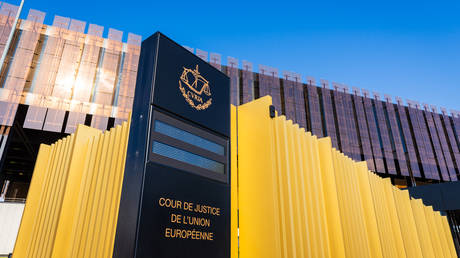
National authorities can no longer rely on broad political assumptions to freeze corporate assets. The Court of Justice of the European Union delivered a landmark judgment establishing that the autocratic character of a foreign political system does not, on its own, prove that a head of state exercises control over a specific private or partially state-linked enterprise.
This ruling strikes directly at the heart of expedient regulatory overreach. For years, European compliance offices and national governments operating under intense geopolitical pressure have stretched legal interpretations to immobilize funds. They assumed that because a country operates under a centralized, authoritarian governance model, every economically significant entity within its borders acts as an extension of the regime. Luxembourg just drew a hard line against that administrative shortcut.
The Anatomy of Regulatory Overreach
The legal battle stems from a 2022 decision by Lithuanian authorities to freeze the funds of Inter Rao Lietuva, a regional electricity supplier. The company was not explicitly named on the European Union sanctions blacklist. Instead, regulators targeted its assets through an indirect chain of ownership linked to Russian state structures, arguing that because Vladimir Putin wields sweeping executive power under Russia’s political framework, he ultimately commanded the operations of the firm.
Vilnius treated the political architecture of the Russian state as self-evident proof of corporate command. The European court dismantled that logic.
Judges ruled that freezing assets under the presumption of indirect control requires concrete, verifiable architecture. Regulators must produce objective and sufficiently solid evidence rather than leaning on geopolitical shorthand. Ownership and control remain distinct legal concepts under European law. While a sanctioned individual can exercise decisive influence without holding a majority stake, demonstrating that influence requires examining actual corporate mechanisms.
What Constitutes Real Evidence
The judgment forces regulatory bodies back into the difficult, granular work of corporate investigation. General assumptions about presidential authority are insufficient. To justify an asset freeze on an unsanctioned corporate entity, authorities must point to specific, precise, and consistent indications of interference.
This evidentiary standard changes the compliance landscape for cross-border commerce. Valid proof of control can include explicit governance rights, documented operational instructions, irregular financing channels, management appointments dictated from outside standard corporate hierarchy, or patterns of commercial conduct that reveal a lack of operational independence.
Consider a hypothetical manufacturing firm operating in a centralized state. If regulators want to freeze its European accounts because of ties to a blacklisted official, pointing to the nation's authoritarian constitution will no longer suffice. They must trace financial flows, uncover backchannel communications, or expose binding shareholder agreements that prove the target entity cannot make independent commercial choices.
The court preserved the mechanics of rapid enforcement. Governments retain the power to execute asset freezes without prior notice when advance warning would compromise the effectiveness of the measure. However, the procedural safety net has been tightened. Affected entities must receive the specific grounds for the freeze promptly, and domestic courts must provide meaningful judicial review. A rubber-stamp review of national security claims violates the framework of European law.
The Fallout for Compliance Officers
Corporate compliance departments across the continent face an immediate operational crisis. For the past several years, risk-averse banks and multinational corporations have erred heavily on the side of caution. Faced with vague ownership structures, compliance teams routinely severed ties or froze counterparty funds to avoid regulatory penalties.
That defensive over-compliance now carries legal exposure. If a bank freezes funds based purely on a country-risk profile or broad political associations without building a documented, evidence-based file of actual control, those actions become legally vulnerable.
The ruling forces a transition from lazy macro-level profiling to exhausting micro-level forensics. Investigators must look past corporate registries and unpack the messy reality of operational dependencies. This shift demands more resources, deeper investigative capabilities, and a willingness to defend enforcement actions with hard data rather than political rhetoric.
The Luxembourg decision does not grant blanket immunity to companies originating from authoritarian states, nor does it dismantle the broader sanctions architecture. Legitimate enforcement mechanisms remain fully intact for entities that can be proven to act as instruments of sanctioned regimes.
The court simply demanded adherence to the rule of law. When governments discard evidentiary standards in the name of political expediency, they undermine the very legal foundations they claim to defend. Sanctions policy must now return to the hard facts of corporate control, leaving political assumptions out of the ledger.


